
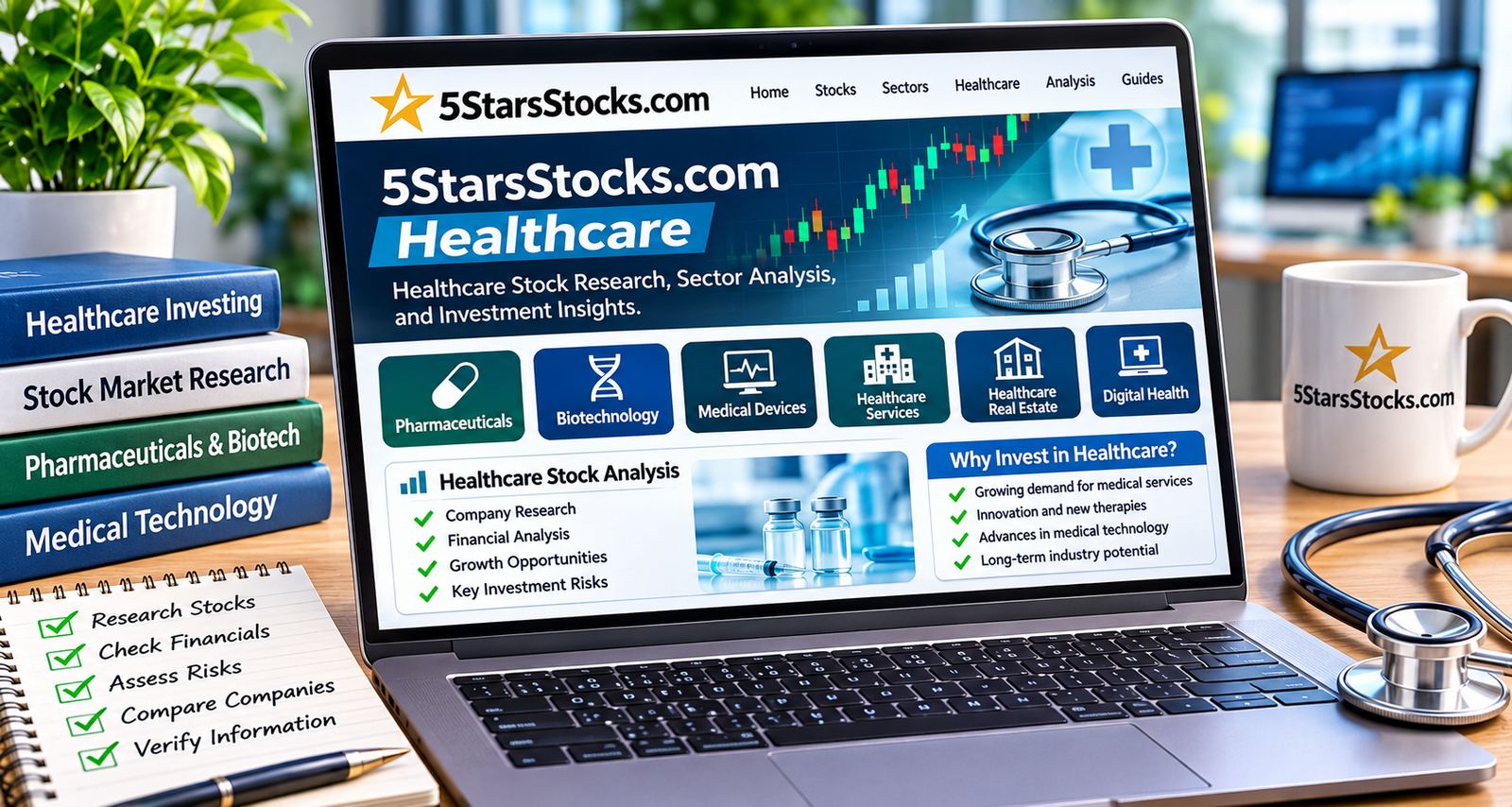
5StarsStocks.com Healthcare is associated with healthcare-sector investment articles and stock research published on 5StarsStocks.com. The website provides information about healthcare companies, industry trends, financial fundamentals, and potential investment risks.
Although the platform presents itself as a research-driven investment resource, investors should distinguish its educational content from verified stock recommendations or independently audited ratings.
This guide explains how 5StarsStocks.com Healthcare works, which healthcare industries it discusses, what investors should analyze, and how to verify information before making investment decisions.
What Is 5StarsStocks.com Healthcare?
5StarsStocks.com Healthcare refers to the healthcare-focused investment content available on 5StarsStocks.com, a website that publishes stock market research, company analysis, and educational investing articles.
The publication covers multiple industries and investment strategies. Healthcare is one of its sector categories, alongside areas such as technology, industrials, and consumer-related businesses.
Its healthcare articles introduce readers to different types of publicly traded companies, including pharmaceutical manufacturers, biotechnology businesses, medical equipment producers, and healthcare service providers.
Rather than focusing exclusively on short-term stock movements, the website describes an investment approach based on examining company fundamentals, industry conditions, and growth potential.
For example, someone researching pharmaceutical stocks might use its articles to understand patent-related risks, while another investor interested in biotechnology could explore how clinical trials affect company valuations.
However, these articles should serve as starting points for further research rather than definitive recommendations to purchase particular shares.
Is 5StarsStocks.com a Stock Trading Platform?
5StarsStocks.com primarily presents itself as an investment research and educational website.
Its publicly accessible pages do not establish it as a regulated brokerage where customers can open trading accounts, deposit investment funds, or directly execute stock transactions.
This is an important distinction.
A brokerage provides the infrastructure required to buy and sell securities, while an investment research publication provides information that readers may consider when making decisions.
If someone wants to purchase a healthcare stock, they generally need access to an appropriate brokerage account.
Reading an investment article does not itself involve buying shares.
What Does Its Healthcare Section Offer?
The website’s healthcare content discusses industry fundamentals, business models, growth opportunities, and investment considerations.
Its published healthcare investing guide covers categories of healthcare stocks and explains factors investors should examine before making decisions.
These include financial performance, competitive position, market opportunities, and potential regulatory challenges.
The content may be particularly useful for beginners trying to understand how different healthcare businesses generate revenue.
How Does 5StarsStocks.com Healthcare Work?
The healthcare research experience is similar to reading other investment publications.
Visitors can access the website, explore healthcare-related articles, and use the information to identify companies or industries they want to investigate further.
The platform describes its broader approach as research-driven, emphasizing financial statements, company quality, and long-term business prospects.
Healthcare Industry Categories
Healthcare is not a single business model.
The industry includes companies developing medicines, manufacturing medical equipment, operating hospitals, providing insurance, and delivering healthcare technology.
Understanding these differences matters because companies face different financial pressures and growth opportunities.
For instance, an established pharmaceutical company may generate significant revenue from existing products, while a smaller biotechnology business might depend on the success of an experimental treatment.
Comparing the two requires different financial and operational considerations.
Company Research and Financial Analysis
Fundamental analysis involves examining a company’s financial condition and business prospects.
Important considerations include revenue growth, profitability, cash flow, debt, competitive advantages, and valuation.
Investors should also understand how a company makes money and whether its business model can remain competitive.
A healthcare company experiencing rapid sales growth may appear attractive, but high debt or excessive valuation could increase investment risk.
Understanding Five-Star Ratings and AI Claims
The name 5StarsStocks naturally suggests a rating-based approach to evaluating investment opportunities.
Some independent reviews also describe AI-assisted stock screening, automated ratings, and performance predictions.
However, a fully documented public methodology explaining how individual healthcare stocks receive particular star ratings has not been independently established.
Similarly, claims about specific prediction accuracy or consistent investment performance should not be accepted without reliable evidence.
A rating can help draw attention to a company, but it cannot replace financial analysis.
Investors should understand the data, assumptions, risks, and valuation behind any recommendation before acting on it.
What Types of Healthcare Stocks Does 5StarsStocks.com Cover?
Healthcare includes several distinct industries, each with its own opportunities and risks.
The website’s healthcare investing content discusses pharmaceutical businesses, biotechnology companies, medical devices, and healthcare services.
Other related investment categories include healthcare real estate and emerging medical technologies.
Pharmaceutical Companies
Pharmaceutical companies develop, manufacture, and sell medicines used to treat different medical conditions.
Established companies such as Pfizer, Merck, and AbbVie illustrate this category.
Their financial performance may depend on prescription drug sales, successful product launches, patent protection, research spending, and regulatory approvals.
One important consideration is patent expiration.
When exclusive patent protection ends, competing products may enter the market and place pressure on revenue and profit margins.
Investors should examine how diversified a pharmaceutical company’s product portfolio is and whether it has promising treatments under development.
Biotechnology Companies
Biotechnology businesses use biological research and scientific innovation to develop new therapies, treatments, and medical technologies.
Amgen is an example of an established biotechnology company.
However, the sector also includes smaller companies that may not yet generate meaningful revenue from approved products.
These businesses can experience substantial stock-price movements following clinical trial announcements or regulatory decisions.
A successful treatment may create significant commercial potential, while a failed trial can damage a company’s valuation.
For biotechnology investors, understanding clinical development stages and available funding is especially important.
Medical Device Companies
Medical device businesses manufacture products used in diagnosis, treatment, surgery, and patient monitoring.
Examples include Medtronic, Abbott, and Intuitive Surgical.
These companies may benefit from innovation, improvements in healthcare infrastructure, and demand for advanced medical procedures.
However, they also face regulatory requirements, product development costs, manufacturing challenges, and competition.
Investors should evaluate product demand, research spending, operating margins, and the company’s ability to maintain technological advantages.
Healthcare Services Companies
Healthcare services businesses provide medical care or support the delivery and financing of healthcare.
Examples include UnitedHealth Group, CVS Health, and HCA Healthcare, although their business models differ considerably.
Hospitals depend on patient volumes, treatment costs, staffing expenses, and reimbursement arrangements.
Health insurers face risks related to medical spending, premium pricing, regulation, and changing reimbursement policies.
These companies should be evaluated using financial measures appropriate to their specific operations.
Healthcare Real Estate
Healthcare real estate includes properties such as senior living communities, medical offices, and specialized healthcare facilities.
Real estate investment trusts such as Welltower and Ventas provide examples of this category.
Their financial performance depends on property occupancy, rental income, operating costs, financing conditions, and tenant stability.
Interest rates are particularly important because real estate companies frequently use debt to finance property investments.
Emerging Healthcare Technologies
Digital health, telemedicine, medical artificial intelligence, and advanced diagnostics are developing areas within the broader healthcare industry.
These technologies may improve healthcare delivery and create opportunities for businesses offering innovative solutions.
However, a promising technology does not automatically translate into a profitable investment.
Companies must demonstrate demand, sustainable revenue, appropriate regulatory compliance, and a viable business model.
Key Features of 5StarsStocks.com Healthcare
The most clearly supported features of 5StarsStocks.com’s healthcare coverage are its informational articles and investment education.
Its content can help readers explore healthcare subsectors, understand financial analysis, and identify risks associated with different companies.
Healthcare Stock Research Articles
The website publishes explanatory content about healthcare investing.
These articles can introduce beginners to the factors affecting pharmaceutical companies, biotechnology businesses, and healthcare service providers.
Industry and Market Insights
Healthcare performance is influenced by demographic trends, medical innovation, public policy, reimbursement conditions, and business competition.
Understanding these broader forces can help investors evaluate how individual companies might perform.
Fundamental Analysis Guidance
The publication discusses the importance of financial statements, company fundamentals, and investment quality.
These are useful starting points for evaluating a potential investment.
Investment Risk Discussions
Healthcare stocks can experience losses caused by clinical failures, regulatory changes, rising costs, and financial problems.
Recognizing these risks is essential for making informed decisions.
What Features Remain Unverified?
Some outside descriptions mention automated alerts, real-time dashboards, portfolio trackers, and proprietary AI-powered healthcare ratings.
These capabilities have not been independently demonstrated through the reviewed public website materials.
Readers should therefore verify whether a specific feature actually exists before relying on it.
How to Research Healthcare Stocks Using 5StarsStocks.com
A structured research process can help investors assess healthcare companies without relying entirely on promotional claims or stock ratings.
Step 1: Identify a Healthcare Subsector
Begin by deciding which healthcare industry interests you.
Pharmaceuticals, biotechnology, medical equipment, health insurance, and healthcare services have different business models.
Understanding the sector helps you identify the most relevant financial indicators and risks.
Step 2: Review Financial Performance
Examine the company’s latest financial statements.
Important measures include:
- Revenue and revenue growth.
- Operating profit margins.
- Free cash flow.
- Earnings per share.
- Total debt and interest obligations.
- Cash reserves.
- Valuation ratios.
A financially strong company may be better positioned to manage uncertainty, although strong fundamentals do not eliminate investment risk.
Use the SEC’s EDGAR filing database to review official annual and quarterly reports for US public companies.
Step 3: Examine Product Pipelines and Regulatory Risks
For pharmaceutical and biotechnology companies, product development is particularly important.
Investors should determine which treatments are approved, which remain experimental, and what regulatory milestones are approaching.
A clinical trial’s progress can influence investor expectations, but a registered trial does not establish that a treatment is effective or will receive approval.
The ClinicalTrials.gov database provides information about registered clinical studies and reported results where available.
Step 4: Compare Companies Within the Same Industry
Comparing similar businesses can provide a clearer understanding of valuations and competitive performance.
For example, two established pharmaceutical companies may be compared using product revenue, operating margins, research spending, and patent exposure.
A pre-revenue biotechnology company, however, may require greater attention to cash reserves, clinical milestones, and future funding needs.
Avoid treating all healthcare companies as directly comparable.
Step 5: Verify Information Independently
Never rely entirely on one article, stock rating, or investment commentary.
Check company investor-relations websites, regulatory filings, earnings announcements, and other credible sources.
Also confirm that the information is current, particularly when a company has recently released financial results or announced a major clinical development.
Why Do Investors Research Healthcare Stocks?
Healthcare attracts investor attention because of its essential services, innovation, and wide range of business models.
However, these characteristics do not guarantee positive stock returns.
Demand for Medical Services
Medical care remains important across different economic conditions.
Hospitals, medical suppliers, and pharmaceutical manufacturers serve needs that do not disappear during economic downturns.
Nevertheless, healthcare companies can still experience financial pressure from operating costs, reimbursement changes, competition, and regulatory decisions.
Pharmaceutical and Biotechnology Innovation
Scientific advances can create demand for new treatments.
Companies successfully developing commercially valuable medicines may benefit from new revenue opportunities.
However, drug development involves substantial research costs and uncertainty.
Medical Technology and Digital Health
Advanced diagnostics, robotic surgery, remote monitoring, and digital healthcare systems are changing how medical services are delivered.
Businesses that develop effective technologies may find opportunities for growth.
Still, competition, adoption rates, pricing pressure, and profitability remain important considerations.
Important Risks of Healthcare Stock Investing
Healthcare investments involve risks that can affect both established companies and emerging businesses.
| Risk | Potential impact |
|---|---|
| Clinical trial failure | Significant declines in biotechnology valuations |
| Regulatory rejection | Delayed or canceled product launches |
| Patent expiration | Revenue pressure from competing products |
| Reimbursement changes | Reduced profitability for insurers and providers |
| Rising operating costs | Lower profit margins |
| High debt | Greater financial and refinancing pressure |
| Overvaluation | Stock losses despite business growth |
| Portfolio concentration | Increased exposure to individual company failures |
Clinical and Regulatory Uncertainty
Healthcare businesses often depend on government approvals.
Unexpected regulatory decisions can significantly influence future sales and investor confidence.
Financial and Valuation Risks
Even a successful company can become a poor investment if its stock price already assumes unrealistic future growth.
Investors should consider both business quality and valuation.
Diversification and Risk Management
Concentrating an entire portfolio in one healthcare company or subsector can increase vulnerability to unexpected events.
Diversification may reduce exposure to individual companies, although it cannot eliminate market risk.
Investors should also consider their financial goals, investment time horizon, and ability to tolerate losses.
Is 5StarsStocks.com Healthcare Reliable?
5StarsStocks.com provides publicly accessible investment content and describes an approach based on researching companies and market conditions.
Its healthcare articles can help readers become familiar with different investment categories and financial concepts.
However, publication of investment research does not independently establish the accuracy of every analysis.
What the Official Website Confirms
The website publishes stock-related educational articles, includes healthcare among its sectors, and discusses company fundamentals and investment risks.
It also provides a disclaimer acknowledging that stock prices fluctuate and that investors can lose money.
The website encourages readers to consider their circumstances and seek qualified financial advice when appropriate.
What Remains Unverified
Publicly reviewed materials do not establish a fully transparent, independently audited record of healthcare stock ratings.
They also do not provide sufficient evidence to verify specific claims about AI-driven accuracy, proprietary scoring formulas, or guaranteed investment performance.
Investors should be cautious whenever a platform presents strong performance claims without clear supporting records.
Why Independent Research Matters
A single research publication may offer useful ideas, but it cannot replace comprehensive financial analysis.
Before making an investment, review original company disclosures and consider independent perspectives.
The SEC’s educational resource on using EDGAR to research investments explains how investors can examine official corporate filings.
5StarsStocks.com Healthcare vs. Other Research Resources
Different research tools serve different purposes.
| Resource | Primary purpose |
|---|---|
| 5StarsStocks.com | Investment articles, company discussions, and sector education |
| SEC EDGAR | Official financial statements and company disclosures |
| ClinicalTrials.gov | Information about registered clinical research |
| Company investor-relations websites | Earnings releases, presentations, and corporate announcements |
| Financial-data platforms | Stock prices, historical performance, and company comparisons |
These resources can complement each other.
For example, an investor might discover a biotechnology company through an article, examine its financial condition using SEC filings, and investigate its treatment pipeline through clinical-trial records.
This process provides a stronger foundation than relying on an isolated rating.
Who Can Benefit From 5StarsStocks.com Healthcare?
The website may be useful for different groups of readers.
Beginner investors can learn about healthcare subsectors and common investment terminology.
Healthcare-sector researchers may use its articles to identify companies and subjects requiring further examination.
Long-term investors may benefit from understanding competitive advantages, business fundamentals, and industry developments.
Readers comparing investment ideas can use the content as an introductory resource before consulting official financial information.
However, none of these uses makes the website a substitute for personalized investment advice.
Frequently Asked Questions About
Q1: What is 5StarsStocks.com Healthcare?
Ans: 5StarsStocks.com Healthcare refers to healthcare-focused stock research and educational articles published on 5StarsStocks.com. Its coverage includes pharmaceuticals, biotechnology, medical devices, and healthcare services.
Q2: Is 5StarsStocks.com a brokerage?
Ans: No brokerage service has been established through its publicly reviewed website content. It primarily presents itself as a stock research and educational publication.
Q3: What healthcare stocks does the website cover?
Ans: Its healthcare articles discuss companies and industries such as pharmaceuticals, biotechnology, medical devices, and healthcare services. Examples include Pfizer, Merck, Amgen, Medtronic, and UnitedHealth Group.
Q4: Does 5StarsStocks.com use AI for stock ratings?
Ans: Some third-party descriptions refer to AI-assisted stock analysis, but a detailed, independently verified AI rating methodology has not been established from the reviewed official material.
Q5: Are its five-star healthcare ratings reliable?
Ans: There is insufficient independently audited evidence to confirm the predictive accuracy of its star ratings. Investors should examine company fundamentals and verify recommendations through other sources.
Q6: Can beginners use 5StarsStocks.com Healthcare?
Ans: Yes. Its educational content can help beginners understand healthcare stock categories and investment concepts. However, new investors should also learn basic risk management and financial analysis.
Q7: Is healthcare stock investing risky?
Ans: Yes. Healthcare stocks face risks involving clinical trials, regulatory decisions, patent expirations, operating costs, competition, and valuation changes.
Q8: Does the website provide real-time stock prices?
Ans: Real-time pricing capabilities have not been independently verified through the reviewed public pages. Investors should use an established market-data provider for current prices.
Q9: How can investors verify healthcare stock information?
Ans: Use SEC filings, official company announcements, investor-relations pages, ClinicalTrials.gov, and reliable financial-data sources.
Q10: Does a five-star stock rating guarantee returns?
Ans: No. No stock rating can guarantee positive returns. Stock prices can decline, and investors may lose some or all of their invested capital.
Final Thoughts
5StarsStocks.com Healthcare provides an introduction to healthcare-sector investing through articles discussing pharmaceutical businesses, biotechnology companies, medical technology, and healthcare services.
Its content can help readers understand industry differences, financial fundamentals, and potential risks.
However, investors should approach its stock ideas and rating claims carefully, particularly when detailed scoring methods and independently audited performance records are unavailable.
Healthcare investing requires more than identifying promising industries. A sound research process involves reviewing financial statements, understanding competitive conditions, examining clinical and regulatory developments, and considering valuation.
For readers interested in the sector, 5StarsStocks.com Healthcare can serve as an initial research resource. Important investment decisions should ultimately rely on independently verified information, appropriate risk management, and individual financial objectives.
Disclaimer: This article is for educational and informational purposes only. It does not provide personalized investment advice or recommend purchasing or selling any particular security. Investing involves risk, including the potential loss of principal.