
The search for Peter Orszag bald raises a question that has followed the American economist and financial executive through different stages of his public career: Is Peter Orszag bald, does he wear a hairpiece, or has his appearance simply changed over time?
The question is not entirely new. In January 2010, media coverage discussed Orszag’s hairstyle while he was serving as Director of the White House Office of Management and Budget. One widely discussed article featured comments from a hairpiece specialist who had examined photographs of Orszag. However, an opinion based on photographs is not the same as verified evidence that someone wears a wig or toupee.
Today, Orszag is better known for his leadership at Lazard and his earlier work in U.S. economic policy. His official corporate profile identifies him as Lazard’s CEO and Chairman. Meanwhile, public photographs provide a way to observe his appearance without making unsupported claims about his personal grooming or medical history.
This article examines the origins of the Peter Orszag bald discussion, what historical reporting actually established, how his public appearance has changed, and what readers can responsibly conclude from the available evidence.
Is Peter Orszag Bald?
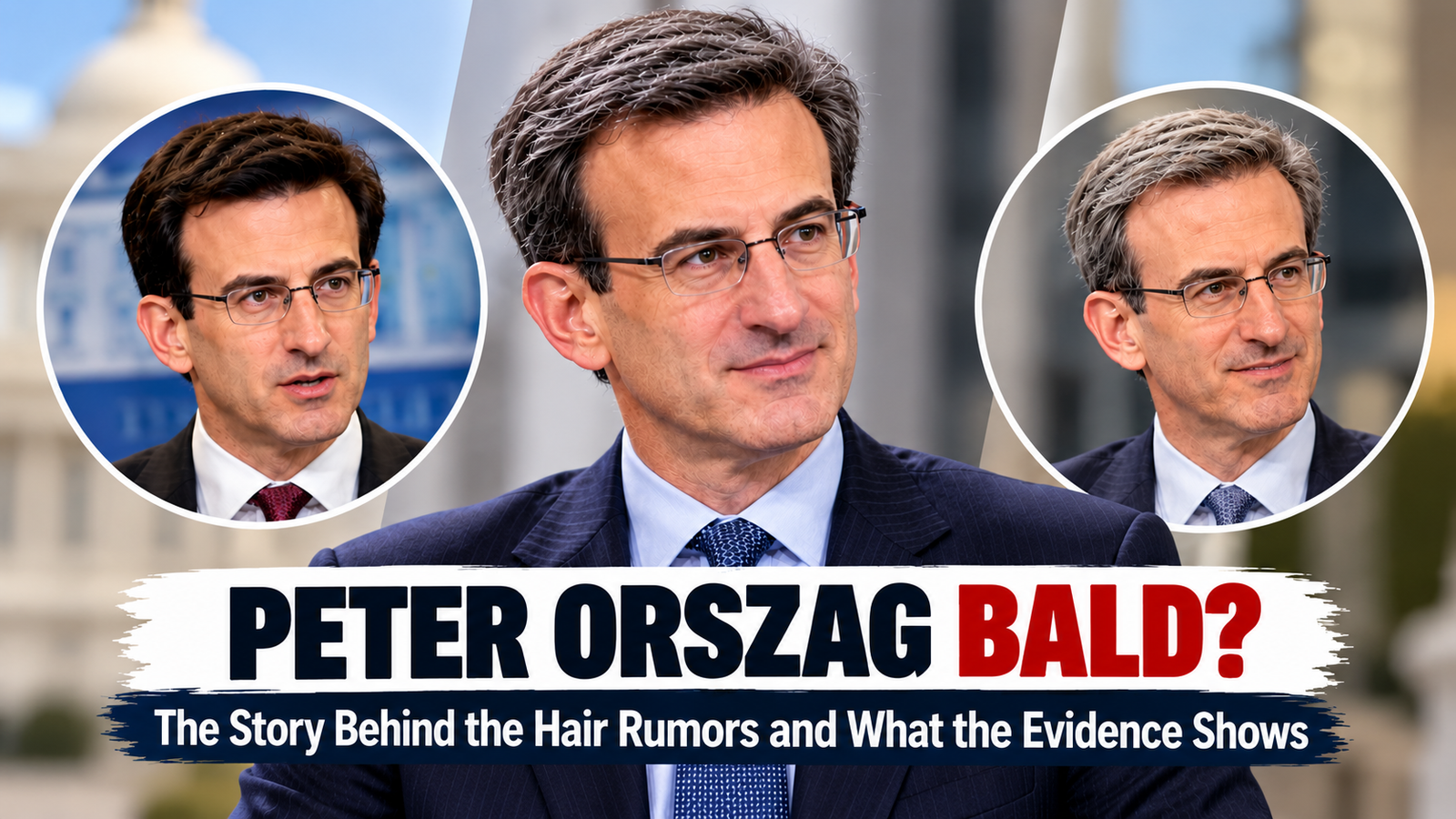
The available public photographs do not support describing Peter Orszag as completely bald. His official Lazard profile shows him with short, predominantly gray hair. Older photographs from his government career show a darker hairstyle.
That visible difference is real, but it does not establish why his appearance changed. Hair color, haircut, lighting, styling, camera angle, and image quality can all affect how a person’s hair looks in photographs.
It is also important to distinguish between several terms that are often used interchangeably online:
- Baldness: A substantial absence of hair across part or all of the scalp.
- Thinning hair: Reduced hair density in a particular area.
- A receding hairline: Hair that has moved farther back around the forehead or temples.
- A short hairstyle: Hair deliberately cut close to the scalp.
- Gray hair: Hair that has lost some or most of its natural pigment.
These descriptions refer to different things. A person can have short gray hair without being bald, and a photograph cannot reliably establish the medical cause of a change in hair density.
The most accurate conclusion is therefore limited: public images show Orszag with visible hair, while the precise condition of his hair and any private treatment history cannot be established from photographs alone.
Where Did the Peter Orszag Hair Rumor Begin?
One important historical reference is a January 26, 2010, article published by The New York Observer titled “The Toupee Titan of New York.”
The article profiled Joseph Paris, a specialist in hairpieces. During the interview, the journalist showed Paris photographs of Orszag, who was then 41 and serving as the director of the Office of Management and Budget. Paris made critical comments about Orszag’s apparent hairstyle and suggested that it resembled a hairpiece.
The distinction between the source’s actual evidence and its conclusion matters. Paris was commenting on photographs. The article did not document a personal examination of Orszag’s scalp, and the comments should not be treated as a confirmed medical or cosmetic finding.
This historical article helps explain why the subject became associated with Orszag’s name in online searches. It documents that speculation existed at the time. It does not independently prove that he wore a toupee.
That difference is especially important when older stories are repeated by newer websites. A claim can appear on multiple pages because publishers refer to the same original article. Repetition does not turn the original allegation into independent confirmation.
What Did the 2010 Reporting Actually Establish?
The 2010 coverage established that Orszag’s hairstyle attracted media attention during his time in the Obama administration. It also documented a hairpiece specialist’s opinion after viewing photographs.
It did not establish all the things that later readers might assume from the headline or discussion.
For example, the report did not provide a verified medical diagnosis, documentary proof of a hair transplant, or a confirmed statement from Orszag that he used a wig or toupee. The specialist’s comments were opinions about his appearance rather than the result of a documented examination.
This distinction illustrates a broader issue in reporting about public figures. A headline may pose a question, while the article itself contains speculation, humor, or an expert’s interpretation of limited information. Readers need to examine the underlying evidence rather than treating the headline as the conclusion.
A careful account of the Peter Orszag bald topic should therefore identify the historical reporting while making clear what it did—and did not—prove.
Peter Orszag’s Hair: Older Photos Versus Recent Images
Orszag has been photographed in different professional settings over many years. During his government career, he appeared in news photographs, public events, interviews, and official portraits. His current work in finance continues to generate professional images.
Comparing photographs from these periods can help readers observe visible changes. However, comparisons should be made cautiously.
Hair color and age
Older photographs show Orszag with darker hair, while his current Lazard portrait shows predominantly gray hair. Hair commonly changes color as people age, and this visible difference does not by itself establish baldness or a cosmetic procedure.
Hair length and styling
A closely cropped hairstyle can look different from hair that is longer or combed in a particular direction. Styling also changes how much of the scalp is visible in a photograph.
Lighting and camera angles
Bright overhead lighting, high-contrast images, and photographs taken from above can make the scalp more noticeable. A portrait taken straight on may create a different impression.
Image quality and editing
Older photographs may have lower resolution, while modern corporate portraits may use different cameras, lighting, and image processing. These differences can affect how hair texture and density appear.
For these reasons, a before-and-after comparison can describe what is visible in two images, but it cannot reliably identify the cause of a person’s changing appearance.
For a current professional reference, readers can consult Peter Orszag’s official biography.
Does Peter Orszag Wear a Wig or Toupee?
There is no reliable public confirmation in the official biography and sources reviewed for this article that Orszag wears a wig or toupee.
The historical discussion is relevant because it explains the origin of the rumor. However, the fact that a specialist expressed an opinion about photographs does not establish that the opinion was correct.
A reliable confirmation would require stronger evidence, such as a clear public statement from Orszag or dependable reporting based on verified information. Without that evidence, claims about a hairpiece should remain unconfirmed.
This approach does not mean that the historical article should be ignored. Instead, it means that the source must be described accurately: it documents the existence of speculation, not definitive proof of the allegation.
Has Peter Orszag Had a Hair Transplant?
The sources reviewed for this article do not provide reliable confirmation that Orszag has undergone a hair transplant or another hair-restoration procedure.
Photographs cannot establish whether a person has received a transplant, used medication, worn a hair system, or made any other private grooming choice. Those claims require evidence beyond visual impressions.
It would therefore be inaccurate to present a hair transplant as an established fact. The same standard applies to claims about particular hair-loss conditions or treatments.
For readers researching this subject, the most useful distinction is between observable appearance and private medical history. The first can sometimes be described from photographs; the second should not be inferred without reliable evidence.
Who Is Peter Orszag?
Although searches often focus on his appearance, Peter Richard Orszag has a substantial professional background in economics, government, and finance.
According to Lazard’s official biography, Orszag is the firm’s CEO and Chairman. He joined Lazard in 2016 after working in government and senior financial roles. His career has included responsibilities involving public policy, economic analysis, and financial advisory services.
He is also known for his academic background. He graduated summa cum laude from Princeton University and earned a Ph.D. in economics from the London School of Economics as a Marshall Scholar.
His career provides important context for understanding why he has such an extensive public photographic record. He has worked in prominent government positions and continued to appear publicly as a senior financial executive.
His work at the Congressional Budget Office
Orszag served as Director of the Congressional Budget Office from January 2007 to December 2008. The CBO provides nonpartisan budget and economic analysis to the U.S. Congress.
This role placed him in the middle of important national discussions about federal spending, fiscal policy, and economic conditions. His work brought him into contact with lawmakers, journalists, and other policy officials.
His role in the Obama administration
In January 2009, Orszag became Director of the Office of Management and Budget under President Barack Obama. He held the position until July 2010.
The OMB plays a central role in preparing the president’s budget proposal, coordinating budget policy, and overseeing aspects of federal agency management. Orszag’s position made him a prominent figure in Washington during a period of major economic and fiscal policy debates.
His move into financial services
Orszag joined Lazard in 2016. He later served as CEO of the firm’s Financial Advisory business before becoming CEO of Lazard in October 2023. Lazard’s official materials identify him as CEO and Chairman.
For readers interested in his professional background, the Lazard leadership biography is a more dependable source than websites that repeat unverified claims about his appearance.
Why Does the Peter Orszag Bald Search Continue?
There is no verified explanation establishing exactly why people search for this phrase. However, several factors may help explain why an appearance-related query can persist over time.
A long public career
Orszag has been in the public eye for years. His government service and financial leadership have generated photographs from different stages of his career. That makes it easy for readers to compare older and newer images.
A memorable historical story
The 2010 Observer article gave the subject a recognizable historical reference point. When a story receives attention and is repeated online, later readers may encounter it without seeing the original context.
Search engines and repeated questions
People often search for a question after seeing it on another website or social platform. Search suggestions and related queries can also make an unusual phrase easier to discover.
However, search interest does not establish whether the underlying claim is true. A popular query can reflect curiosity about a rumor rather than confirmation of the rumor itself.
The appeal of before-and-after comparisons
People frequently compare public figures’ appearances across decades. Hair color, facial hair, clothing, and hairstyle are easy to notice, even when the photographs were taken under very different conditions.
In Orszag’s case, such comparisons can help explain the curiosity surrounding his hair, but they do not establish whether he has experienced a particular type of hair loss.
How to Evaluate Claims About a Public Figure’s Appearance
The Peter Orszag bald discussion offers a useful example of how readers can assess online claims.
First, identify the original source. If several websites repeat the same allegation, check whether they rely on one historical report or provide independent evidence.
Second, separate observation from interpretation. Saying that two photographs show different hairstyles is an observation. Claiming that the difference proves a wig or hair transplant is an interpretation that requires additional evidence.
Third, check the date. A story published in 2010 may explain the history of a rumor, but it does not automatically establish a person’s current appearance or circumstances.
Fourth, look for direct confirmation. Official biographies are useful for professional facts, while reliable firsthand reporting may help establish whether a personal claim has been confirmed.
Finally, avoid treating repetition as verification. Multiple pages can repeat the same unsupported statement without adding any new evidence.
These principles are useful well beyond this particular search term. They help readers distinguish documented facts from speculation when researching business leaders, politicians, celebrities, and other public figures.
Frequently Asked Questions
Q1: Is Peter Orszag bald in 2026?
Ans: His official professional portrait shows short, predominantly gray hair. The available public images do not support describing him as completely bald, although photographs cannot establish every detail of his hair condition.
Q2: Why did people question Peter Orszag’s hair?
Ans: His hairstyle attracted media attention during his government career. A January 2010 article in The New York Observer featured comments from a hairpiece specialist who had viewed photographs of Orszag. Those comments explain part of the historical discussion but do not constitute verified proof that he wore a toupee.
Q3: Does Peter Orszag wear a wig or toupee?
Ans: The sources reviewed do not provide reliable confirmation that he wears a wig or toupee. The historical speculation should not be presented as an established fact.
Q4: Has Peter Orszag had a hair transplant?
Ans: No reliable confirmation was identified in the sources reviewed for this article. A person’s appearance in photographs is not enough to establish whether a hair-restoration procedure has taken place.
Q5: Has Peter Orszag’s hair changed over time?
Ans: Older public photographs show darker hair, while his current official portrait shows predominantly gray hair. This is a visible difference between photographs taken years apart, but it does not establish the cause of any change in hair density.
Q6: What is Peter Orszag known for?
Ans: Orszag is an economist and financial executive. He previously directed the Congressional Budget Office and served as Director of the Office of Management and Budget under President Barack Obama. He is currently CEO and Chairman of Lazard.
Q7: Where can readers verify Peter Orszag’s professional background?
Ans: Lazard’s official Peter Orszag biography provides his professional profile. The U.S. Securities and Exchange Commission’s Lazard filing also documents his executive role and career highlights.
Conclusion
The search for Peter Orszag bald is connected to a long-running discussion about his appearance, including media commentary dating back to January 2010. The historical record shows that a hairpiece specialist commented on photographs of Orszag, but those comments did not establish that he wore a wig or toupee.
Recent professional images show Orszag with short, predominantly gray hair. They do not establish a medical condition or prove that he has undergone a cosmetic procedure.
His professional record is much clearer. He has served in senior U.S. government roles, worked in financial services, and become CEO and Chairman of Lazard.
The responsible conclusion is to describe what public photographs show, explain the origins of the historical speculation, and avoid presenting unverified claims as fact. That approach gives readers a more useful answer while keeping the article accurate and trustworthy.