
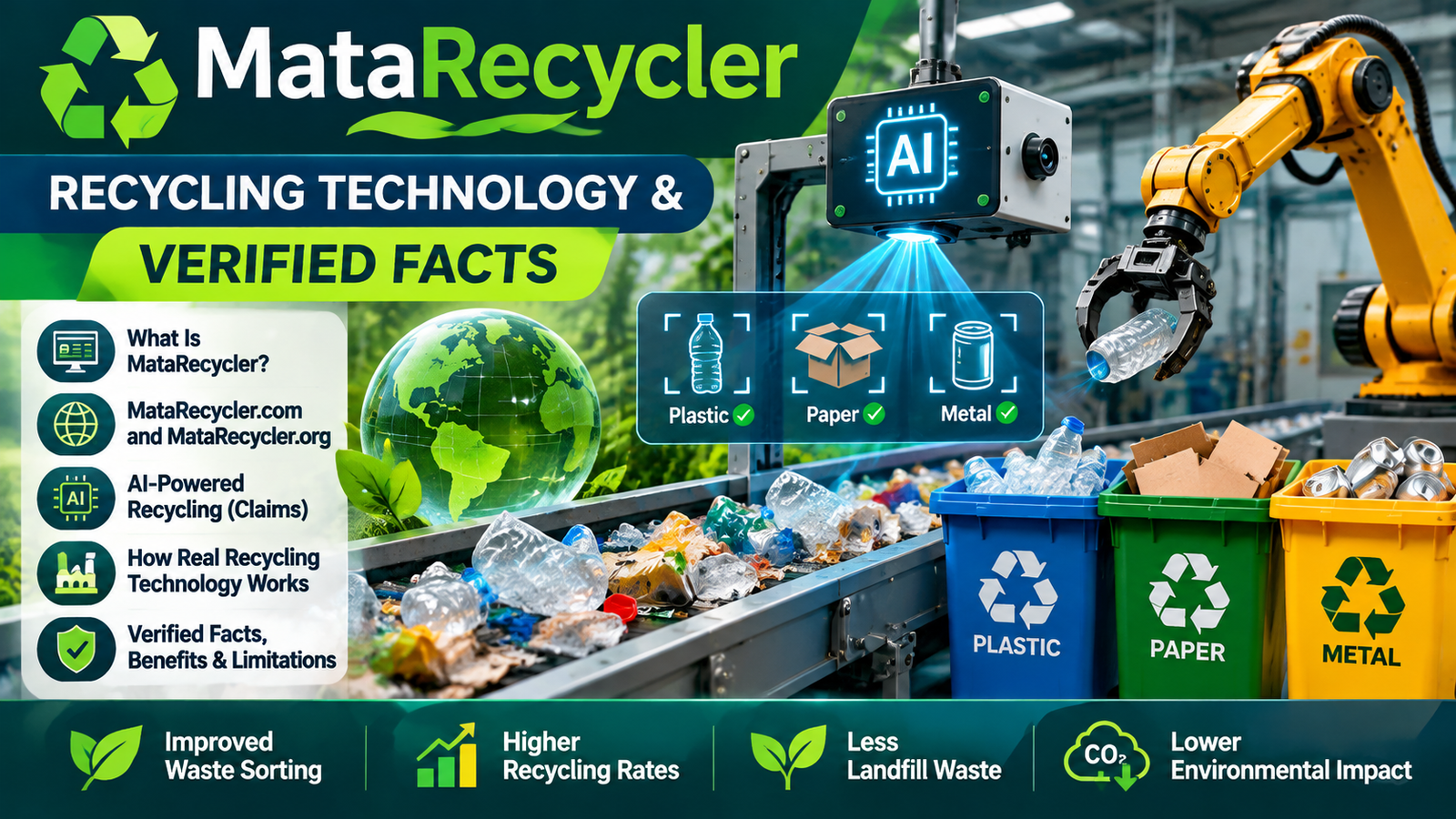
MataRecycler is a name associated with online recycling information, sustainability discussions, and descriptions of modern waste-management technology. However, different websites use the term in different ways. MataRecycler.com presents itself as an educational platform covering recycling and environmental awareness, while other online articles describe MataRecycler as an AI-powered recycling system. The available evidence does not establish that a commercial machine or technology product called MataRecycler is currently available. Understanding the name requires looking at the actual websites, examining the technology claims, and separating documented facts from assumptions.
What Is MataRecycler?
MataRecycler is an online term associated with recycling, environmental information, and discussions about automated waste management. It is used by websites that publish content about sustainability and by articles exploring the possible role of artificial intelligence in recycling operations.
One identifiable use of the name is MataRecycler.com, which describes itself as an educational resource focused on responsible recycling and sustainable practices. Another website, MataRecycler.org, publishes general-interest information across several categories.
Some online explanations go further and describe MataRecycler as an advanced recycling machine that uses artificial intelligence, cameras, and sensors to recognize and separate waste. Although these technologies are used in real recycling facilities, there is insufficient independent evidence to establish a specific commercial product under the MataRecycler name.
Therefore, it is useful to distinguish the websites using this name from the broader technology concepts associated with it.
What Is MataRecycler.com?
MataRecycler.com is an accessible online publishing website that presents information about recycling, sustainability, and environmental responsibility.
Its About Us page describes a mission focused on helping individuals and organizations understand recycling processes, reduce waste, and adopt more responsible environmental practices.
The website presents recycling as an important part of resource conservation. Its stated approach includes encouraging people to understand different materials, improve waste-handling habits, and consider the environmental effects of everyday consumption.
Its Stated Purpose and Mission
The website describes several areas of interest:
- Responsible recycling practices.
- Waste reduction and reuse.
- Environmental awareness.
- Sustainable resource management.
- Educational information about recycling materials.
- Practical guidance for individuals and organizations.
These subjects are relevant to people who want to understand how recycling contributes to environmental protection.
However, a distinction should be made between the website’s stated mission and its actual publishing activity.
What Content Does MataRecycler.com Publish?
Although the website describes itself as a recycling and sustainability resource, its visible homepage also contains articles covering subjects outside environmental management.
Examples include content about financial services, online education, video games, AI video-generation tools, and digital communication platforms.
This suggests that the website operates as a broader informational publication rather than a specialist recycling database.
Visitors should therefore examine individual articles to understand their subject and purpose instead of assuming that everything published on the domain is directly related to recycling.
Is It a Recycling Company or an Information Website?
The publicly reviewed pages establish MataRecycler.com as an accessible publishing platform with an environmental and recycling-related description.
However, the available information does not independently establish it as a recycling manufacturer, waste-processing company, or supplier of industrial recycling equipment.
No verified product catalogue, named recycling facility, or independently documented commercial installation was identified under the MataRecycler name during this research.
This distinction matters because an informational website and a commercial recycling technology provider serve different purposes.
MataRecycler.com vs. MataRecycler.org
MataRecycler.com and MataRecycler.org are two separate domain names. Their similar spelling may lead visitors to assume that they belong to the same organization, but that relationship has not been independently established.
MataRecycler.com describes its purpose around recycling education, sustainability, and environmental awareness. Its visible homepage also contains general informational articles.
MataRecycler.org presents a wider digital magazine-style experience. Its homepage includes categories such as entertainment, fashion, sports, technology, business, and health.
The .org website also describes its publishing identity in terms of information, recycling, and technology.
These differences are important when researching the name. A description found on one domain should not automatically be attributed to the other.
Visitors should check the complete website address, About Us information, contact details, and published content before deciding whether two similarly named platforms have a connection.
Is MataRecycler an AI-Powered Recycling System?
Some online articles describe MataRecycler as a smart recycling system that could use artificial intelligence to identify waste and automate the sorting process.
These descriptions commonly mention cameras, sensors, machine-learning models, smart bins, and automated sorting equipment.
The general technology behind these descriptions is real. Modern recycling facilities increasingly use computer vision and automated equipment to identify different materials and improve sorting operations.
However, this does not establish that a specific MataRecycler machine exists.
During this research, no independently verified manufacturer, technical manual, commercial product catalogue, confirmed customer installation, or published performance study was identified for a product specifically called MataRecycler.
What Do Online Articles Claim?
Descriptions of MataRecycler commonly present a system with several proposed components.
Cameras and sensors: These are described as tools for collecting information about waste materials and identifying objects before sorting.
Artificial intelligence: Machine-learning systems are proposed as a way to classify materials according to their visual characteristics.
Automated sorting: Some explanations describe mechanical equipment that separates identified materials into different waste streams.
Smart monitoring: Other descriptions mention dashboards and digital reporting tools that could help organizations monitor recycling activity.
These are recognizable features of modern smart-recycling systems. Nevertheless, they should be treated as general technology descriptions rather than confirmed specifications of a MataRecycler product.
Is There a Verified MataRecycler Machine?
The available evidence does not establish a commercially available recycling machine under the MataRecycler name.
A verified product would normally have identifiable information such as:
- A manufacturer or registered business.
- Technical documentation.
- Product specifications.
- Demonstrations or installation records.
- Independent testing results.
- Identifiable customers or operating facilities.
Without these details, claims about specific MataRecycler hardware, sorting accuracy, or commercial performance should not be treated as established facts.
How Does Real AI-Powered Recycling Technology Work?
Artificial intelligence is already being used in parts of the recycling industry. Its purpose is to help identify materials, improve sorting operations, and recover useful resources from mixed waste.
A typical automated sorting process involves several stages.
Cameras and Optical Recognition
Industrial cameras capture images of materials moving along a conveyor belt. Optical systems examine visible characteristics such as shape, colour, and surface appearance.
Some facilities also use additional sensing technologies to identify material properties that cannot be determined through ordinary photographs alone.
Artificial Intelligence and Material Classification
Machine-learning models can be trained using examples of different waste materials. Once trained, these systems analyze new images and help classify objects.
Depending on the installation, the system may identify particular plastics, paper, cardboard, beverage cartons, or other recyclable materials.
Automated Sorting and Robotic Equipment
After identifying an object, sorting equipment can separate it from the main waste stream.
Industrial systems may use pneumatic air jets, mechanical diverters, or robotic arms to move selected materials into designated containers.
The combination of recognition software and physical sorting equipment allows facilities to process large amounts of material.
A Real-World Example: Recycleye
An actual example of AI-assisted recycling is Recycleye’s optical sorting technology.
Tetra Pak reported an installation at Cumbria Waste Management’s facility in Carlisle, UK. The system uses artificial intelligence and cameras to identify beverage cartons in mixed waste and pneumatic valves to separate the materials.
Tetra Pak reported output purity above 98% for that particular installation.
This is an important example because it demonstrates that AI-assisted waste sorting is not simply a theoretical concept.
However, the reported performance belongs to that specific Recycleye installation. It should not be attributed to MataRecycler or used as evidence of a separate MataRecycler product.
What Are the Benefits and Limitations of Smart Recycling?
Automated recycling technology can offer several benefits when properly designed and integrated into a waste-processing facility.
One advantage is improved material identification. Computer vision can help recognize recyclable objects moving through sorting equipment, potentially reducing the amount of useful material that enters the wrong waste stream.
Automation can also improve processing consistency and reduce the need for some repetitive manual sorting tasks.
Other possible benefits include better operational monitoring, more efficient material recovery, and improved information about the types of waste passing through a facility.
However, smart recycling systems also have limitations.
Installation costs: Cameras, sensors, conveyors, robotic equipment, and software require investment.
Maintenance requirements: Industrial equipment needs regular inspection, repairs, and calibration.
Contaminated materials: Food residue, damaged packaging, and mixed materials can make identification more difficult.
Data limitations: AI models depend on suitable training data and may perform differently when exposed to unfamiliar materials.
Operational reliability: A system must work consistently in a demanding industrial environment rather than only under controlled testing conditions.
Research published by the National Institute of Standards and Technology in 2026 examines AI and robotic sorting in material recovery facilities, including technical and operational challenges.
This demonstrates why smart recycling should be evaluated through real installations and independent performance evidence rather than promotional descriptions alone.
Is MataRecycler a Real Company or Product?
The answer depends on what is meant by MataRecycler.
As an online name, it is associated with accessible websites that publish information about recycling, sustainability, and other subjects.
However, the available evidence does not establish a particular commercial recycling manufacturer or a verified AI-powered machine operating under this name.
No sufficiently documented product catalogue, technical specifications, named industrial customers, or independent performance results were identified during this research.
Anyone considering a business relationship or equipment purchase should request verifiable information before making a decision.
This includes checking the legal business identity, manufacturer details, technical documents, installation history, warranty conditions, and independent testing.
A website describing recycling technology should not automatically be treated as proof that the organization sells or manufactures that technology.
Is MataRecycler Connected to the Old Recycler Computer Virus?
There is another historical use of the name that is different from modern recycling discussions.
In April 2009, a Spanish-language blog published information about a utility called Mata Recycler. The post advertised it as a tool for removing the Windows Recycler shortcut virus.
This older computer-security context involved malware associated with USB drives, hidden folders, and misleading shortcuts.
Such infections could interfere with normal file access and create confusion when users opened removable storage devices.
The historical utility is not the same as the current MataRecycler.com or MataRecycler.org publishing websites.
It is also important not to assume that an old download is still safe to use. Unknown executable files can present security risks, especially when their original developer, code, and current integrity cannot be verified.
Anyone dealing with a suspicious USB drive or malware infection should use updated security software and trusted technical support rather than relying on an old executable simply because its name appears in a historical article.
How to Verify Recycling Technology Claims
When researching an unfamiliar recycling platform or technology product, a few checks can help establish whether its claims are supported.
- Identify the manufacturer: Look for a named company responsible for producing the equipment.
- Check technical documentation: Genuine products should have identifiable specifications and operating information.
- Find real installations: Look for named recycling facilities or organizations using the equipment.
- Review independent testing: Performance claims should be supported by identifiable research or testing.
- Check customer evidence: Confirm whether actual facilities have reported using the technology.
- Examine performance figures: Accuracy and recovery rates should identify the system, testing conditions, and measurement method.
These checks are particularly important when a website makes claims about advanced automation or environmental performance.
Frequently Asked Questions About MataRecycler
Q1: What does MataRecycler mean?
Ans: MataRecycler is a name associated with recycling information websites and online discussions about waste-management technology. Its exact linguistic meaning has not been established by the sources examined.
Q2: Is MataRecycler.com a real website?
Ans: Yes. MataRecycler.com is an accessible online publishing website that describes its purpose around recycling education, environmental awareness, and sustainable practices.
Q3: Is MataRecycler an AI recycling machine?
Ans: Some online articles describe it as an AI-powered recycling system, but a specific commercial MataRecycler machine has not been independently verified.
Q4: Can I buy a MataRecycler machine?
Ans: No verified manufacturer or commercial product catalogue was identified during this research. Anyone considering a purchase should first request independently verifiable product and company information.
Q5: Are MataRecycler.com and MataRecycler.org the same?
Ans: They are different domain names with different visible website content. Their common ownership or organizational relationship has not been established.
Q6: Is MataRecycler a computer virus?
Ans: The name Mata Recycler appeared in a 2009 Spanish-language article advertising a utility for removing the Windows Recycler shortcut virus. This historical reference is separate from the current recycling-information websites.
Q7: Does real AI-powered recycling technology exist?
Ans: Yes. Companies such as Recycleye develop AI-assisted optical sorting systems for recycling facilities. These systems use cameras, software, and automated equipment to identify and separate recyclable materials.
Final Thoughts on MataRecycler
MataRecycler is an interesting example of how one name can appear in different online contexts. MataRecycler.com provides recycling and sustainability information, while MataRecycler.org operates as a separate general-interest publishing website. Claims about a dedicated AI-powered MataRecycler machine remain unverified. However, real AI-assisted recycling systems already operate in industrial facilities. Readers should distinguish documented technology from unsupported product claims and verify important information before relying on it.