
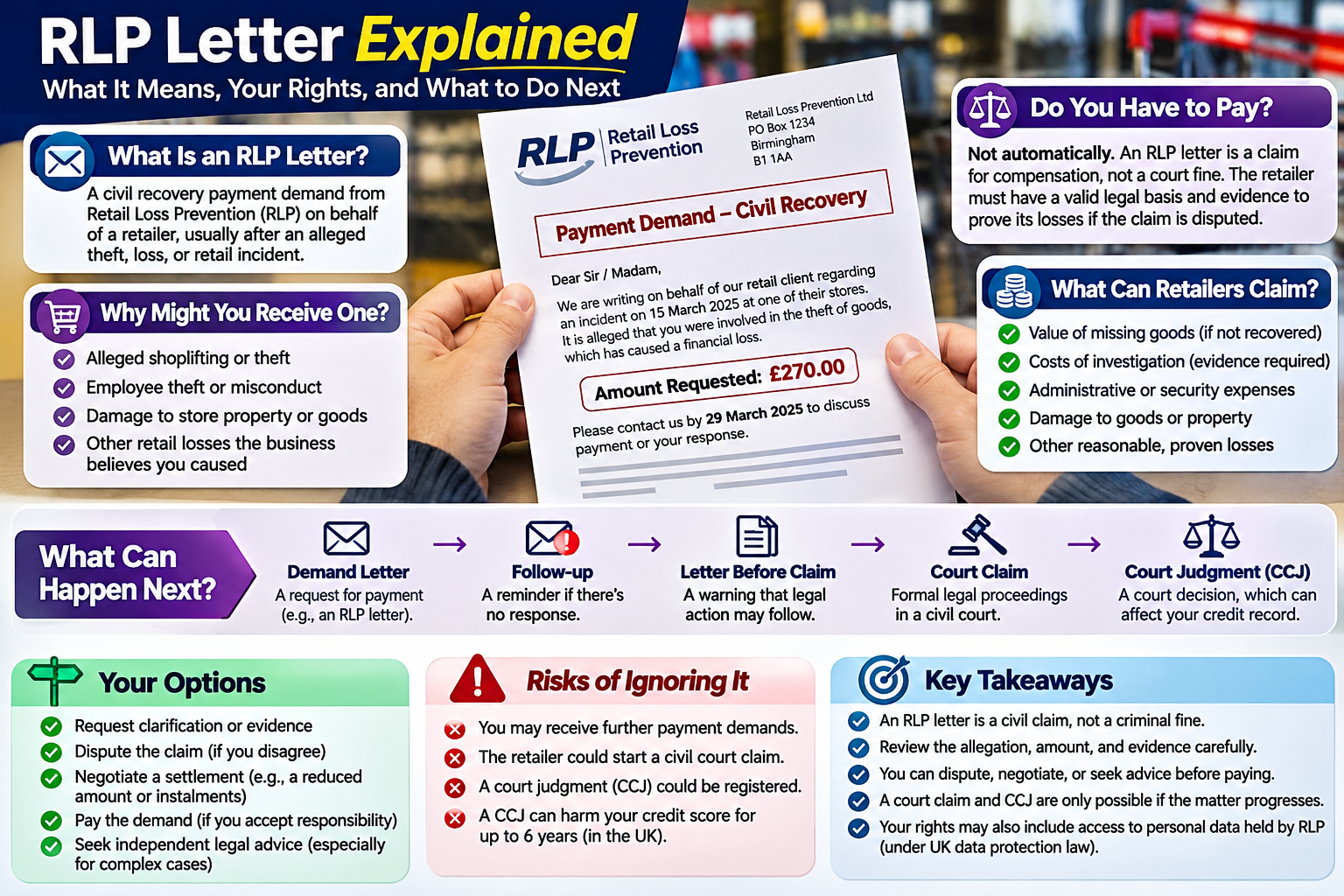
An RLP letter is usually a civil recovery payment demand sent by Retail Loss Prevention (RLP) on behalf of a retailer seeking compensation for alleged losses. These letters often follow accusations of shoplifting, theft, or other incidents involving retail property. Receiving one can be worrying, particularly when it requests money and refers to possible court action.
However, an RLP letter is not the same as a court judgment, and receiving one does not automatically mean you are legally required to pay the amount demanded. Whether compensation is owed depends on the facts, the evidence, the applicable law, and the losses the retailer can establish.
This guide explains what an RLP letter means, how civil recovery works, what retailers may claim, and the practical options available to recipients. It focuses on the United Kingdom, where Retail Loss Prevention operates, while highlighting important considerations for international readers.
Legal information notice: This article provides general information, not individual legal advice. UK legal procedures differ between England and Wales, Scotland, and Northern Ireland. Anyone facing a formal court claim, criminal allegation, or significant financial demand should seek advice appropriate to their jurisdiction.
Key Takeaways
- An RLP letter is generally a demand for civil compensation, not a fine imposed by a court.
- A retailer must establish legal entitlement to compensation if the claim is contested in court.
- Recovering allegedly stolen goods does not necessarily prevent a retailer from claiming other proven losses.
- A demand letter does not itself create a County Court Judgment (CCJ) or criminal conviction.
- Ignoring ordinary correspondence carries risks, and ignoring actual court papers can have serious consequences.
- Checking the evidence, understanding the amount claimed, and obtaining appropriate advice can help recipients make informed decisions.
What Is an RLP Letter?
An RLP letter is correspondence associated with Retail Loss Prevention, a UK business involved in civil recovery services for retailers. It commonly requests compensation following an alleged incident that the retailer believes caused a financial loss.
Civil recovery is the process through which a business seeks financial compensation using civil law rather than relying solely on criminal enforcement.
For example, a retailer might allege that an individual took merchandise without paying. Following the incident, the retailer may seek compensation for the goods or certain additional losses.
The letter typically identifies an incident, explains the basis of the demand, requests payment, and describes possible further action if the matter remains unresolved.
The important distinction is that a demand represents a claim, not a judicial finding.
Who Is Retail Loss Prevention?
Retail Loss Prevention Limited is a UK company associated with retail loss prevention and civil recovery.
It acts in connection with claims made by retailers following incidents involving alleged theft, employee misconduct, or other losses.
The company is not a criminal court, police authority, or government agency. Its correspondence should therefore be understood within the civil claims process.
The existence of an RLP letter does not establish that the recipient committed an offence or that the amount requested is legally recoverable.
Why Do Retailers Use Civil Recovery?
Retailers may incur financial losses following incidents involving merchandise, cash, property damage, or misconduct.
Civil recovery provides a route through which businesses can seek compensation for losses they believe another party caused.
Depending on the circumstances, retailers may seek recovery of:
- Missing merchandise or cash.
- Damage to property.
- Reasonable investigation expenses.
- Certain administrative or security costs.
- Other legally recoverable losses connected with the incident.
However, claiming an expense is different from proving that it is recoverable.
Citizens Advice explains that businesses seeking compensation must establish their entitlement and demonstrate the reasonableness of relevant costs.
Why Have You Received an RLP Letter?
An RLP letter usually follows a report made by a retailer about an incident involving alleged financial loss.
The circumstances can vary considerably. Some recipients may recognise the incident immediately, while others may dispute the allegations or believe the amount demanded is incorrect.
Common Situations That May Lead to an RLP Letter
Alleged shoplifting
A retailer may allege that goods were taken without payment. The merchandise may have been recovered, partially recovered, damaged, or lost.
Employee theft allegations
An employer may suspect an employee of taking cash, merchandise, or company property.
Property damage
An incident may involve damage to products, equipment, or other retail property.
Disputed retail incidents
A retailer may allege misconduct even when the individual involved disagrees with the account of what happened.
These situations do not all produce the same legal outcome. The nature of the incident, available evidence, and actual loss matter.
What Information Should the Letter Contain?
A recipient should examine the correspondence for enough information to understand the allegation and assess the demand.
Important details include:
- The retailer or business making the claim.
- The date and location of the alleged incident.
- A description of the alleged conduct.
- The compensation amount requested.
- An explanation of the losses or expenses claimed.
- The requested response date.
- Contact details and a reference number.
- Any explanation of possible further proceedings.
Not every initial letter will contain every supporting document. However, unclear allegations or unexplained amounts are reasonable matters to raise when seeking clarification.
Before making payment or disclosing additional personal information, recipients should independently verify the sender’s identity.
How Does RLP Civil Recovery Work?
Civil recovery is separate from the criminal justice process, although the same alleged incident can sometimes give rise to both.
A retailer may investigate an incident, collect evidence, and decide whether to seek compensation. A demand may then be sent directly or through a representative.
If the recipient disputes the claim, the parties may exchange correspondence, consider settlement, or seek legal advice.
A retailer may ultimately decide whether to start civil proceedings. That possibility does not mean every unpaid demand will result in litigation.
Civil Recovery Versus Criminal Proceedings
| Civil recovery | Criminal proceedings |
|---|---|
| Primarily concerns compensation for alleged loss | Concerns alleged criminal wrongdoing |
| Usually pursued by the affected business or its representative | Generally pursued by relevant prosecuting authorities |
| May involve a demand for payment | May involve criminal investigation and prosecution |
| Civil liability is generally assessed on the balance of probabilities | Criminal guilt must be proved beyond reasonable doubt |
| May result in a civil judgment | May result in a criminal conviction and sentence |
A civil compensation demand is not a criminal fine.
Equally, the absence of criminal charges does not automatically prevent a civil claim. The legal tests and purposes differ.
Can Civil Recovery Continue if the Police Take No Action?
Potentially, yes.
A retailer may pursue civil compensation even when criminal charges are not brought, because the two processes involve different legal questions.
However, a retailer still needs a valid legal basis for its claim. Police inaction does not prove that the civil demand is justified.
Do You Legally Have to Pay an RLP Letter?
Receiving an RLP letter does not automatically establish a legal obligation to pay the amount demanded. The retailer must have a valid basis for compensation and, if the claim is contested, must establish its entitlement through the applicable legal process.
This does not mean recipients should automatically refuse payment.
Some claims may be supported by evidence of genuine financial loss. Others may involve disputed allegations, unclear calculations, or costs whose recoverability is questionable.
The correct decision depends on the individual circumstances.
What Must a Retailer Prove?
In a contested civil recovery case, relevant questions may include:
- Did the alleged incident occur?
- Is the recipient legally responsible?
- Did the retailer suffer a compensable loss?
- Was the loss caused by the alleged conduct?
- Is the amount claimed reasonable and legally recoverable?
- What evidence supports the claim?
The precise legal requirements depend on the cause of action and jurisdiction.
An allegation alone is not a substitute for evidence.
Can RLP Charge a Fixed Administration Fee?
This is an important distinction.
Citizens Advice explains that retailers seeking investigation, administration, or security expenses must demonstrate the actual costs incurred in the particular case. A standard fixed amount cannot simply replace proof of those expenses.
For example, suppose a retailer requests £180 for investigation and administration costs.
That figure should not automatically be treated as recoverable merely because it appears in a letter.
Relevant questions include what work was undertaken, what expense was actually incurred, how it relates to the incident, and whether the law permits recovery.
The example amount is hypothetical and does not represent an RLP tariff.
What If the Allegedly Stolen Goods Were Recovered?
Recovery of merchandise can affect the calculation of loss, but it does not necessarily eliminate every possible claim.
Consider two hypothetical situations.
Scenario A: Undamaged goods recovered
A retailer recovers merchandise in a condition suitable for resale. The business may have difficulty establishing that it permanently lost the full retail value of those goods.
However, it may allege other recoverable expenses associated with the incident.
Scenario B: Goods recovered but damaged
A retailer recovers merchandise that can no longer be sold in its original condition.
There may be a more direct argument for a financial loss, although the amount and legal basis still require evidence.
In either case, the retailer cannot automatically establish compensation simply by stating a figure.
How to Check an RLP Letter Before Responding
The most useful first step is to separate what the letter alleges from what it actually establishes.
Step 1: Verify the Sender
Check the company’s identity using independently obtained contact details.
Avoid relying solely on telephone numbers, payment links, or email addresses printed in unexpected correspondence.
A genuine company name can be misused in fraudulent messages.
Step 2: Identify the Exact Allegation
Read the description of the incident carefully.
Check whether the date, retailer, location, and circumstances match your understanding.
If the allegations are incorrect, preserve any information that may help establish what happened.
Step 3: Examine the Payment Calculation
Look for an itemised explanation of the amount requested.
A useful review separates the following categories:
| Claimed amount | What to examine |
|---|---|
| Value of missing goods | Whether goods were actually lost and how their value was calculated |
| Damaged merchandise | Evidence of damage and resulting loss |
| Staff investigation | Work performed, actual costs, and legal recoverability |
| Administration | Case-specific evidence rather than an unexplained standard charge |
| Security expenses | Whether additional costs were incurred and attributable to the incident |
| Legal expenses | Whether the applicable law permits their recovery |
This framework helps identify questions that may need clarification. It does not determine the legal outcome.
Step 4: Preserve Relevant Records
Keep copies of the original letter, envelopes, emails, payment requests, and subsequent correspondence.
If relevant, preserve receipts, transaction records, witness details, or other evidence lawfully available to you.
Avoid altering documents or making speculative statements about events you cannot remember clearly.
Step 5: Identify the Type of Correspondence
A routine payment demand is different from a formal letter before claim or court-issued claim form.
The distinction matters because legal procedures and response deadlines become more significant as a dispute progresses.
Step 6: Seek Advice Before Making Important Admissions
If liability is disputed, consider speaking with a qualified legal adviser before admitting responsibility, making a settlement offer, or signing an agreement.
Statements made during correspondence may have legal consequences.
What Are Your Options After Receiving an RLP Letter?
Recipients may have several possible courses of action. None is automatically appropriate for every case.
Option 1: Request Clarification or Supporting Evidence
If the letter is unclear, you may ask the sender to explain the allegation and provide an itemised basis for the amount requested.
For example, you might ask which losses are being claimed, how they were calculated, and what documents support them.
Keep the request factual and avoid making admissions that are not necessary.
Option 2: Dispute the Claim
If you believe the allegation is incorrect or the amount unjustified, you may dispute liability or the amount claimed.
A reasoned response may identify factual inaccuracies, missing evidence, or disputed expenses.
Seeking legal advice is particularly important where the incident involves criminal allegations, employment consequences, or substantial financial exposure.
Option 3: Negotiate a Resolution
Some disputes may be resolved through negotiation.
A person who believes some liability may exist might consider settlement, including a reduced amount or an instalment arrangement.
However, settlement communications can affect legal rights. It is important to understand what the agreement covers and whether it fully resolves the claim.
Option 4: Pay the Demand
Payment may be considered where the recipient accepts the claim or decides that settlement is appropriate after reviewing the circumstances.
Before paying, confirm the recipient’s identity, payment instructions, and whether the payment will resolve the particular claim in full.
Keep documentary proof of payment and any settlement terms.
Option 5: Seek Independent Legal Advice
Independent advice can help evaluate the evidence, the legal basis for the demand, and the risks of each response.
Citizens Advice is a useful starting point for relevant UK consumer guidance.
What Happens If You Ignore an RLP Letter?
Ignoring an RLP letter does not automatically create a judgment or criminal conviction.
However, it is not a risk-free strategy.
The sender may issue further correspondence, seek clarification, propose settlement, or consider civil proceedings.
Whether litigation follows depends on the circumstances. No general statement can reliably predict the outcome of an individual case.
Can RLP Take You to Court?
A retailer may potentially pursue a civil claim where it believes it has a legally supportable case.
Whether proceedings are appropriate, successful, or economically worthwhile depends on factors such as evidence, the amount claimed, and the applicable legal rules.
An initial demand is not proof that a claim has been filed.
Demand Letter Versus Court Claim
| Document | What it generally means | Why it matters |
|---|---|---|
| Initial RLP demand | Compensation is being requested | Review the allegation and options |
| Reminder or follow-up | The demand remains unresolved | Assess whether a response is needed |
| Formal letter before claim | Litigation may be contemplated | Check applicable pre-action requirements |
| Court-issued claim form | Legal proceedings have begun | Follow the official response deadline |
| Court judgment | The court has made a decision | Understand payment and challenge options |
For civil claims in England and Wales, pre-action rules generally encourage parties to exchange relevant information and consider resolving disputes before proceedings.
A formal court claim requires particular attention. GOV.UK explains that failing to respond by the stated deadline may lead to a judgment.
What If You Receive Actual Court Papers?
Do not treat court-issued documents as another ordinary payment reminder.
Check the court details, claim number, response instructions, and deadline.
Depending on the claim and your position, you may be able to admit the claim, dispute it, or respond to only part of the amount.
If more time is needed, follow the relevant court procedure rather than assuming an informal request to the claimant will extend the deadline.
The applicable procedure differs across UK jurisdictions.
Can an RLP Letter Affect Your Credit Score?
An ordinary RLP demand letter does not itself create a County Court Judgment.
The potential credit consequences become more significant if a claim progresses through court and results in a registrable judgment.
What Is a County Court Judgment?
A County Court Judgment, commonly called a CCJ, is a civil court judgment that may establish a payment obligation.
In England and Wales, a CCJ may arise following court proceedings, including circumstances where a defendant fails to respond appropriately.
A CCJ can affect access to borrowing and other credit arrangements.
How Long Does a CCJ Remain on a Credit Record?
GOV.UK explains that registered CCJs generally remain on the Register of Judgments, Orders and Fines for six years.
If the full judgment amount is paid within one month, the judgment can be removed from the register.
Payment after one month can result in the judgment being marked as satisfied, but it generally remains registered for the six-year period.
These rules concern court judgments, not the mere receipt of a civil recovery demand.
Can an RLP Letter Give You a Criminal Record?
An RLP civil recovery letter does not itself create a criminal record.
Civil compensation demands and criminal convictions are different legal matters.
A criminal record may arise through separate criminal proceedings, depending on the offence and outcome.
The existence of an RLP claim does not establish that criminal proceedings have occurred.
If police involvement or a criminal investigation is ongoing, obtain advice about that separate matter.
Special Situations That May Affect an RLP Claim
Not every recipient faces the same circumstances. Certain factors may make a case more complicated.
When the Recipient Is Under 18
Claims involving minors require particular care.
Legal capacity, responsibility, and procedural requirements may differ from those applicable to adults.
Parents or guardians should not assume that receiving correspondence automatically makes them personally liable for every amount requested.
A qualified adviser can help assess the position under the relevant jurisdiction’s law.
When the Allegation Is Disputed
A person may disagree with the retailer’s description of an incident or deny that any wrongdoing occurred.
The claim should be evaluated on evidence rather than assumptions.
Relevant material might include receipts, transaction records, contemporaneous notes, and other lawfully available information.
Disputing an allegation does not guarantee that proceedings will end, but neither does the allegation establish liability.
When Goods Were Returned Immediately
The return of goods may affect the retailer’s financial loss.
Nevertheless, a retailer might allege additional costs associated with the incident.
Those costs should be evaluated independently rather than assuming that the return of merchandise either eliminates or validates the entire demand.
When Payment Is Unaffordable
A recipient who believes payment is owed but cannot afford the amount may consider seeking advice about settlement or instalments.
Financial hardship does not automatically extinguish liability.
However, it may be relevant to negotiations and the practical management of a dispute.
Personal Data, Privacy and RLP Records
Civil recovery correspondence can involve personal information, including names, addresses, incident reports, and other identifying details.
Individuals may have rights under applicable data protection legislation.
In the UK, these can include rights to access personal information held by an organisation and, in appropriate circumstances, request correction of inaccurate information.
Can You Request Information Held About You?
Under UK data protection law, individuals can generally make a subject access request to obtain personal information held about them.
An organisation will normally need to respond within one month, although lawful extensions, exemptions, and identity-verification requirements may apply.
A subject access request is not necessarily the same as obtaining every document relevant to a civil dispute. Some information may be withheld or redacted where legal exemptions apply.
What If Your Personal Information Is Incorrect?
If you believe an organisation holds inaccurate information about you, consider asking it to correct the relevant details.
Keep a record of your request and the response.
Where appropriate, concerns about data protection compliance may be raised with the Information Commissioner’s Office.
Privacy rights and civil liability are separate questions. Exercising a data protection right does not automatically cancel a compensation claim.
RLP Letters Outside the UK: What International Readers Should Know
Although this guide is written for a global English-speaking audience, the legal information above primarily concerns UK civil recovery.
Readers in other countries should not assume that UK procedures, court terminology, or compensation rules apply locally.
Are RLP Letters the Same as US Civil Demand Letters?
Not necessarily.
Some US jurisdictions allow retailers to pursue civil demands related to alleged retail theft. However, the relevant rules may arise under state-specific statutes and can differ substantially from UK civil recovery principles.
The amount recoverable, notice requirements, treatment of minors, and available defences can vary by state.
A UK RLP letter should therefore not be treated as interchangeable with a US statutory civil demand.
What If You Live Outside the UK?
If you receive correspondence relating to an incident in another country, identify:
- Where the alleged incident occurred.
- Which business is making the claim.
- Which country’s law is said to apply.
- Whether any court proceedings have actually begun.
- Whether cross-border enforcement or jurisdictional issues arise.
International residence alone does not establish whether a claim is enforceable.
Cross-border disputes can involve complicated legal questions, making jurisdiction-specific advice particularly valuable.
Frequently Asked Questions About RLP Letters
Q1: Is an RLP letter a fine?
Ans: No. An RLP letter is generally a civil compensation demand rather than a criminal fine imposed by a court. The legal basis and amount requested must be assessed separately.
Q2: Do I have to pay an RLP letter immediately?
Ans: Not automatically. Receiving the letter does not itself prove liability. Check the claim, evidence, deadline, and available options. Seek advice where appropriate, particularly if formal proceedings are threatened.
Q3: Can RLP take me to court for shoplifting?
Ans: A retailer may potentially bring civil proceedings to recover legally compensable losses. Whether a particular claim succeeds depends on the evidence, applicable law, and circumstances.
Q4: What happens if I ignore an RLP letter?
Ans: Further demands or possible legal proceedings may follow. However, court action is not automatic. Ignoring formal court documents is especially risky because it may result in judgment without your defence being considered.
Q5: Can I dispute the amount requested?
Ans: Yes. You may question the basis of the allegation or the amount claimed. An itemised explanation and relevant evidence can help clarify the dispute.
Q6: Does returning the goods cancel the RLP claim?
Ans: Not necessarily. Returning undamaged goods may affect the retailer’s loss, but the retailer might allege other recoverable expenses. Those expenses still require a valid legal basis.
Q7: Will an RLP letter affect my credit score?
Ans: The demand letter itself does not create a CCJ. Credit consequences may arise if separate court proceedings result in a registrable judgment.
Q8: Can an RLP letter affect employment?
Ans: An RLP letter is not itself a criminal conviction. However, allegations, employment disciplinary procedures, and the processing or disclosure of personal information can raise separate legal questions. The answer depends on the circumstances.
Q9: Can I request evidence before paying?
Ans: You can ask the claimant to explain the allegation and provide information supporting the amount requested. What must be disclosed, and when, depends on the applicable procedural rules.
Q10: Can I negotiate an RLP payment?
Ans: Negotiation may be possible. Before agreeing to payment, consider whether liability is accepted, what the settlement covers, and whether the agreement resolves the claim in full.
Conclusion
Receiving an RLP letter can be unsettling, particularly when it involves allegations of theft, a payment demand, or references to legal action.
The most important distinction is between an allegation, a demand for compensation, and an enforceable court judgment. These are not the same thing.
An RLP letter should be reviewed carefully, but it should not automatically be treated as proof that the recipient owes the amount requested.
Understanding the allegation, examining the claimed losses, preserving relevant records, and identifying the type of correspondence can help clarify the situation.
Where liability is disputed or the consequences could be significant, independent legal advice offers a more reliable basis for deciding how to respond.
Above all, recipients should distinguish ordinary demands from formal court proceedings and respond appropriately to genuine legal deadlines.