
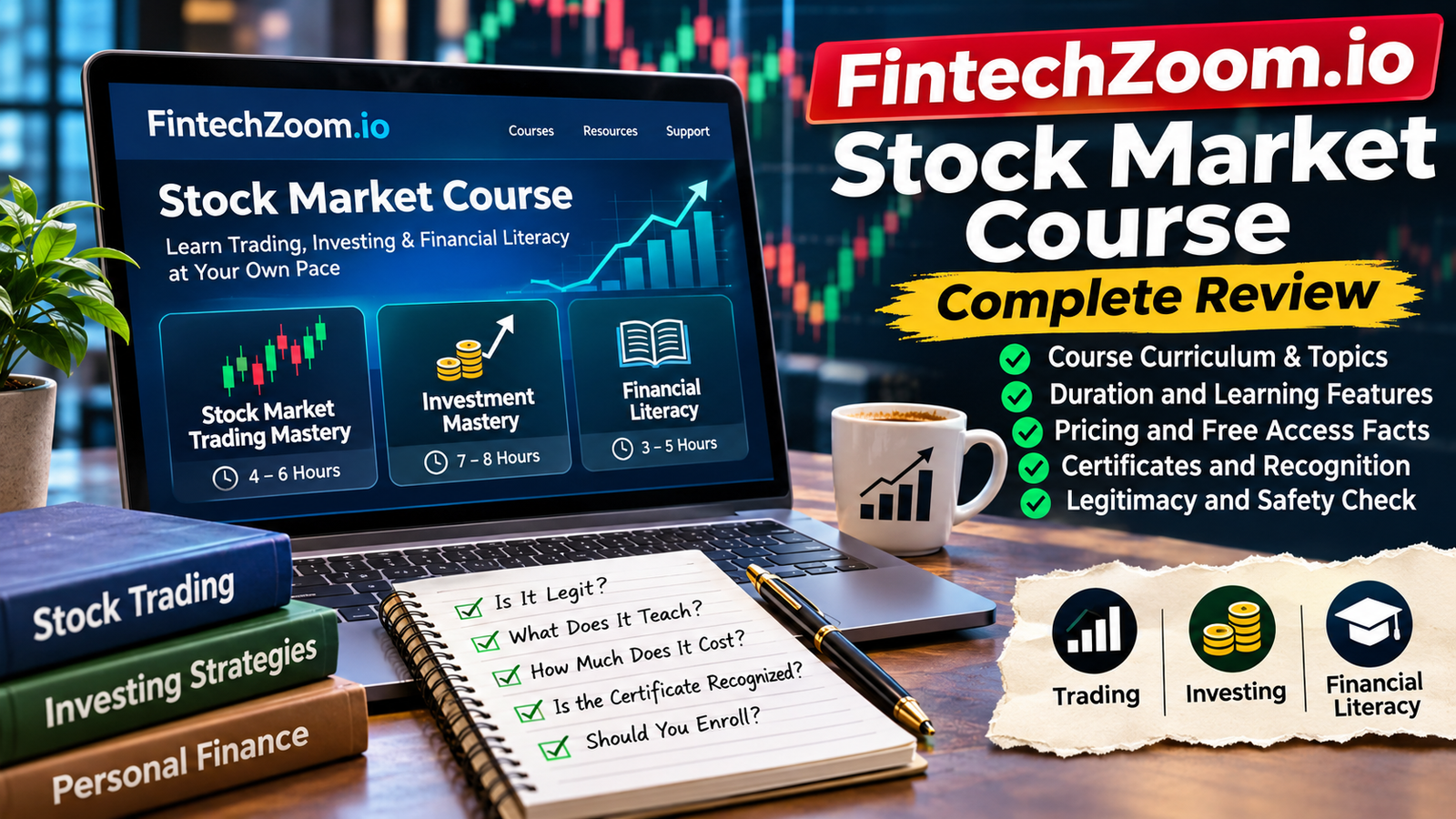
The FintechZoom.io stock market course refers to financial education programmes advertised on FintechZoom.io, including separate courses in stock market trading, investing, and financial literacy. Their published descriptions mention video lessons, quizzes, downloadable resources, and completion certificates. However, prices, instructor credentials, and actual course delivery remain unverified. There is also an important brand warning: FintechZoom.com publicly states that FintechZoom.io is not affiliated with it.
This independent review examines what the programmes claim to offer, how their subjects differ, and what prospective learners should verify before enrolling.
What Is the FintechZoom.io Stock Market Course?
The phrase FintechZoom.io stock market course sounds like the name of one educational programme. However, the website’s published catalogue identifies two stock-market learning paths alongside a separate financial literacy option.
The programmes address different learning objectives.
Stock Market Trading Mastery focuses on analysing shorter-term market movements, reading charts, selecting trading approaches, and managing trading risks.
Investment Mastery explores asset classes, portfolio management, diversification, investment analysis, and longer-term financial goals.
The Complete Financial Literacy Course introduces budgeting, saving, debt management, credit, and personal financial planning.
This distinction matters because learning how to trade stocks is not identical to learning how to invest for retirement or manage household finances.
A beginner may want an overview of all three subjects. Someone with a specific goal, however, should evaluate the appropriate syllabus rather than assume the courses are interchangeable.
FintechZoom.io Stock Market Course at a Glance
| Feature | Research finding |
|---|---|
| Website advertising the courses | fintechzoom.io |
| Main course options | Stock Market Trading, Stock Market Investing, Financial Literacy |
| Trading course duration | Advertised 4–6 hours |
| Investing course duration | Advertised 7–8 hours |
| Financial literacy duration | Advertised 3–5 hours |
| Learning format | On-demand videos, according to the descriptions |
| Quizzes and materials | Advertised for all three programmes |
| Completion certificate | Advertised; recognition not independently verified |
| Standard course prices | $197 and $499 |
| Lifetime access | Claimed in the course catalogue |
| Refund policy | Advertised 30-day satisfaction guarantee |
| Relationship with FintechZoom.com | FintechZoom.com expressly denies affiliation |
| Independent hands-on testing | not displayed upfront on public pages |
What the Course Listings Actually Confirm
The available indexed descriptions identify programme titles, advertised learning subjects, approximate video durations, and certain proposed learning features.
They do not establish whether a paying customer currently receives everything described.
For example, the website mentions guidance from experienced professionals. That is a publisher claim, not independent verification of named instructors or their qualifications.
Likewise, a description promising practical training cannot establish the quality of its exercises without access to the actual lessons.
The most accurate way to assess these programmes is to separate what is publicly advertised from what a prospective buyer can verify.
What Does the FintechZoom.io Stock Market Course Teach?
The advertised curriculum spans market fundamentals, trading techniques, portfolio construction, and personal finance.
The following comparison summarises the three learning paths.
| Programme | Main subjects | Most relevant learning goal |
|---|---|---|
| Trading Mastery | Technical analysis, charts, trading strategies, risk controls | Understanding active trading |
| Investment Mastery | Stocks, ETFs, asset allocation, portfolio management | Understanding longer-term investing |
| Financial Literacy | Budgeting, debt, savings, credit, financial planning | Building personal finance knowledge |
Stock Market Trading Mastery: Technical Analysis and Trading Risk
The Stock Market Trading course advertises lessons on stock-market fundamentals and methods used by active traders.
Its published topics include candlestick patterns, market trends, price movements, day trading, swing trading, and position trading.
These techniques differ in how long a trader intends to hold a position.
Day trading generally involves opening and closing positions during the same trading day. Swing trading involves attempting to capture price movements over multiple days or weeks. Position trading commonly uses a longer holding period.
The course also lists stop-loss strategies, market indicators, portfolio allocation, and trading psychology.
These subjects are relevant because a trading strategy is not simply a prediction about whether a stock price will rise.
A trader also needs to understand position sizing, potential losses, transaction costs, and the circumstances under which a strategy may fail.
Advanced subjects such as margin trading, options, foreign exchange, and algorithmic trading appear in the advertised syllabus.
However, a short introduction to an advanced technique should not be confused with comprehensive practical training.
Margin and derivatives trading can involve substantial losses. Anyone studying these topics should understand the associated risks before attempting to use real money.
An unusual curriculum detail deserves attention: The trading syllabus also contains a lesson description about credit scores and borrowing rates. That subject is more naturally associated with financial literacy.
This does not prove the course is ineffective, but it raises a reasonable question about how carefully individual modules have been organised.
Before enrolling, request the full lesson-by-lesson curriculum.
Investment Mastery: Asset Classes and Portfolio Strategies
The Investment Mastery programme focuses on broader investment decision-making rather than primarily short-term price movements.
Its published syllabus covers stocks, bonds, mutual funds, exchange-traded funds (ETFs), real estate, and alternative investments.
An ETF is an investment fund traded on a stock exchange. Depending on what it holds, it may provide exposure to several securities through a single product.
The course also mentions value investing, dividend strategies, passive index investing, and portfolio rebalancing.
Another major topic is asset allocation: deciding how investment funds are distributed among categories such as stocks, bonds, and cash.
According to the US Securities and Exchange Commission’s Investor.gov educational resources, appropriate asset allocation depends on factors including investment horizon and tolerance for risk.
The programme further advertises introductions to artificial intelligence, robo-advisers, economic indicators, international markets, and estate-planning concepts.
These topics may offer useful context, although their presence in a syllabus does not establish how thoroughly each one is taught.
For a learner interested in long-term investing, the critical question is whether the course explains how to make suitable, informed decisions—not merely whether it mentions numerous investment strategies.
Financial Literacy: Budgeting, Debt, and Investment Basics
The third option is The Complete Financial Literacy Course.
It is not exclusively a stock-market programme.
Its advertised lessons cover income, expenses, budgets, credit scores, debt repayment, emergency savings, and financial goals.
The syllabus also includes beginner investment concepts, retirement planning, taxation, and financial tools.
These topics may be relevant to someone who wants to understand their overall financial position before beginning to invest.
For example, learning how to assess high-interest debt and establish emergency savings may be more immediately useful than studying technical trading patterns.
The financial literacy option therefore addresses a different starting point from the two market-focused programmes.
Its suitability still depends on lesson quality, instructional accuracy, and whether the actual teaching materials match the public description.
Course Duration, Lessons, and Learning Features
FintechZoom.io advertises a self-paced learning model rather than a traditional classroom schedule.
The published descriptions identify the following approximate video durations:
- Trading Mastery: 4–6 hours.
- Investment Mastery: 7–8 hours.
- Financial Literacy: 3–5 hours.
These figures describe advertised video content, not necessarily the complete time required to understand or practise the material.
A student who pauses lessons, completes exercises, reads supporting material, and reviews difficult concepts could spend considerably longer.
Is There Enough Time to Cover the Syllabus?
This is one of the most important questions raised by the advertised curriculum.
Trading Mastery covers technical indicators, several trading styles, psychology, risk management, margin, derivatives, and algorithmic techniques within a stated 4–6 hours.
Investment Mastery similarly lists many subjects, ranging from basic asset classes to AI-assisted investing and estate planning, within 7–8 hours.
The breadth of these topics suggests that at least some may receive introductory rather than advanced treatment.
That is an analytical observation based on the published descriptions, not a conclusion drawn from watching the lessons.
A prospective student should ask how much time the course devotes to each subject and whether practical exercises demonstrate the concepts.
Worksheets, Quizzes, and Study Resources
FintechZoom.io advertises downloadable charts and strategy guides for the trading programme.
The investing and financial literacy descriptions mention printable worksheets. Interactive quizzes are also advertised across the three programmes.
These resources could support learning if they are accurate, accessible, and well designed.
For example, a portfolio worksheet might help students practise calculating the percentage allocated to different asset classes.
A trading journal could encourage learners to document their reasoning and assess simulated outcomes.
However, the actual quality and functionality of the advertised materials were not independently tested.
Lifetime Access, Updates, and Support
The published course catalogue states that learners can retain lifetime access to course materials.
It also advertises support through email or the course platform, along with a 30-day satisfaction guarantee.
These statements create expectations, but they do not answer every contractual question.
Learners should clarify what lifetime access means, whether lessons remain accessible if the platform changes, which updates are included, and how support requests are handled.
A detailed written agreement is more useful than a broad promotional promise.
Is the FintechZoom.io Stock Market Course Free?
The publicly reviewed information does not establish that both Stock Market Mastery programmes are free.
FintechZoom.io’s indexed homepage mentions a free training programme that visitors can request by email.
However, this statement does not clearly identify that offer as either the complete Trading Mastery or Investment Mastery programme.
The existence of a free educational offer is therefore different from confirmation that every advertised course costs nothing.
What Is Known About Course Pricing?
No reliable, current standard price for the three programmes could be independently established during this review.
Without a functioning checkout or written offer, it would be misleading to quote a precise amount.
Before buying, prospective learners should confirm the complete price, currency, taxes, any recurring charges, and any optional purchases.
They should also verify which company or individual receives the payment.
What About the 30-Day Refund Guarantee?
The website’s indexed catalogue advertises a 30-day satisfaction guarantee.
That is a publisher-stated offer.
It was not possible to independently establish the full refund conditions, exclusions, processing method, or actual success of refund requests.
Before making a payment, obtain the applicable terms in writing and retain a copy.
If the provider cannot clearly explain the price, payment recipient, and refund process, the purchase should be postponed.
Who Teaches the Courses, and Are the Certificates Recognised?
FintechZoom.io describes its training as expert-led and advertises certificates for course completion.
Nevertheless, two different questions need answering: who provides the instruction, and what value does the resulting certificate carry?
Instructor Identity and Qualifications
The publicly reviewed descriptions do not provide sufficiently verified details about each instructor’s identity, professional experience, and teaching background.
For financial education, relevant evidence could include a named instructor, documented professional experience, a genuine employment or academic history, and examples of their teaching.
Professional registration may be relevant if an instructor claims to provide regulated investment services or personalised investment advice.
However, not every person teaching general financial concepts is required to hold the same regulatory credentials.
The appropriate verification depends on what the instructor claims to do.
Completion Certificates Versus Professional Qualifications
A course completion certificate generally indicates that the issuing provider considers its completion conditions satisfied.
That is not automatically equivalent to academic accreditation, a professional licence, or a government-recognised qualification.
FintechZoom.io advertises certificates, but independent evidence of recognised accreditation or widespread employer acceptance was not established.
A certificate may still document informal learning. Its practical value depends on the issuing organisation, assessment standards, and the expectations of whoever reviews it.
Students seeking career qualifications should verify recognition with the relevant employer, professional body, or educational institution before paying.
Is FintechZoom.io Legit? Understanding the Brand Warning
One issue makes this course investigation more complicated than a standard online-learning review.
FintechZoom.com publicly identifies FintechZoom.io as an unaffiliated website and includes it in a warning about sites it says impersonate the FintechZoom brand.
The relevant statement appears on FintechZoom.com’s official-domain information page.
This is a significant publisher-origin warning, especially for someone who may assume that the similar domains belong to the same company.
FintechZoom.io Versus FintechZoom.com
The two addresses should not be treated as interchangeable.
FintechZoom.com presents itself as a financial news and market-information publisher. Its warning specifically lists fintechzoom.io among websites it says are not affiliated with its operation.
FintechZoom.io separately advertises financial education and other market-related services.
The public warning establishes FintechZoom.com’s stated position about affiliation.
It does not, by itself, establish a criminal offence, a regulatory penalty, or the actual quality of the courses advertised by the .io website.
Still, readers should not rely on assumed brand recognition when deciding whether to provide information or make a payment.
What Remains Unverified?
Several essential points require independent confirmation:
- The legal identity of the course provider.
- The credentials of the individuals delivering instruction.
- The organisation receiving payments.
- The complete current course price.
- The accessibility and quality of delivered lessons.
- The full refund agreement.
- The status and recognition of advertised certificates.
An independently confirmed legal identity would not automatically establish course quality, but it would address a basic accountability question.
Likewise, evidence of actual lesson delivery would not automatically validate every financial claim.
How to Protect Your Information
If a reader is considering the course, the sensible response is verification rather than speculation.
Confirm the website’s operator, review written purchase terms, and independently check any claimed professional affiliations.
Do not submit identification documents, banking credentials, or payment information merely because a website uses a familiar financial brand name.
For US readers, Investor.gov’s Ask and Check guidance explains how to investigate individuals and firms that claim regulated investment credentials.
The US Securities and Exchange Commission also advises prospective trading students to examine promoters, costs, risks, and claims about past trading success.
These are general investor-protection principles, not an official finding against the FintechZoom.io course.
Which FintechZoom.io Course Fits Your Learning Goal?
The right starting subject depends on what someone wants to learn.
A person who has difficulty managing monthly expenses is likely to have different educational priorities from a learner interested in portfolio management.
Similarly, active trading requires knowledge of risks that may not be central to a beginner’s long-term investment plan.
| Your learning goal | Most relevant advertised programme | Important next step |
|---|---|---|
| Understand budgeting and saving | Financial Literacy | Learn personal-finance fundamentals |
| Explore how short-term trading works | Trading Mastery | Study risk management and practise without real funds |
| Understand ETFs and diversification | Investment Mastery | Review investment horizon and risk tolerance |
| Learn technical chart analysis | Trading Mastery | Evaluate sample charts and exercises |
| Plan long-term financial goals | Investment Mastery | Compare approaches using authoritative sources |
| Obtain a recognised professional qualification | None established | Verify accreditation separately |
This table compares the stated curriculum, not the tested quality of each programme.
Beginners should also avoid assuming that complicated trading methods will produce superior results.
Trading activity, especially with leverage or derivatives, may introduce risks that exceed those of simpler investment approaches.
Educational progress should be assessed through understanding and decision-making skills rather than promised profits.
What Should You Check Before Enrolling?
A useful course review should help readers make a decision even when information is incomplete.
For FintechZoom.io, several items should be verified before any financial commitment.
Provider Identity, Instructor Details, and Syllabus
Ask for the registered name of the organisation operating the programme and reliable contact information.
Request the instructor’s full name, relevant qualifications, and professional background.
Examine a detailed lesson list showing which subjects are introductory and which include substantial practical instruction.
A sample lesson can help determine whether the teaching style suits your level.
Price, Payment Recipient, and Refund Terms
Ask for an itemised price in writing.
The agreement should identify any additional fees, subscription terms, access restrictions, and conditions affecting cancellation or refunds.
Check whether the name of the payment recipient matches the identified provider.
Avoid sending money through arrangements that prevent you from identifying the recipient or understanding your contractual rights.
Student Feedback and Course Support
Look for independent reviews that describe actual course access, lesson quality, instructor interaction, and support.
General praise without evidence of enrollment offers limited reassurance.
Screenshots or testimonials may be helpful but are not independently conclusive.
When appropriate, ask for access to a sample lesson, a description of the learning platform, and confirmation of how support works.
Practical decision rule: If the provider’s identity, full payment terms, or access arrangements cannot be established satisfactorily, do not pay until those questions are resolved.
FintechZoom.io Course Benefits and Important Limitations
The published descriptions contain features that could appeal to learners. Their value, however, depends on actual delivery.
| Advertised feature | Potential educational benefit | Current limitation |
|---|---|---|
| Self-paced videos | Flexible learning schedule | high-level interactive simulators |
| Wide-ranging syllabus | Exposure to different financial concepts | Depth uncertain |
| Downloadable materials | Supports practice and review | Materials not independently assessed |
| Interactive quizzes | Could reinforce understanding | Assessments not tested |
| Completion certificate | Documents claimed course completion | Recognition unverified |
| Lifetime access | Opportunity to revisit lessons | Contractual scope unclear |
| Email support | Potential help with questions | Responsiveness not tested |
| Satisfaction guarantee | Potential purchase protection | Full conditions unverified |
The descriptions may justify further investigation by interested learners, but they are insufficient for a confident recommendation to purchase.
The most significant limitations are related to transparency and independent verification, not simply the number of subjects covered.
Free Alternatives to Explore Before Paying
Beginners do not need to purchase a particular branded programme to start learning financial fundamentals.
Several established resources explain important investment concepts without requiring enrollment in an unverified commercial course.
Investor.gov
Investor.gov is operated by the US Securities and Exchange Commission.
Its educational materials explain investment products, risk, compound growth, asset allocation, diversification, and long-term financial planning.
This makes it a useful reference for checking general investing concepts.
FINRA Investor Education
The Financial Industry Regulatory Authority’s investor resources provide educational information about investing, financial professionals, investment risks, and investor protection.
They are especially useful for understanding how to research professionals and recognise common financial warning signs.
These resources are not necessarily substitutes for structured, personalised teaching. They are reliable starting points for foundational study and for evaluating claims made by commercial education providers.
Frequently Asked Questions
Q1: How long does the FintechZoom.io stock market course take?
Ans: The website advertises 4–6 hours of videos for Trading Mastery, 7–8 hours for Investment Mastery, and 3–5 hours for Financial Literacy. These are publisher-stated durations, not independently measured completion times.
Q2: Is the advertised free course the same as Trading Mastery?
Ans: That has not been established. The indexed homepage mentions free training available through an email request, but does not clearly identify it as the complete Trading Mastery programme.
Q3: Does FintechZoom.io offer a 30-day refund?
Ans: Its published course catalogue advertises a 30-day satisfaction guarantee. The complete contractual conditions and actual refund process were not independently verified.
Q4: Are FintechZoom.io course certificates accredited?
Ans: The provider advertises completion certificates, but independent evidence of recognised accreditation was not established during this review.
Q5: Is FintechZoom.io affiliated with FintechZoom.com?
Ans: FintechZoom.com expressly says it is not affiliated with FintechZoom.io and includes the domain in a warning about alleged brand impersonation. The warning should be attributed to the .com publisher rather than described as a regulatory finding.
Q6: Can beginners take the stock market courses?
Ans: The descriptions market the courses to beginners, alongside more experienced learners. Whether the actual lessons provide sufficient beginner guidance remains untested.
Final Verdict
The FintechZoom.io stock market course listings describe a potentially useful range of financial education subjects, including trading, portfolio management, and personal finance.
However, an extensive syllabus does not establish instructional quality.
Current public information does not independently verify essential purchase details such as instructor credentials, course pricing, delivered content, certificate recognition, or the practical operation of refund promises.
The public warning from FintechZoom.com adds a separate reason to verify the provider’s identity carefully.
The most defensible conclusion is that the advertised programmes can be researched further, but there is not enough independently verified evidence to recommend paying for them.
Prospective learners should first explore authoritative free educational resources, define their learning goals, and request clear written evidence before considering enrollment.
Financial education can improve understanding, but no course removes market risk or guarantees trading profits.
One thought on “FintechZoom.io Stock Market Course: Lessons, Costs, Legitimacy & Review”