
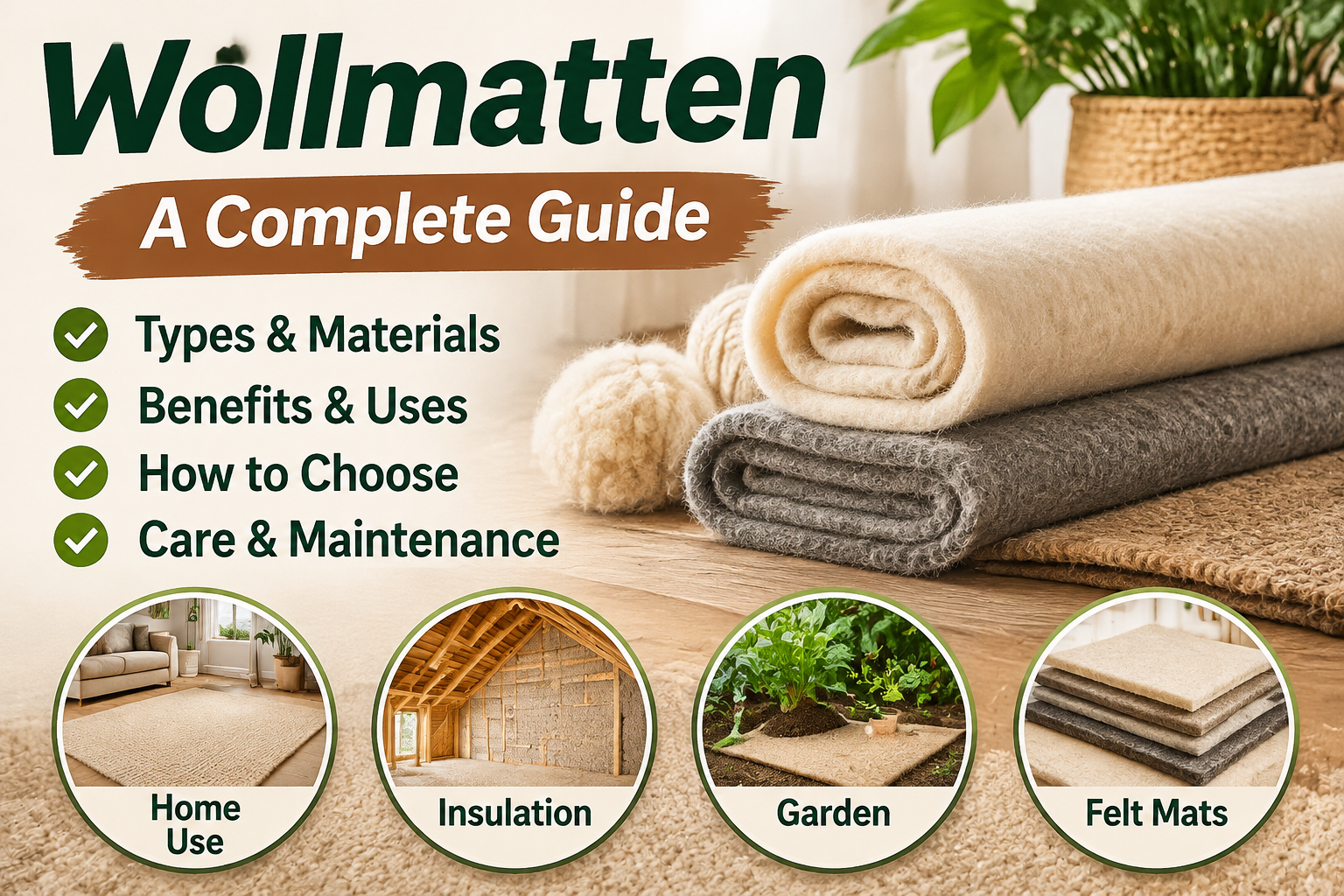
Wollmatten are wool-based mats and textile products used in homes, construction, gardening, furniture protection, and other practical applications. Made from natural wool fibres or wool blends, they are available in different forms, including decorative floor mats, felt sheets, insulation products, and protective coverings.
Their popularity is connected to the natural properties of wool. Wool fibres can absorb moisture vapour, provide cushioning, offer thermal comfort, and maintain their structure under suitable conditions. A decorative wool mat, for example, cannot automatically replace a specially manufactured insulation product.
Understanding the different types of Wollmatten, their materials, advantages, and limitations can help buyers choose the right option. This guide explores how wool mats are made, where they are used, how to maintain them, and what to consider before purchasing one.
What Are Wollmatten?
Wollmatten is a German word that translates to wool mats in English. The singular form is Wollmatte, while Wollmatten refers to multiple mats.
These products are made using natural wool fibres, commonly obtained from sheep. Depending on their intended application, they may contain pure wool, recycled wool, or mixtures of natural and synthetic fibres.
Wool mats are manufactured in different shapes, thicknesses, densities, and textures. Some are designed for everyday household use, while others are produced for insulation, sound absorption, gardening, or technical applications.
The most important distinction is their intended purpose. A soft decorative mat offers comfort and appearance, whereas a dense wool felt product may be designed for cushioning or protection. Building insulation products also require specific technical properties.
Therefore, understanding the material and manufacturing method is essential when choosing Wollmatten.
What Are Wollmatten Made Of?
The main material used in traditional Wollmatten is sheep’s wool. However, manufacturers may combine wool with other fibres or materials to achieve particular characteristics.
1. Natural Sheep’s Wool
Sheep’s wool is a natural textile fibre with several useful characteristics.
It contains a complex protein structure called keratin. Its fibre structure contributes to elasticity, moisture absorption, and natural resilience.
Depending on how it is processed, sheep’s wool can be used to manufacture:
- Decorative floor mats.
- Wool felt sheets.
- Insulation products.
- Protective pads.
- Acoustic materials.
- Gardening mats.
The percentage of actual wool in a finished product can vary, so buyers should check the manufacturer’s material specifications.
2. Recycled Wool
Some manufacturers use recycled wool from textile production waste, old garments, or previously manufactured wool products.
Recycled fibres can be processed into new felt materials and other wool-based products.
This approach can reduce the need for newly sourced raw materials. However, the quality and characteristics of recycled wool depend on the original fibres, sorting, cleaning, and manufacturing process.
3. Wool Blends
Certain Wollmatten contain a mixture of wool and synthetic fibres.
Manufacturers may use blended materials to improve specific properties, such as dimensional stability, durability, or production consistency.
A blended product should not automatically be described as 100% natural wool.
If natural material content is important to your purchasing decision, check the fibre composition rather than relying only on product descriptions.
Different Types of Wollmatten
Wollmatten are available in several forms. Their construction and intended applications determine which type is appropriate for a particular situation.
1. Decorative Wool Mats
Decorative wool mats are commonly used in homes and interior spaces.
They can add warmth, texture, and visual interest to different rooms. Depending on their construction, they may be woven, tufted, knitted, or made using felted wool.
Common applications include:
- Living rooms.
- Bedrooms.
- Hallways.
- Reading corners.
- Home offices.
- Decorative interior arrangements.
When selecting a decorative wool mat, consider its dimensions, surface texture, backing material, and cleaning requirements.
2. Wool Felt Mats
Wool felt mats are made by compressing and interlocking fibres to create a dense textile material.
Unlike woven fabrics, felt does not depend on traditional weaving patterns to maintain its structure.
Depending on their thickness and density, wool felt products can be used for:
- Furniture protection.
- Cushioning.
- Craft projects.
- Equipment protection.
- Decorative panels.
- Selected industrial applications.
Dense felt mats can provide a protective layer between surfaces, helping reduce direct contact and minor abrasion.
However, their resistance to pressure, moisture, and wear depends on the specific product.
3. Wool Insulation Mats
Wool insulation mats are specially manufactured products designed for building applications.
They are commonly produced using processed sheep’s wool fibres and supplied in rolls, batts, or flexible insulation formats.
Possible applications include:
- Roof insulation.
- Wall cavities.
- Ceiling spaces.
- Timber-frame construction.
- Selected floor insulation systems.
Wool insulation can help reduce heat transfer when correctly specified and installed.
Its actual performance depends on factors such as thickness, density, thermal conductivity, installation quality, and moisture conditions.
It is important to distinguish insulation-grade wool products from ordinary decorative mats. A floor rug or felt sheet should not be used as building insulation unless the manufacturer specifically approves that application.
4. Garden Wool Mats
Garden wool mats are designed for outdoor gardening applications.
Depending on their construction, they may be used around plant containers, garden beds, or selected planting areas.
Potential applications include:
- Covering soil surfaces.
- Helping reduce moisture evaporation.
- Providing some protection around plant roots.
- Supporting selected winter-protection arrangements.
- Reducing direct exposure of soil surfaces.
Their performance depends on the wool material, thickness, weather conditions, and installation method.
Not every wool mat is suitable for outdoor use. Products intended for indoor decoration may deteriorate when repeatedly exposed to rain, sunlight, and soil moisture.
5. Acoustic and Protective Wool Mats
Certain wool-based felt materials are used in acoustic and protective applications.
Their fibrous structure can help absorb sound energy when products are appropriately designed and installed.
Potential applications include:
- Interior acoustic panels.
- Furniture padding.
- Protective equipment layers.
- Room dividers.
- Decorative wall coverings.
Acoustic performance is not determined by the material name alone. Thickness, density, mounting arrangement, air gaps, and product testing all influence results.
How Are Wollmatten Manufactured?
The manufacturing process depends on the type of wool mat being produced.
Different methods create different textures, densities, and physical properties.
1. Wool Cleaning and Preparation
The process generally begins with raw wool obtained from sheep.
The fibres are cleaned to remove dirt, grease, and unwanted material. They may then be sorted according to their characteristics and prepared for further processing.
2. Fibre Opening and Carding
The cleaned wool is opened and separated to create a more consistent fibre arrangement.
Carding helps align and distribute fibres, making them suitable for subsequent manufacturing processes.
The exact preparation depends on whether the final product will be woven, felted, or manufactured as insulation.
3. Felting and Compression
Felting is an important process in the production of many wool mats.
Wool fibres can interlock through moisture, heat, agitation, and mechanical processes.
Needle felting uses specially designed needles to entangle fibres mechanically.
These processes can create dense and relatively stable wool felt sheets.
4. Weaving or Knitting
Some wool mats are manufactured using traditional textile methods.
Wool yarns can be woven or knitted into different structures, depending on the desired texture and appearance.
This approach is particularly relevant to decorative mats and textile floor coverings.
5. Cutting and Finishing
The finished material may be cut into standard dimensions or custom shapes.
Manufacturers may also add backing materials, edge treatments, surface finishes, or protective treatments.
For insulation products, additional quality checks may be required to ensure that the material meets its declared technical specifications.
Benefits of Wollmatten
Wool mats offer several useful properties, although their actual benefits depend on fibre composition and product design.
1. Natural Moisture Management
Wool fibres can absorb moisture vapour from their surroundings and release it when environmental conditions change.
This characteristic is one reason wool is used in clothing, carpets, upholstery, and certain insulation products.
However, moisture absorption does not mean that wool mats are waterproof.
Prolonged exposure to liquid water can affect their performance and condition.
2. Thermal Comfort
Wool fibres can trap air within their structure.
This contributes to the insulating behaviour of many wool-based materials.
Decorative wool mats can provide a more comfortable surface underfoot, while specially manufactured wool insulation products can help reduce heat transfer in buildings.
Their thermal performance should always be evaluated using the relevant product specifications.
3. Natural Resilience
Wool fibres have natural elasticity.
When appropriately manufactured, wool textiles can recover from some compression and bending.
This characteristic makes wool useful in products such as carpets, cushioning materials, and selected felt applications.
However, repeated heavy pressure can still cause permanent deformation.
4. Acoustic Applications
Certain wool felt products can help absorb sound.
This makes them useful in selected interior acoustic applications.
For example, wool-based panels may be installed in offices, studios, meeting rooms, and residential spaces.
The actual sound-absorption performance depends on the complete panel system rather than simply the presence of wool.
5. Natural Fibre Composition
Wool is an animal-derived natural fibre.
Products made predominantly from sheep’s wool can offer an alternative to certain synthetic textile materials.
However, sustainability depends on several factors, including animal farming, processing, transport, manufacturing energy, product lifespan, and end-of-life disposal.
A natural fibre is not automatically environmentally harmless.
6. Versatile Applications
Another advantage of Wollmatten is their versatility.
Depending on their construction, they can be used for decoration, insulation, gardening, cushioning, furniture protection, and acoustic treatments.
This makes it important to select products according to their actual intended use.
Disadvantages and Limitations of Wollmatten
Although wool mats offer several advantages, they also have limitations.
Understanding these issues before purchasing can help prevent unsuitable product choices.
1. Moisture Sensitivity
Wool can absorb moisture, but prolonged damp conditions may create problems.
If a wool mat remains wet for extended periods, it may develop unpleasant odours, become damaged, or provide conditions suitable for microbial growth.
Products intended for outdoor or damp environments should have suitable specifications.
2. Cleaning Requirements
Some wool mats require more careful cleaning than synthetic alternatives.
Harsh chemicals, excessive heat, unsuitable detergents, and aggressive washing methods may damage wool fibres.
Always follow the manufacturer’s cleaning instructions.
3. Moth Damage
Wool contains keratin, which can attract certain textile-damaging insects.
Clothes moth larvae may damage wool carpets, clothing, and other animal-fibre products.
Regular inspection, appropriate storage, and good cleaning practices can help reduce this risk.
4. Price Differences
High-quality wool products can cost more than some synthetic alternatives.
The price depends on fibre quality, wool percentage, thickness, manufacturing method, product dimensions, and additional treatments.
Comparing prices without considering these specifications can lead to misleading purchasing decisions.
5. Not Every Product Is Fireproof
Wool has naturally different flame behaviour from many synthetic fibres and is generally more resistant to ignition.
However, this does not mean that every wool mat is fireproof.
Some products contain synthetic backing, adhesives, coatings, or blended fibres that change their fire performance.
For construction applications, always check the manufacturer’s fire classification and relevant testing documentation.
Where Can Wollmatten Be Used?
The right wool mat can serve different purposes in residential, commercial, and outdoor environments.
| Application | Suitable wool mat type |
|---|---|
| Living room | Decorative wool mat |
| Bedroom | Soft wool floor covering |
| Furniture protection | Dense wool felt |
| Roof construction | Certified wool insulation |
| Wall insulation | Building-grade insulation batts |
| Garden containers | Outdoor-rated garden wool mat |
| Office interiors | Acoustic wool felt |
| Craft projects | Wool felt sheets |
The most important consideration is product suitability.
A material designed for furniture protection may not meet the technical requirements of a building insulation system.
Likewise, an indoor decorative rug may not be appropriate for permanent outdoor installation.
Wollmatten vs Synthetic Mats: What Is the Difference?
Wool mats and synthetic mats can look similar, but their material properties and maintenance requirements may differ.
| Feature | Wool mats | Synthetic mats |
|---|---|---|
| Main material | Natural animal fibre | Manufactured fibres |
| Moisture behaviour | Can absorb moisture vapour | Depends on polymer type |
| Elasticity | Naturally resilient | Depends on construction |
| Cleaning | May require careful treatment | Often easier, depending on material |
| Insect damage | Can be vulnerable to moths | Generally less attractive to wool-damaging moths |
| Environmental impact | Depends on farming and processing | Depends on raw materials and manufacturing |
| Price | Can be relatively expensive | Available across many price ranges |
Neither option is automatically better for every application.
Wool may be suitable when natural fibre characteristics and material feel are important. Synthetic alternatives may be more appropriate when specific cleaning, moisture, or cost requirements take priority.
The best choice depends on the intended application and product specifications.
How to Choose the Right Wollmatten
Selecting the right wool mat involves more than choosing an attractive design.
The material should match the environment and purpose in which it will be used.
1. Check the Wool Percentage
Look at the product label to determine whether the mat contains 100% wool or a blend.
A product described as wool-based may contain additional fibres or backing materials.
2. Consider Thickness and Density
Thickness affects cushioning and can influence insulation or acoustic performance.
Density is another important specification because two mats with identical thicknesses may have different structures and performance.
Choose these characteristics according to the manufacturer’s recommendations for your intended use.
3. Examine the Backing Material
Decorative wool mats may include backing made from cotton, latex, synthetic materials, or other compounds.
The backing can influence stability, grip, durability, and cleaning requirements.
For example, a mat intended for smooth indoor flooring may require a suitable non-slip backing.
4. Check the Dimensions
Measure the available space before purchasing.
For insulation products, dimensions should match the intended installation area and the manufacturer’s installation requirements.
For decorative products, consider the relationship between the mat size and surrounding furniture.
5. Review Product Certifications
For construction and insulation applications, check technical documentation, declared thermal conductivity, fire performance, and relevant product conformity information.
Do not assume that a decorative wool product meets building-material requirements.
6. Understand Maintenance Requirements
Before purchasing, check whether the mat requires professional cleaning, special detergents, dry cleaning, or regular ventilation.
A product that looks suitable may not be practical if its maintenance requirements do not match your routine.
How to Clean and Maintain Wollmatten
Proper maintenance helps preserve the appearance and condition of wool mats.
The correct cleaning method depends on the product’s construction, fibre content, backing, and intended use.
Here are some general recommendations.
Regular vacuuming: Remove loose dust and dirt using an appropriate vacuum setting. Avoid unnecessarily aggressive brushing.
Clean spills promptly: Blot liquid spills with a clean absorbent cloth. Avoid rubbing, which can push dirt deeper into the fibres.
Use suitable cleaning products: Choose products specifically approved for wool when required.
Avoid excessive moisture: Do not soak a wool mat unless its manufacturer explicitly allows washing.
Dry carefully: Follow the recommended drying method and avoid excessive heat.
Inspect for insects: Check stored wool products periodically for signs of moth activity.
Follow manufacturer instructions: Different wool products may require different care methods.
For valuable, delicate, or heavily soiled mats, professional cleaning may be the safest option.
Are Wollmatten Environmentally Friendly?
Wool is a renewable natural fibre obtained from sheep. It can be shorn periodically, and its fibres can be processed into different textile and insulation products.
This gives wool certain environmental advantages over some materials made entirely from non-renewable resources.
However, the overall environmental impact of a wool mat depends on its entire lifecycle.
Important factors include:
- Sheep farming and land management.
- Water and energy used during processing.
- Chemicals used in cleaning and finishing.
- Transport and manufacturing.
- Product lifespan.
- Recycling and disposal options.
Recycled wool can provide another material option by making use of existing textile fibres.
Consumers should look for clear material declarations, credible environmental certifications, and manufacturer information instead of relying only on general claims such as eco-friendly or sustainable.
Frequently Asked Questions About Wollmatten
Q1. What does Wollmatten mean in English?
Ans: Wollmatten is a German word meaning wool mats. Its singular form is Wollmatte.
Q2. What are Wollmatten made from?
Ans: They are commonly made from sheep’s wool, recycled wool, or blends containing wool and other fibres. Their exact composition depends on the manufacturer and intended application.
Q3. Are Wollmatten suitable for home interiors?
Ans: Yes. Decorative wool mats and wool felt products can be used in living rooms, bedrooms, offices, and other indoor spaces.
Q4. Can Wollmatten be used for building insulation?
Ans: Certain specially manufactured wool mats are suitable for insulation applications. However, ordinary decorative wool mats should not be used as building insulation unless specifically approved for that purpose.
Q5. Do wool mats absorb moisture?
Ans: Yes. Wool fibres can absorb moisture vapour. However, wool mats are not automatically waterproof and can be damaged by prolonged exposure to moisture.
Q6. Are Wollmatten better than synthetic mats?
Ans: Neither material is universally better. Wool offers natural fibre characteristics, while synthetic mats may provide advantages in cost, cleaning, and particular moisture-related applications.
Q7. How long do wool mats last?
Ans: Their lifespan depends on fibre quality, manufacturing, usage, maintenance, and environmental conditions. A well-maintained mat used appropriately may last for many years.
Q8. Can wool mats be washed in a washing machine?
Ans: Some products may be machine washable, but others require professional or specialised cleaning. Always check the manufacturer’s instructions before washing.
Q9. Do Wollmatten attract moths?
Ans: Wool can be damaged by clothes moth larvae. Proper cleaning, inspection, and storage help reduce the risk of infestation.
Q10. Are wool mats environmentally sustainable?
Ans: Wool is a renewable natural fibre, but sustainability depends on farming practices, manufacturing, transportation, product lifespan, and disposal. Recycled wool may offer additional material-efficiency benefits.
Final Thoughts
Wollmatten offer a versatile way to use wool fibres across different applications, from household decoration and furniture protection to specialised insulation and acoustic materials.
Their natural characteristics, including moisture-vapour absorption, elasticity, and thermal properties, make wool an interesting material for several industries.
However, not all wool mats are manufactured in the same way. Decorative mats, felt products, garden coverings, and building insulation materials have different requirements and should not be treated as interchangeable products.