
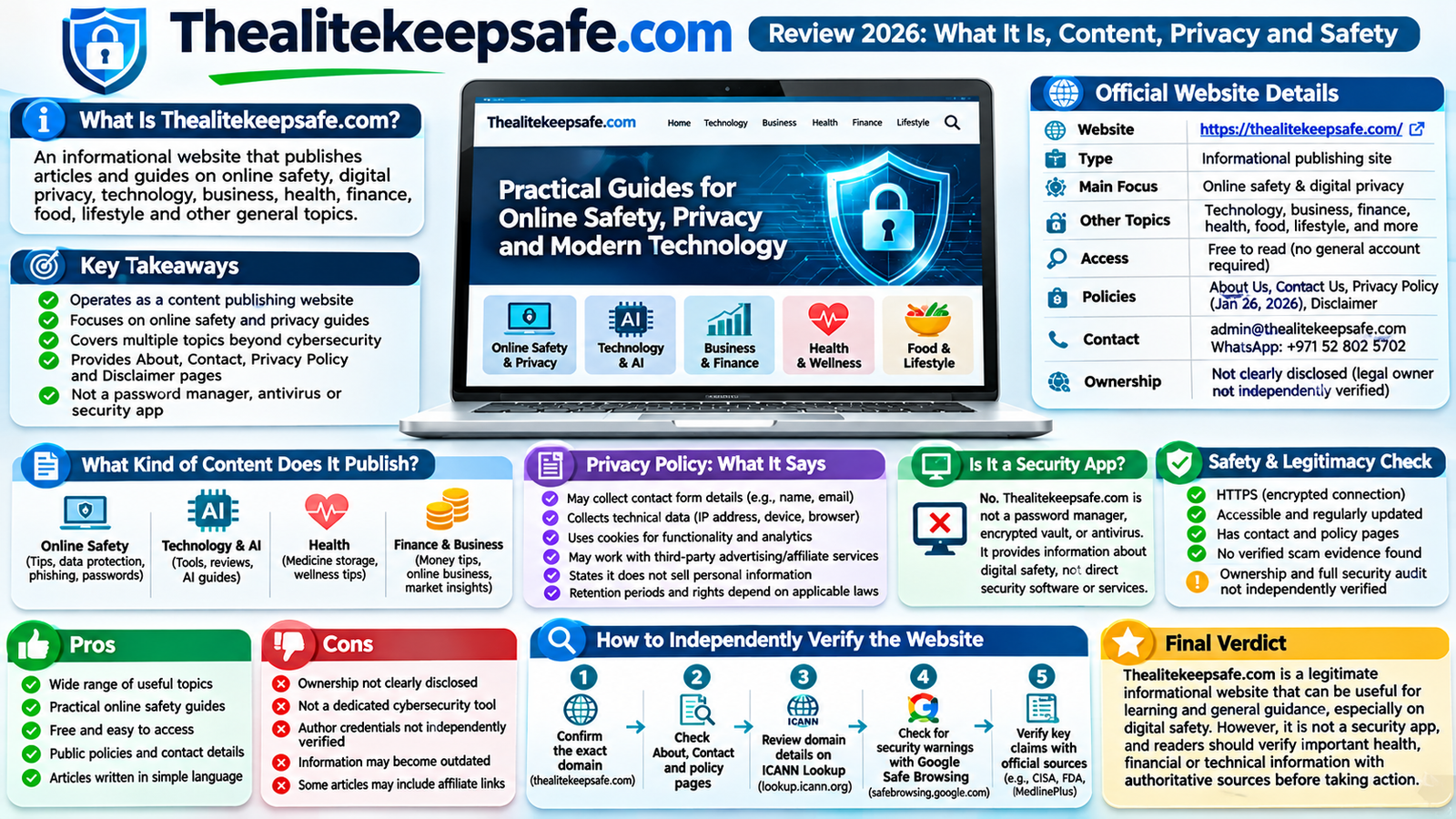
Thealitekeepsafe.com is an informational website publishing articles about online safety, digital privacy, technology, business, health, finance, and everyday topics. Despite its security-related name, the website does not appear to operate as a password manager, antivirus application, or encrypted storage service. It provides written guides and general information rather than direct cybersecurity protection.
If you’ve encountered Thealitekeepsafe.com through a search result, you may be wondering what the website actually does, who operates it, and whether its information is trustworthy.
These are reasonable questions, particularly because the site’s name suggests digital protection while its published content covers numerous unrelated subjects.
This independent review examines the website’s actual features, publicly disclosed information, privacy practices, editorial content, and safety considerations. It also explains how to verify important claims before relying on them.
What Is Thealitekeepsafe.com?
Thealitekeepsafe.com is a website where visitors can read articles, educational explanations, practical guides, and reviews on different subjects.
Its About Us page describes a mission to make online safety and privacy easier to understand, particularly for readers in the United States.
The publisher says it aims to explain digital risks without unnecessary technical language or fear-based messaging.
However, the website’s actual content extends considerably beyond that stated mission. Its categories include subjects such as artificial intelligence, cryptocurrency, business, entertainment, food, healthcare, sports, and search engine optimization.
This makes Thealitekeepsafe.com more accurately described as a general-interest information publisher with a safety-oriented identity than a specialized cybersecurity resource.
Thealitekeepsafe.com at a Glance
| Feature | Verified information |
|---|---|
| Website name | Thealite Keep Safe |
| Official domain | https://thealitekeepsafe.com/ |
| Website type | General informational publishing website |
| Stated original focus | Online safety, privacy, and practical digital guides |
| Other subjects | Technology, AI, business, finance, health, food, lifestyle, and more |
| Main functionality | Reading articles, browsing categories, and searching content |
| Free public articles | Available without a general reading account |
| Password manager or antivirus | No such product identified in the reviewed official pages |
| Privacy policy | Available, last updated January 26, 2026 |
| Contact information | Publicly displayed on the official website |
| Legal ownership | Not independently established through the reviewed disclosures |
| Overall assessment | An accessible content website whose individual claims require appropriate verification |
Why Does the Website’s Name Cause Confusion?
The words “Keep Safe” can suggest a service that protects passwords, documents, private photos, or personal information.
That association may lead visitors to expect an application with features such as encryption, secure file storage, or account protection.
But a website’s name does not establish its functionality.
Thealitekeepsafe.com publishes information about protecting data. That is different from directly protecting someone’s data through software.
For example, an article explaining how password managers work does not mean the publisher operates a password manager.
Understanding this distinction helps readers choose the correct type of service for their needs.
What Can Visitors Actually Do?
The publicly accessible website allows readers to browse articles, select content categories, use its search feature, and access archived publications.
Visitors can also read its policy pages and contact the publisher about questions, corrections, or advertising opportunities.
These are standard functions associated with an informational blog.
No independently demonstrated secure vault, personal file-storage dashboard, or comparable account-protection service was identified during the review.
What Content Does Thealitekeepsafe.com Publish?
The website maintains an extensive collection of topics, including both safety-related information and general-interest articles.
Examining its actual published material provides a clearer picture than relying on its name alone.
Online Safety and Digital Privacy
Digital safety is one of the subjects most closely connected to the website’s stated mission.
For example, its article How to Keep Data Safe and Secure discusses account security, multifactor authentication, software updates, backups, encryption, and phishing awareness.
The guide recommends using unique passwords, protecting email accounts, enabling additional login verification, and keeping important data backed up.
These topics are consistent with widely accepted cybersecurity guidance.
The U.S. Cybersecurity and Infrastructure Security Agency (CISA) similarly recommends strong passwords, multifactor authentication, software updates, and phishing awareness as important protective practices.
This agreement supports those particular recommendations. It does not mean every statement across the publisher’s archive has been independently verified.
Technology, Artificial Intelligence, and Business
The website also covers technologies and business practices that are not necessarily related to personal security.
Examples visible in its article listings include AI face-swapping tools, remote system administration, social media services, and home security technology.
These subjects appeal to readers researching digital tools or business operations.
However, articles about software products may become outdated as features, subscription terms, or security policies change.
When reading a technology comparison, check the publication date and verify product capabilities through the developer’s official documentation.
Health, Finance, Food, and Lifestyle
Thealitekeepsafe.com includes articles on everyday health and household subjects.
A notable example is Five Safe Places to Keep Medicines, which discusses storage conditions, humidity, temperature, and keeping medicines away from children.
Its advice to avoid excessive heat and moisture is broadly consistent with guidance from the U.S. Food and Drug Administration and MedlinePlus.
However, medication requirements vary. Some products need refrigeration or other specific conditions, so the original medication label and pharmacist’s instructions take priority over a general article.
This example demonstrates an important principle: a website may publish broadly useful advice while still requiring readers to verify details relevant to their particular circumstances.
Website example: https://thealitekeepsafe.com/five-safe-places-to-keep-medicines/
How Does Thealitekeepsafe.com Work?
Thealitekeepsafe.com uses a conventional article-based website structure.
Its homepage displays recent posts and highlighted articles. Readers can navigate through categories or use the search field to find information about a particular subject.
The website also displays publication dates, author bylines, and monthly archives.
Browsing Categories and Articles
Users can open a category to explore related content or select an article directly from the homepage.
For instance, someone researching digital privacy can look for data security guides, while someone interested in technology can explore AI-related posts.
Because the website publishes across many categories, the relevance and expertise behind individual articles may differ.
A useful approach is to evaluate the specific article rather than assuming that all content has the same level of credibility.
Checking Publication Dates and Authors
A visible publication date helps readers identify when an article appeared.
Some pages also display updated dates.
These details are particularly important for topics involving changing regulations, cybersecurity practices, software functionality, or financial products.
Author bylines are another useful signal. However, a name appearing on an article does not independently establish professional qualifications or direct experience.
Readers should look for relevant author biographies, credentials, source citations, and demonstrable subject knowledge when expertise matters.
Who Owns and Operates Thealitekeepsafe.com?
Thealitekeepsafe.com provides public information about its purpose and how readers can contact the publisher.
However, the legal identity of its owner was not independently established through the pages reviewed for this article.
That distinction matters because a functioning website and an independently identifiable publishing business are not necessarily the same thing.
What Does the Website Disclose?
Its About Us page discusses its mission, editorial approach, and potential affiliate partnerships.
The Contact Us page provides:
- Email: admin(@)thealitekeepsafe dot com
- WhatsApp: +971 52 802 5702
- A stated response window of one to three business days.
The website also invites readers to report inaccuracies and contact the publisher about advertising or partnerships.
These disclosures provide potential communication channels.
However, their presence does not independently verify the identity of the person operating them, the publisher’s legal registration, or the reliability of its advertised response time.
Are Its Writers Qualified Experts?
Articles on the website display author names, including Nicai de Guzman, alongside other contributor bylines.
A named author can improve accountability because readers have a reference point for the material.
Nevertheless, professional expertise should not be inferred solely from a byline.
For medical information, look for qualifications relevant to clinical practice or pharmacy. Financial advice should be assessed against appropriate professional and regulatory evidence.
Cybersecurity articles benefit from verifiable technical expertise and references to reliable security guidance.
The review did not independently authenticate the qualifications of every contributor.
Editorial Standards and Affiliate Relationships
The About Us page says the publisher aims to produce accurate, accessible, and practical content.
It also states that some pages may contain affiliate links that generate commissions when readers make purchases.
Affiliate publishing is not inherently inappropriate. However, financial incentives can create potential conflicts of interest.
Readers should distinguish editorial explanations from product recommendations and look for clear disclosures when an article promotes a commercial service.
Published editorial standards are useful, but verifying their consistent implementation would require a broader independent review of the publisher’s practices.
Is Thealitekeepsafe.com Legit and Safe to Visit?
Thealitekeepsafe.com is an operating informational website with accessible articles, public contact information, and policy pages.
This supports identifying it as a functioning publication.
However, no responsible evaluation should treat an active website as automatically safe in every respect.
Website legitimacy, technical security, privacy practices, and information accuracy are related but separate questions.
Four Different Questions Readers Should Ask
| Trust dimension | What the review establishes | What remains uncertain |
|---|---|---|
| Website identity | The domain hosts a functioning informational publication | Independently authenticated legal ownership |
| Technical safety | Ordinary public pages were accessible during research | Comprehensive malware testing and security audits |
| Privacy transparency | A published privacy policy explains declared practices | Independent confirmation of actual data handling |
| Editorial reliability | Articles, dates, authors, and editorial statements are visible | Accuracy of every article and contributor expertise |
A website can provide useful information without meeting the standards expected of a medical publisher, investment adviser, or cybersecurity company.
Similarly, technical accessibility should not be treated as a guarantee that every advertisement or outbound link is trustworthy.
Does HTTPS Prove a Website Is Safe?
HTTPS encrypts information transmitted between a browser and a website when implemented correctly.
It helps protect the connection from certain forms of interception or modification.
However, HTTPS does not establish that a publisher is honest, its information is accurate, or every linked destination is harmless.
A deceptive website can also use an encrypted connection.
Therefore, readers should evaluate the website’s content, transparency, security warnings, and external links separately.
Does Thealitekeepsafe.com Have a Verified Malware-Free Status?
This review did not complete a domain-specific malware scan or an independent technical security audit.
As a result, it would be inaccurate to declare the domain definitively malware-free or malicious.
Google Safe Browsing provides a Site Status tool that readers can use to check whether Google currently identifies dangerous content associated with a particular website.
Even a clean result should not be interpreted as a permanent safety guarantee.
Is Thealitekeepsafe.com a Scam?
The reviewed evidence does not establish that the website is a fraudulent operation.
It is an accessible informational publisher with public content and contact channels.
At the same time, its operation as a real website does not independently verify corporate ownership, advertising claims, or the accuracy of all published advice.
A fair conclusion is that the website’s existence is confirmed, while certain aspects of transparency and security remain unverified.
Thealitekeepsafe.com Privacy Policy Explained
Thealitekeepsafe.com publishes a privacy policy dated January 26, 2026.
The policy explains what information the website says it may collect, why that information is used, and under which circumstances it may be shared.
These disclosures are important because visitors can provide information even when they are not creating an account.
What Information Does the Website Say It Collects?
According to its privacy policy, the website may collect information in two general categories.
Information visitors provide: Names, email addresses, and message details submitted through contact forms.
Information collected automatically: IP addresses, browser and device information, pages visited, referring websites, and cookie-related information.
An IP address may indicate an approximate geographic location, while browser and usage information can help a publisher understand website performance.
The policy does not establish that every listed data category is collected from every visitor.
Cookies, Analytics, and Advertising
The privacy policy says the publisher may use cookies or similar technologies for functionality and analytics.
It also mentions possible third-party advertising networks and affiliate services.
Such services may process information according to their own policies.
Readers can use browser settings to manage cookies, although disabling certain cookies may affect website functions.
Importantly, the policy’s wording describes possible practices. It does not independently identify every active analytics vendor, advertising partner, or cookie deployed during each visit.
Does Thealitekeepsafe.com Sell Personal Information?
The publisher states in its privacy policy that it does not sell personal information.
The same policy allows certain disclosures to service providers, where required by law, or in connection with a permitted business transfer.
These statements should be represented accurately as the publisher’s declared practices, not as independently audited findings.
How Long Does the Website Retain Data?
The privacy policy says information is retained for as long as needed for the stated purposes, except where a longer period is legally required.
However, the reviewed policy does not provide a specific retention period for every data category.
A reader seeking clarification about a particular submission can contact the publisher directly.
What Privacy Rights Do Visitors Have?
The policy acknowledges that certain U.S. residents may have rights to access, correct, or request deletion of their information, depending on applicable laws and exceptions.
It directs readers to its Contact page for privacy requests.
Privacy rights vary by jurisdiction, and the presence of a policy does not independently confirm that all legal obligations have been satisfied.
Is Thealitekeepsafe.com a Security App or Password Manager?
Despite its name, Thealitekeepsafe.com should not be confused with a dedicated digital-security application.
The reviewed website functions as a content publication.
There was no demonstrated password-management dashboard, encrypted personal storage feature, antivirus download, or dedicated security-monitoring service on the pages examined.
Security Education Versus Security Software
The distinction is simple:
| Security education website | Security software |
|---|---|
| Explains threats and protective practices | Performs specific security functions |
| Publishes tutorials and articles | Provides usable applications or services |
| Helps readers understand passwords and encryption | May store credentials or encrypt files |
| Does not automatically protect a device | May provide direct protection within its stated capabilities |
Reading a guide about avoiding phishing may improve someone’s awareness. It does not automatically block phishing messages or secure an account.
Likewise, learning about encryption is not equivalent to placing files inside an encrypted vault.
Is It Related to Other “Keep Safe” Products?
Similar names do not establish a business connection.
A photo vault application, password manager, or other product containing the words “Keep Safe” should not be assumed to belong to Thealitekeepsafe.com.
Before downloading a security application, verify its developer, official website, app-store listing, documented functionality, and applicable privacy policies.
This is particularly important when the application will handle sensitive documents, passwords, or personal photographs.
How Reliable Is the Information Published on Thealitekeepsafe.com?
Content reliability should be evaluated at the article level.
Thealitekeepsafe.com publishes across subjects with very different evidence requirements. A general lifestyle article does not require the same degree of professional oversight as advice concerning medication, investments, or digital security.
Two examples illustrate how readers can assess its information.
Example 1: Evaluating Its Data Security Advice
The website’s article How to Keep Data Safe and Secure recommends unique passwords, multifactor authentication, software updates, phishing awareness, and backups.
Several of these recommendations align with CISA’s public cybersecurity guidance.
That agreement strengthens confidence in the relevant advice.
However, practical cybersecurity guidance should also be evaluated for context. A backup recommendation, for instance, is most useful when the backup can be restored successfully and is appropriately protected from unauthorized access.
The presence of reasonable recommendations in one article does not establish that every cybersecurity claim on the website is accurate.
Example 2: Checking Its Medicine Storage Guidance
The website recommends cool, dry storage locations and precautions against heat, moisture, and accidental access by children.
These general principles are supported by MedlinePlus and the FDA.
However, its list of household storage locations should not override medicine-specific requirements.
Some medications require refrigeration, special temperature limits, or other handling instructions.
This is why credible medical information should clearly distinguish general recommendations from product-specific requirements.
Readers should check medication packaging and consult a pharmacist when conditions are uncertain.
Why Article-Level Verification Matters
A practical credibility assessment should consider:
- Authorship: Is the author identifiable, and is relevant expertise documented?
- Evidence: Do important claims link to appropriate original sources?
- Currency: Is the information current enough for the subject?
- Context: Are exceptions, uncertainties, and limitations explained?
- Commercial influence: Are advertising and affiliate relationships disclosed?
No single factor establishes trustworthiness.
For important health, legal, financial, or cybersecurity decisions, readers should prioritize authoritative original documentation and qualified professionals.
What Does the Website’s Disclaimer Say?
The publisher’s disclaimer, updated January 26, 2026, states that its content is for general information and should not replace professional advice.
It specifically says the publisher does not provide legal, medical, financial, or cybersecurity consulting services.
It also acknowledges that information may be incomplete or become outdated.
These statements help readers understand the intended scope of the website.
How to Independently Verify Thealitekeepsafe.com
A useful website review should give readers a practical verification method rather than relying on an unsupported numerical trust score.
The following process applies to Thealitekeepsafe.com and other unfamiliar informational websites.
Step 1: Confirm the Exact Domain
Enter the official URL directly:
Check its spelling carefully, particularly when following links from unfamiliar articles or social media posts.
A slightly altered domain may lead to a different publisher.
Do not assume two websites are affiliated simply because their names look similar.
Step 2: Examine the Publisher’s Disclosures
Review the About Us, Contact, Privacy Policy, and Disclaimer pages.
Look for information that answers relevant questions:
- What does the website claim to do?
- Who is responsible for its content?
- How can readers request corrections?
- What information does it collect?
- Does it disclose commercial relationships?
Then distinguish those statements from facts independently confirmed elsewhere.
Step 3: Check Domain Registration Information
ICANN provides an official domain-registration lookup service.
Its registration-data system uses the Registration Data Access Protocol, or RDAP.
Readers may find information about a domain’s registrar, registration dates, and technical status.
However, registration records may limit or redact the identity of the registrant.
A domain’s age or registrar does not, by itself, establish whether its content is reliable.
Step 4: Check Google’s Website Safety Information
Google Safe Browsing provides information about potentially dangerous website content.
Its Site Status diagnostic can help users investigate whether Google has identified certain security threats.
A warning is a reason to investigate carefully. The absence of a warning is not a guarantee that every advertisement, downloadable file, or article is safe.
Google Safe Browsing: https://safebrowsing.google.com/
Step 5: Verify the Article You’re Reading
If an article discusses medicine, compare important instructions with official medical information.
For cybersecurity, consult organizations such as CISA or the relevant software developer.
For financial regulations, use the appropriate regulator’s published guidance.
This approach is more useful than deciding whether an entire general-interest website deserves one universal credibility label.
Thealitekeepsafe.com: Advantages and Limitations
Thealitekeepsafe.com has several practical strengths as a reading resource, alongside limitations readers should understand.
| Advantages | Limitations |
|---|---|
| Accessible articles across numerous subjects | Broad coverage does not establish specialist expertise |
| Practical online safety and privacy guides | No demonstrated direct cybersecurity software |
| Public About, Contact, Privacy, and Disclaimer pages | Legal ownership not independently established |
| Visible author names and publication dates | Credentials and accuracy require separate verification |
| Public content available without general registration | Website data collection still applies to visitors |
| Some advice aligns with authoritative guidance | Not every article has been independently audited |
These observations do not establish that the website is either universally trustworthy or untrustworthy.
They show why the appropriate level of reliance depends on the specific article and its subject.
Who Should Use Thealitekeepsafe.com?
Thealitekeepsafe.com may be useful for casual readers researching technology, online privacy, practical safety, or everyday topics.
General readers can use the website to discover unfamiliar concepts and locate introductory explanations.
Students and independent learners may find its broad subject coverage convenient, provided they verify important material against authoritative sources.
People seeking cybersecurity advice can use relevant guides as starting points, but should consult official security guidance before making sensitive technical decisions.
Readers dealing with medical, financial, or legal issues should not treat general blog articles as substitutes for qualified professional advice.
Anyone seeking an actual password manager, file vault, antivirus tool, or security-monitoring platform should look for a clearly documented software product rather than assuming this website provides one.
Frequently Asked Questions About Thealitekeepsafe.com
Q1: Is Thealitekeepsafe.com a scam?
Ans: The available evidence does not establish that Thealitekeepsafe.com is a scam. It is a functioning informational website with publicly accessible articles and policy pages. However, its legal ownership and overall technical security were not independently verified in this review.
Q2: Is Thealitekeepsafe.com free to read?
Ans: Public articles reviewed on Thealitekeepsafe.com were accessible without creating a general reading account. This does not establish that every possible service or future feature will remain free.
Q3: Is Thealitekeepsafe.com a cybersecurity company?
Ans: The website describes a safety-oriented publishing mission, but the reviewed pages do not demonstrate a cybersecurity software product or professional security-consulting service. Its own disclaimer states that it does not provide cybersecurity consulting.
Q4: Does Thealitekeepsafe.com collect personal information?
Ans: Its privacy policy says it may collect information submitted through contact forms and certain technical or usage information, including IP addresses and cookies. The exact information processed can depend on how visitors interact with the website.
Q5: Can I trust its health or financial articles?
Ans: Individual articles may contain useful information, but important claims should be checked against authoritative sources. The publisher itself states that its content is informational and not a substitute for professional medical or financial advice.
Q6: Who is behind Thealitekeepsafe.com?
Ans: The website publishes contributor bylines and contact information. However, the reviewed disclosures did not independently establish the legal identity of the business or individual controlling the domain.
Final Verdict
Thealitekeepsafe.com is a functioning general-information website that can be useful for introductory reading, especially on digital safety and everyday topics.
Its accessible articles, public policies, and contact channels provide useful information about its stated operations. However, these features do not independently establish professional expertise, legal ownership, complete technical safety, or the accuracy of every publication.
The most reasonable approach is to use Thealitekeepsafe.com as a starting point, verify consequential claims with original sources, and avoid confusing its informational content with a professional cybersecurity product.