
Starting a business can be exciting, but turning an idea into a working company requires more than choosing a name and creating a website. You need to understand your customers, test your idea, plan your finances, and handle the legal requirements that apply to your business.
The good news is that you do not have to figure everything out at once.
A practical approach is to move through the process one step at a time. First, identify a real customer need. Next, research the market and create a simple plan. From there, you can estimate your costs, choose a business structure, handle registrations, and prepare for launch.
This guide explains how to start a business in 2026 and provides practical steps you can follow from the initial idea to your first customers.
1. Start With a Business Idea
Every business begins with an idea, but a promising idea should solve a real problem.
Instead of asking only, “What business should I start?” consider asking:
- What problem can I solve?
- Who experiences this problem?
- How are people solving it today?
- Can I offer something more convenient, useful, affordable, or specialized?
- Would customers actually pay for the solution?
For example, imagine you enjoy repairing bicycles. You could simply open a repair shop, or you could focus on a specific customer group such as commuters who need quick repairs before work.
That difference matters because a clear customer problem gives the business a more focused starting point.
Turn the Idea Into a Simple Offer
Once you identify a problem, describe your offer in one sentence.
A useful formula is:
I help [target customer] solve [specific problem] with [product or service].
For example:
I help local restaurants create professional social media content without hiring a full-time marketing employee.
This simple statement can make your business idea easier to explain, market, and test.
2. Research Your Market

Before spending heavily, find out whether people actually want what you plan to sell.
Market research can help you understand potential customers, demand, competitors, market conditions, and pricing. The U.S. Small Business Administration recommends combining market research with competitive analysis to help identify customers and develop a competitive advantage.
Start by researching:
- Your target customers
- Existing competitors
- Common customer complaints
- Typical prices
- Popular products or services
- Gaps in the market
- Buying habits
You do not need a huge research project.
For instance, you could interview potential customers, review competitor websites, examine customer reviews, and study questions people ask in relevant online communities.
Study Your Competitors
Competitor research is not about copying another company.
Instead, look for opportunities to differentiate your business.
Ask:
- What do competitors offer?
- How much do they charge?
- What do customers like about them?
- What complaints appear repeatedly?
- Which customers do they seem to target?
- What could you do differently?
Those answers can help you build a more specific offer.
3. Define Your Target Customer
A business becomes easier to market when you know exactly who you are trying to reach.
Avoid defining your audience as simply “everyone.”
Instead, create a basic customer profile.
Consider:
- Age range
- Location
- Occupation
- Interests
- Budget
- Buying habits
- Main problems
- Reasons for choosing one provider over another
For example, “people who want fitness services” is broad.
A more specific audience could be:
Busy professionals in their 30s and 40s who want short, instructor-led workouts near their workplace.
That level of detail can influence your pricing, advertising, location, website messaging, and service design.
4. Choose a Business Model
Your business model explains how the company will create value and generate revenue.
Depending on the business, you might sell:
- Physical products
- Digital products
- Professional services
- Subscriptions
- Memberships
- Consulting
- Advertising
- Commissions
- Licensing
The right model depends on what you sell and how your customers prefer to buy.
Think About Pricing Early
Pricing should cover your costs while giving customers a reason to choose your offer.
Start by calculating:
Revenue per sale − direct costs = gross profit per sale
Then consider other expenses such as software, rent, payroll, insurance, marketing, payment processing, and professional services.
You do not need perfect financial projections on day one. However, you should understand how the basic numbers work before committing significant money.
5. Create a Simple Business Plan
A business plan gives your idea structure.
The SBA provides resources for business plans and recognizes both traditional and lean approaches. A traditional plan can be detailed, while a lean plan focuses on the essential elements of the business.
For a small business, your initial plan can cover:
- Business concept
- Target customer
- Market opportunity
- Competitors
- Products or services
- Pricing
- Marketing strategy
- Operations
- Startup costs
- Revenue expectations
- Major risks
Keep the First Version Practical
Do not spend months creating a document that never gets used.
Instead, write down the assumptions that matter most.
For example:
We expect local homeowners to pay $150 for a monthly lawn-care package.
That assumption can then be tested through customer conversations and early sales.
As you learn more, update the plan.
6. Calculate Your Startup Costs
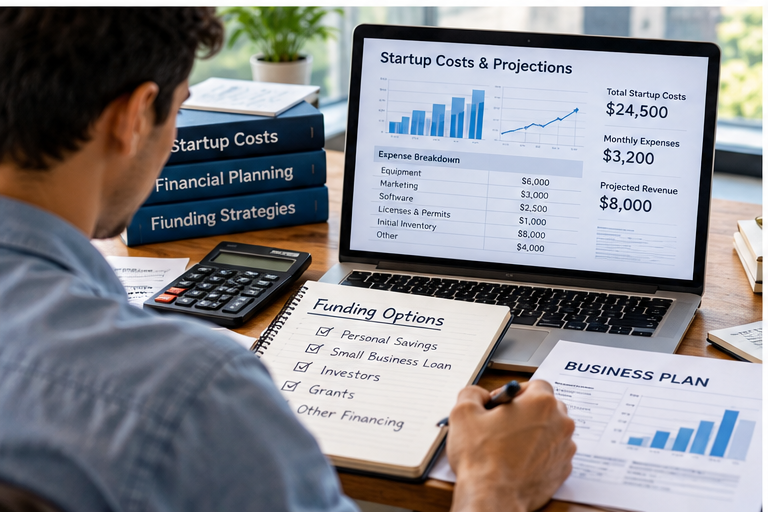
Before launching, determine how much money the business will require.
The SBA recommends calculating startup costs so business owners can estimate funding needs and understand potential financial requirements.
Separate your expenses into two groups.
One-Time Costs
These may include:
- Equipment
- Initial inventory
- Business formation fees
- Website development
- Furniture
- Branding
- Initial professional services
Ongoing Costs
These may include:
- Rent
- Payroll
- Software subscriptions
- Insurance
- Marketing
- Utilities
- Inventory
- Accounting
- Website hosting
Once you list these expenses, estimate how much money you need before revenue becomes dependable.
That calculation can help prevent an avoidable cash shortage during the early months.
7. Choose Your Business Structure
Your business structure affects legal and tax considerations.
In the United States, common structures include sole proprietorships, partnerships, corporations, S corporations, and limited liability companies. The IRS explains that the structure you choose affects tax filing requirements and other legal and tax considerations.
Sole Proprietorship
A sole proprietorship is an unincorporated business owned by one person.
It can be relatively simple to establish, but the owner and business are not separate for liability purposes in the same way as a corporation or LLC.
Partnership
A partnership generally involves two or more owners operating a business together.
Because responsibilities, ownership, and tax treatment can vary, partners should clearly document their arrangement.
Limited Liability Company
An LLC is a business structure created under state law.
It can provide a different legal and tax framework from a sole proprietorship or partnership. However, specific rules vary by state.
Corporation
A corporation is a separate legal entity from its owners.
Corporations can have more formal requirements, so they may make more sense for certain business situations rather than every new venture.
Because structure can affect taxes, liability, ownership, and reporting, consider professional advice when the choice is complicated.
8. Choose a Business Name and Register the Business
A good business name should be easy to remember and appropriate for the market.
Before using one, check whether the name is already being used or protected in the places relevant to your business.
You may also need to register the business depending on its structure, location, and activities.
Requirements can differ by state and local jurisdiction. Therefore, do not assume that a registration process in one location applies everywhere.
Check Your Name Before Building the Brand
Before buying signs, packaging, or large amounts of advertising, check:
- Business-name availability
- Domain availability
- Relevant trademark databases
- Social media availability
- State registration requirements
Taking these steps early can reduce the risk of having to rebuild your brand later.
9. Handle Licenses, Permits, and Tax Requirements
Some businesses need specific licenses or permits before they can operate.
The requirements depend on factors such as:
- Business activity
- Location
- Business structure
- Industry
- State and local rules
For U.S. businesses, the IRS provides a starting checklist that includes selecting a business structure, obtaining an EIN when applicable, choosing a tax year, and understanding business tax obligations. The IRS also notes that state requirements can differ.
Understand Your Tax Responsibilities
Taxes depend on the business structure and activities.
For that reason, avoid relying on a generic online checklist for your specific situation.
Instead, review federal requirements and then check the requirements for your state and local area.
If the rules are complicated, a qualified tax professional can help you understand your obligations.
10. Set Up Business Banking and Recordkeeping
Once the business begins receiving or spending money, organized financial records become important.
Keep track of:
- Sales
- Expenses
- Invoices
- Receipts
- Payroll
- Taxes
- Business assets
- Loans
- Important contracts
A separate business bank account can also make financial management easier and help keep business transactions organized.
The IRS emphasizes recordkeeping as part of managing a business and maintaining appropriate financial documentation.
Keep Business and Personal Spending Organized
Avoid paying business expenses from random personal accounts whenever possible.
Instead, create a simple system for recording business income and expenses.
You can use accounting software, a spreadsheet, or an accountant depending on the size and complexity of the business.
11. Decide How to Fund Your Business
Not every business needs outside funding.
Some entrepreneurs start with personal savings, while others may use loans, investors, or other financing methods.
Your funding decision should match the actual needs of the business.
Before borrowing money or giving away ownership, ask:
- How much money do I actually need?
- What will the money pay for?
- When could the business generate revenue?
- What repayment obligations would exist?
- What risks come with the funding option?
A smaller launch can sometimes reduce the amount of capital required.
For example, a service business may begin from a home office with basic software instead of renting a large commercial space immediately.
12. Build Your Marketing and Sales Plan
A business needs customers, so marketing should not be an afterthought.
Start by identifying where your target customers already spend time.
Depending on the business, that could include:
- Google Search
- Local directories
- Social media
- Industry websites
- Community groups
- Events
- Partnerships
- Referrals
Create a Simple Customer Journey
Think about what happens from the first interaction to the purchase.
For example:
Search → Website → Product page → Contact → Purchase → Follow-up
At each stage, ask whether the customer has enough information to take the next step.
Your website should clearly explain:
- What you offer
- Who it is for
- Why it is useful
- How much it costs, when appropriate
- How customers can contact or buy from you
A simple sales process is often easier to improve than a complicated one.
13. Launch Small and Learn

You do not need every part of the business to be perfect before getting your first customer.
A controlled launch can help you discover problems early.
Start with a manageable version of your offer. Then collect feedback from real customers.
Pay attention to:
- Questions customers repeatedly ask
- Features they value
- Reasons they hesitate
- Complaints
- Refund requests
- Repeat purchases
- Referrals
Use those observations to improve the product, service, pricing, or marketing.
Measure What Matters
Choose a few useful numbers instead of tracking everything.
For example:
- Number of leads
- Conversion rate
- Average order value
- Customer acquisition cost
- Repeat purchase rate
- Monthly revenue
- Monthly expenses
The right metrics depend on the business model.
Common Mistakes to Avoid When Starting a Business
Skipping Market Research
An exciting idea does not automatically create customer demand.
Research the market before committing significant resources.
Underestimating Costs
New owners often focus on the initial purchase price and forget recurring expenses.
Build a realistic monthly expense list before launch.
Mixing Personal and Business Finances
Poor financial organization can make accounting and tax reporting more difficult.
Set up a consistent system from the beginning.
Ignoring Legal Requirements
Licenses, registrations, taxes, and permits can vary by location and industry.
Check the rules that apply to your specific business.
Trying to Serve Everyone
A broad audience can make marketing less effective.
Start with a clearly defined customer group and expand later if the business supports it.
Spending Too Much Before Validating Demand
A polished website or expensive equipment cannot guarantee customers.
Test your offer before making large investments whenever practical.
Frequently Asked Questions
Q1: How much money do I need to start a business?
There is no universal amount. Startup costs depend on the business model, location, equipment, inventory, employees, marketing, licenses, and other expenses.
Create a startup-cost list first. Then estimate your ongoing monthly expenses so you know how much funding the business may require.
Q2: Can I start a business with no money?
Some businesses can begin with very little capital, particularly service-based businesses that do not require inventory or expensive equipment.
However, most businesses still have some costs. These may include software, registration, marketing, transportation, equipment, or professional services.
Q3: What business structure should I choose?
The appropriate structure depends on factors such as ownership, liability, taxes, location, and the nature of the business.
In the United States, common structures include sole proprietorships, partnerships, corporations, S corporations, and LLCs. The IRS recommends considering the legal and tax implications when choosing a structure.
Q4: Do I need an EIN to start a business?
It depends on the business and its circumstances.
The IRS states that an EIN is generally required for businesses with employees and for certain entities and tax situations. Partnerships, corporations, and LLCs generally need an EIN, subject to the applicable rules.
The IRS also provides a free online EIN application for eligible applicants.
Q5: Do I need a business license?
Some businesses do, while others may not.
Licensing and permit requirements can depend on the type of business, location, and activities. Check the requirements for your state and local jurisdiction before operating.
Q6: Should I write a business plan before starting?
A business plan can help you organize your idea, customers, market, costs, revenue model, and strategy.
It does not need to be a huge document. A simple plan can be enough for an early-stage business, while a more detailed plan may be useful when seeking funding or managing a complex operation.
Q7: How do I know if my business idea is good?
Look for evidence rather than relying only on enthusiasm.
Talk with potential customers, research competitors, test your offer, and see whether people are willing to pay.
If customers repeatedly show interest but identify problems with your offer, use that feedback to improve the idea before investing more money.
Final Thoughts
Learning how to start a business is less about completing one giant task and more about making a series of informed decisions.
Start with a real customer problem. Research the market before spending heavily. Then create a simple plan, calculate your costs, choose an appropriate structure, and handle the legal and financial requirements that apply to your business.
After that, launch with a manageable offer and pay attention to customer feedback.
You do not need to build everything at once. A focused first version gives you something real to test, improve, and grow.
The strongest foundation is not simply having a great idea. It is understanding the customer, knowing the numbers, handling the required responsibilities, and being willing to improve as you learn.