
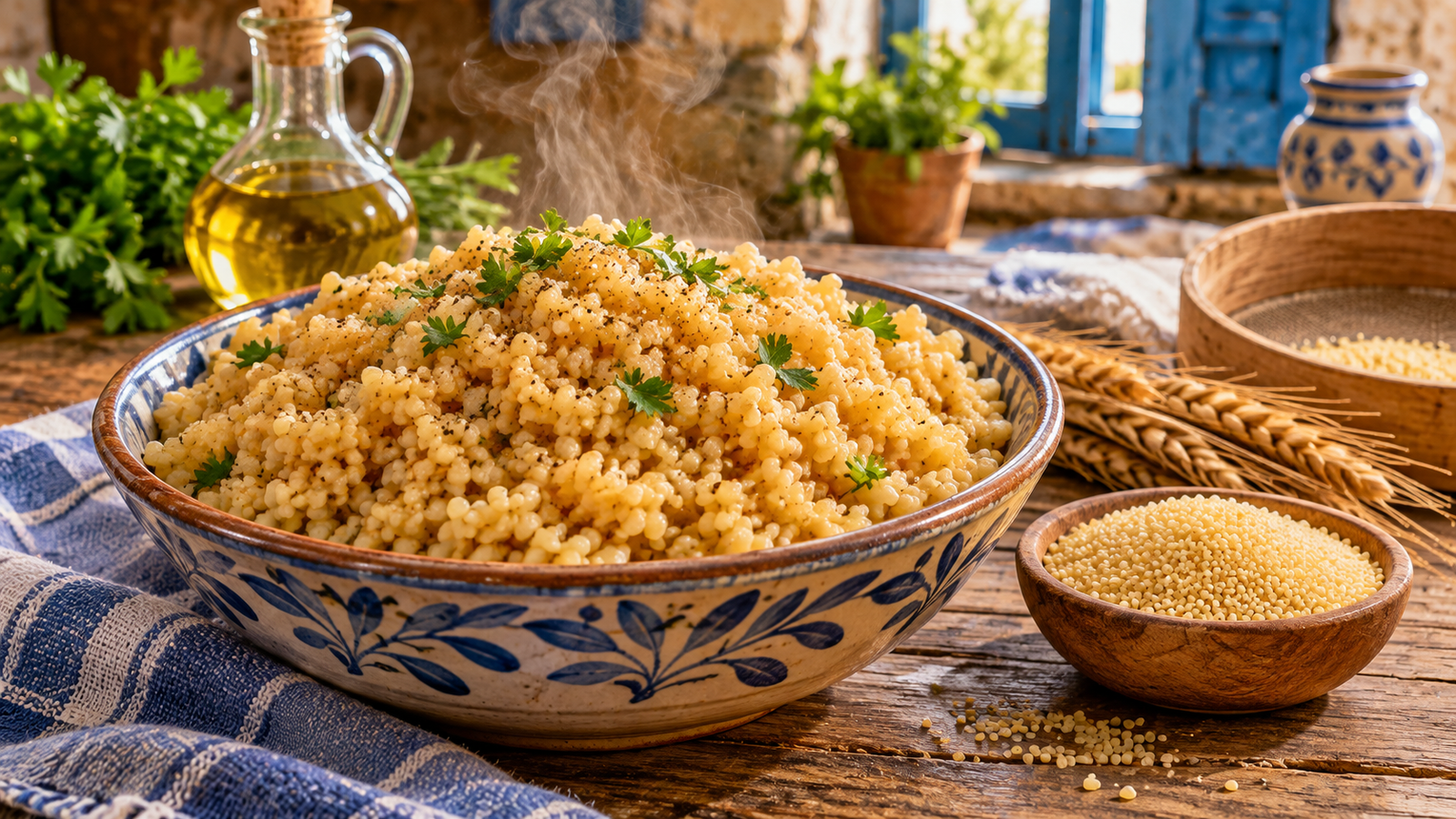
Kouskousi (Greek: κουσκούσι) is a traditional Greek granular pasta associated with Eastern Macedonia and Thrace. It consists of tiny pieces or rounded grains, traditionally made using flour, eggs, milk, salt, and sometimes semolina or bulgur. Although its appearance resembles couscous, Greek kouskousi has its own documented preparation methods and culinary traditions.
The name is unfamiliar to many English-speaking readers, which has led to confusion about its identity. Some descriptions treat it as another name for North African couscous, while others overlook its Greek origins.
Historical Greek food writing provides a clearer picture. Understanding those sources reveals not only what kouskousi is but also how it was traditionally prepared, preserved, and served.
What Exactly Is Kouskousi?
Kouskousi is a type of small-grained pasta made by gradually forming a flour-based mixture into numerous tiny particles.
Unlike spaghetti or other pasta shaped into long strands, traditional kouskousi resembles miniature pellets. Its individual grains can be small and irregular, reflecting the handmade methods historically used to produce them.
The Greek name, κουσκούσι, is transliterated into English as kouskousi. Related forms such as kouskousaki and regional references to kouskous also appear in Greek culinary writing.
These names can create confusion because they resemble the English word couscous. However, similar names do not establish identical ingredients, preparation methods, or culinary histories.
Is Kouskousi Really a Traditional Greek Food?
Yes. Kouskousi is documented in Greek-language culinary sources, including an October 8, 1999 article by Greek food writer Diane Kochilas in the newspaper Ta Nea.
The article, titled Unusual Greek Pasta Dishes, identifies kouskousi among traditional Greek pasta varieties and associates it with Eastern Macedonia and Thrace.
Greek culinary reference Mirsini Cooking also describes its ingredients, granular shaping process, drying practices, and use in savory dishes.
These sources demonstrate that kouskousi is not simply a recently invented internet food name. However, they do not establish an exact date of invention or prove a single geographical birthplace.
The History and Origins of Kouskousi
Kouskousi belongs to Greece’s broader tradition of handmade pasta, in which households turned basic agricultural ingredients into foods that could be stored and cooked later.
Eastern Macedonia and Thrace, regions in northern and northeastern Greece, are particularly associated with the pasta in Greek culinary literature.
Traditionally, making dried pasta was closely connected with seasonal food preparation. Rural households could use locally available grain, milk, and eggs to produce quantities of pasta for future meals.
The resulting food was practical: a dried ingredient that could be added to soup, prepared with meat, or cooked alongside vegetables and seafood.
Kouskousi in Eastern Macedonia and Thrace
Regional identity is one of the clearest features of kouskousi’s documented history.
Diane Kochilas describes it as a specialty of Eastern Macedonia and Thrace. The preparation she records involves combining ingredients, forming miniature grains, and drying them before use.
Accounts of traditional Thracian cuisine also describe comparable small-grained pasta produced through repeated moistening, flouring, and circular rubbing or sieving.
Such methods require patience because the goal is to create numerous small particles rather than one large piece of dough.
This distinguishes the production process from pasta varieties made by rolling sheets and cutting them into strips.
A Tradition of Handmade Greek Pasta
Kouskousi is part of a much larger Greek pasta heritage that includes hilopites, trahanas, flomaria, kritharaki, and other regional specialties.
Greece’s official tourism organization identifies small pasta varieties, including kouskousaki, as part of the country’s traditional food culture.
Historically, homemade pasta helped households preserve ingredients and prepare convenient meals throughout the year.
Kouskousi reflects that tradition, but its granular form and regional production methods give it a distinctive identity.
There is insufficient evidence to assign the pasta a precise ancient origin. Its documented regional tradition is a stronger historical foundation than unsupported claims about who invented it thousands of years ago.
What Is Traditional Kouskousi Made From?
Traditional kouskousi commonly uses a combination of wheat-based ingredients, eggs, milk, and salt.
Greek culinary descriptions mention the following ingredients:
| Ingredient | Traditional role |
|---|---|
| Wheat flour | Provides the pasta’s main structure |
| Semolina | Contributes additional wheat particles and texture in some preparations |
| Bulgur | Appears as an alternative or supporting ingredient in certain documented versions |
| Eggs | Enrich the mixture and help bind ingredients |
| Milk | Adds moisture and contributes to the enriched dough |
| Salt | Seasons the mixture |
Not every traditional preparation uses identical proportions or the same combination of grains.
Some descriptions include semolina, while others mention bulgur. That variation matters because bulgur and semolina are different wheat products.
Semolina is a coarse flour or meal commonly made from durum wheat. Bulgur consists of wheat grains that have been processed, usually including precooking and drying, before cracking.
They cannot automatically be treated as interchangeable in every recipe.
Why Ingredients Matter
Eggs and milk distinguish many traditional Greek kouskousi preparations from conventional North African couscous.
They may also influence flavor, richness, cooking behavior, and allergen content.
However, the exact characteristics of any commercial product depend on its actual ingredient list and manufacturing method.
A modern product sold under a similar name should not be assumed to contain eggs or dairy unless its label confirms them.
Kouskousi vs. Couscous: What’s the Difference?
The difference between Greek kouskousi and North African couscous is one of the most important questions surrounding the name.
Both foods can consist of small wheat-based grains, but their documented culinary traditions are not identical.
| Feature | Greek kouskousi | Traditional North African couscous |
|---|---|---|
| Cultural association | Eastern Macedonia and Thrace, Greece | North African culinary traditions |
| Common ingredients | Flour, eggs, milk, salt, sometimes semolina or bulgur | Semolina and water, with regional variations |
| Traditional production | Mixing, rubbing or sieving into small grains, then drying | Moistening and rolling semolina into granules |
| Traditional cooking | Generally boiled or simmered like pasta | Traditionally steamed, often above a stew |
| Common uses | Soups, meat dishes, seafood, sauces | Vegetable and meat dishes, shared meals |
| Typical texture | Small pasta-like grains | Light, distinct granules when properly steamed |
These differences describe documented traditional methods rather than every modern commercial variation.
Why Are the Names So Similar?
The words share a resemblance, and the foods share a granular appearance.
However, resemblance alone does not prove that Greek kouskousi developed directly from a specific North African recipe or that the two traditions evolved independently.
Establishing that history would require specialized linguistic and culinary research.
For practical cooking purposes, it is more useful to recognize their differences in ingredients and preparation.
What UNESCO Recognizes About Couscous
In 2020, UNESCO added the knowledge and practices associated with producing and consuming couscous to its Representative List of the Intangible Cultural Heritage of Humanity.
The multinational nomination came from Algeria, Mauritania, Morocco, and Tunisia.
The recognition concerns the associated skills, cultural traditions, shared practices, and social importance of couscous.
It does not establish that Greek kouskousi and North African couscous are the same food, nor does it determine the origin of every similarly named grain-based dish.
Readers can consult UNESCO’s official decision for the documented scope of the recognition.
How Is Kouskousi Traditionally Prepared?
Traditional production is more labor-intensive than cooking commercially packaged pasta.
The historical method involves gradually forming many small pieces from a flour-based mixture and drying them for later use.
Traditional Handmade Production
The general process described in Greek culinary accounts involves:
- Preparing a mixture of wheat flour or related grain ingredients, eggs, milk, and salt.
- Working the ingredients into a suitable mixture for shaping.
- Rubbing or moving the mixture through a sieve, or working it by hand, to form tiny grains.
- Repeating the process until the desired granular consistency is achieved.
- Spreading the shaped pasta out for drying before storage.
The resulting particles need not be perfectly uniform.
Their shape reflects the traditional hand-processing technique.
These steps summarize historical production, not a tested home-preservation recipe. Traditional drying methods using raw eggs and milk should not be copied without a validated food-safe procedure.
How to Cook Dried Kouskousi
Once properly dried, kouskousi is generally cooked as a small pasta.
A simple modern cooking approach is:
- Check the package for the manufacturer’s cooking instructions.
- Bring water or suitable broth to a boil, using the amount recommended for the product.
- Add the kouskousi and stir gently to prevent clumping.
- Cook according to the package directions, checking the grains for tenderness.
- Drain if necessary, or continue simmering if preparing a soup or broth-based dish.
- Serve with your preferred sauce, vegetables, or other accompaniments.
There is no single universally verified cooking time for every handmade or commercially produced kouskousi.
Grain size, ingredients, moisture content, and manufacturing methods can change the time required.
For this reason, product instructions are more reliable than an arbitrary cooking time taken from an unrelated couscous recipe.
Cooking Kouskousi in Broth
Kouskousi can also be cooked directly in broth, where its small grains contribute substance to the finished dish.
This method is especially useful when making soup or a moist pasta preparation.
The grains absorb liquid during cooking, so additional broth may be needed to maintain the preferred consistency.
The goal is tenderness without allowing the pasta to become excessively soft.
Traditional Kouskousi Dishes and Serving Ideas
Greek culinary sources document kouskousi as an accompaniment to meat, poultry, seafood, and sauces. It can also be added to soups and stews.
These applications make it more versatile than its unfamiliar name might suggest.
Kouskousi With Mussels and Seafood
One particularly useful historical reference is Diane Kochilas’s 1999 Ta Nea article, which includes a recipe for mussel pilaf with kouskousi.
The dish combines pasta with mussels, squid, tomatoes, garlic, parsley, olive oil, and seasonings.
This is concrete evidence that Greek kouskousi has been used in seafood preparations rather than exclusively as a substitute for ordinary couscous.
The original Greek-language recipe provides further context.
Kouskousi With Meat or Poultry
Kouskousi can accompany slow-cooked meat or poultry dishes, particularly those containing a flavorful sauce.
Its small grains can absorb some of the cooking liquid and distribute the flavors throughout the dish.
Tomato-based preparations are among the serving styles described in Greek culinary references.
A useful home variation is to serve cooked kouskousi beside a vegetable-rich chicken stew, allowing the pasta to absorb some of the sauce.
This is a suggested preparation, not a claim that every Greek household follows the same recipe.
Kouskousi in Soups
The small size of kouskousi makes it suitable for soups.
It can add texture and body without requiring large pasta pieces.
Vegetable broth, chicken soup, and tomato-based soups are possible starting points for modern preparations.
When cooking it directly in soup, monitor the liquid level because the pasta absorbs moisture.
Kouskousi With Vegetables
For a simple meat-free serving idea, combine cooked kouskousi with sautéed vegetables, olive oil, herbs, and lemon.
Possible ingredients include zucchini, tomatoes, onions, and leafy greens.
This is a modern serving suggestion rather than a specifically documented historical dish.
If preparing a vegan meal, choose a product confirmed to contain no eggs or dairy.
Nutritional Information and Dietary Considerations
Kouskousi is generally a wheat-based food, so its nutritional characteristics are broadly comparable to those of other wheat pastas.
However, a precise nutritional profile cannot be assigned without knowing the product’s ingredients, quantities, and serving size.
Traditional recipes containing eggs and milk may differ nutritionally from plain semolina pasta.
Does Kouskousi Contain Gluten?
Traditional wheat-based kouskousi contains gluten.
It is therefore unsuitable for people who must avoid gluten because of celiac disease unless a specifically formulated and verified gluten-free version is used.
Does Kouskousi Contain Eggs or Milk?
Many documented traditional preparations include both eggs and milk.
These ingredients are important allergens for some consumers.
Commercial recipes may vary, so always check the product’s ingredient and allergen declarations.
Is Kouskousi a Healthy Food?
Whether kouskousi fits a balanced diet depends on the ingredients, portion size, preparation, and overall dietary pattern.
It can provide carbohydrates as part of a meal and may be combined with vegetables and protein-containing foods.
Adding butter, cream, cheese, or rich sauces changes the nutritional profile of the finished dish.
It would be misleading to claim that kouskousi is automatically healthier than rice, couscous, or other pasta without comparing specific products and portions.
How to Identify Kouskousi When Shopping
Finding traditional kouskousi outside Greece can be challenging because English spellings and product naming conventions vary.
A practical approach is to check Greek specialty food shops, regional pasta producers, and clearly labeled online listings.
Check the Greek Name
The Greek spelling κουσκούσι is an important identifying clue.
Related product names may include κουσκουσάκι, although similar naming does not always guarantee an identical recipe.
Look at the full product description rather than relying on the name alone.
Compare the Ingredients
Traditional-style products may list wheat flour, semolina, eggs, or milk.
Products consisting only of semolina and water may be closer to conventional couscous, depending on how they are manufactured.
Ingredient lists provide stronger evidence than packaging imagery.
Examine the Cooking Directions
Cooking instructions can help distinguish a small Greek pasta from instant couscous.
Some products require boiling or simmering, while many instant couscous products are prepared by adding hot liquid and allowing the grains to hydrate.
Do not assume that products with similar-looking grains can be cooked identically.
Check Storage and Allergen Information
Confirm the expiry or best-before date, packaging condition, storage requirements, and allergen declarations.
For homemade products, safe drying and storage procedures matter because traditional enriched doughs may contain perishable ingredients.
Frequently Asked Questions About Kouskousi
Q1: Is Kouskousi Greek or North African?
Ans: Kouskousi is documented as a traditional Greek granular pasta associated with Eastern Macedonia and Thrace. North African couscous is a separate, well-established culinary tradition. The names and appearances are similar, but the documented ingredients and preparation methods differ.
Q2: Is Kouskousi the Same as Couscous?
Ans: Not exactly. Traditional Greek kouskousi often contains flour, eggs, and milk, while North African couscous is commonly made from semolina and water. Traditional Greek preparations are generally cooked like pasta, whereas North African couscous is traditionally steamed.
Q3: Is Kouskousi a Type of Pasta?
Ans: Yes. Greek culinary sources classify kouskousi among traditional pasta varieties. Its tiny granular shape makes it look different from familiar pasta such as macaroni or spaghetti.
Q4: Does Kouskousi Contain Gluten?
Ans: Traditional kouskousi contains wheat and therefore gluten. Check product labels for allergen information and avoid assuming that a similar-looking alternative is gluten-free.
Q5: Can You Substitute Couscous for Kouskousi?
Ans: Couscous may serve as a practical substitute in some dishes, but it will not always produce the same texture or flavor. The cooking method and liquid requirements may also differ. Adapt the recipe according to the substitute product’s instructions.
Q6: Can You Make Kouskousi at Home?
Ans: Traditional handmade kouskousi involves forming small grains from a flour-based mixture and drying them. Because many traditional formulas include raw eggs and milk, use a thoroughly tested recipe with verified food-safety instructions rather than improvising a drying and storage method.
Final Thoughts
Kouskousi is a documented part of Greek regional pasta culture, particularly associated with Eastern Macedonia and Thrace.
Its small grains, traditional enriched ingredients, and handmade production techniques distinguish it from many familiar pasta varieties and from traditional North African couscous.
Historical Greek food writing provides useful evidence for understanding its identity, while modern culinary references help explain its preparation and everyday uses.
For readers interested in regional Greek food, kouskousi offers a way to explore the country’s diverse pasta traditions beyond more widely recognized varieties.
The most useful starting point is to recognize the food accurately, understand how its ingredients vary, and follow reliable cooking instructions for the particular product being prepared.