
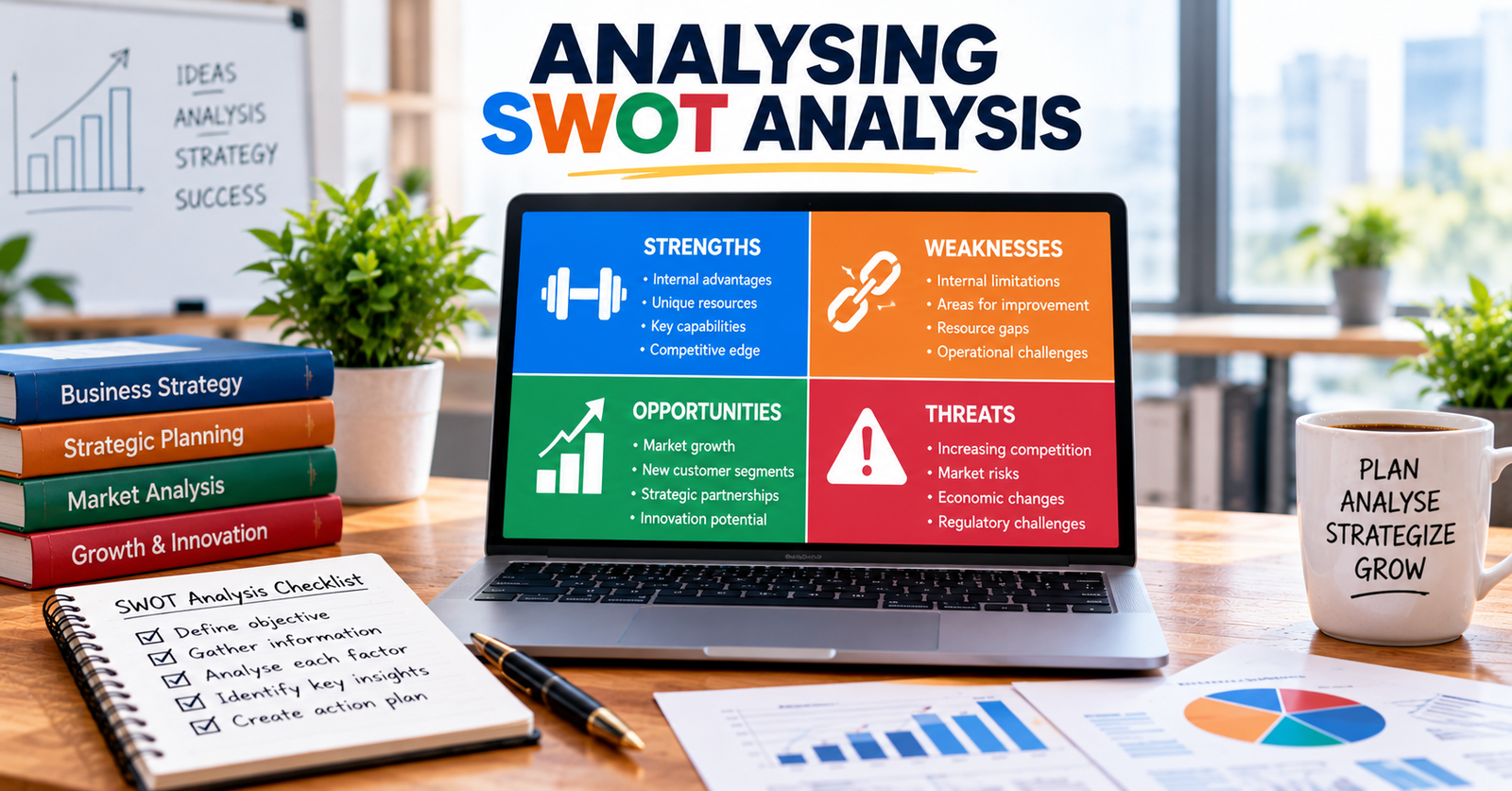
Analysing SWOT analysis helps businesses interpret their strengths, weaknesses, opportunities, and threats to make better strategic decisions. Instead of simply creating a list of factors, companies can examine how these factors relate to one another and determine which actions deserve priority.
Whether you manage a small business, lead a startup, or work in strategic planning, understanding SWOT results can help you identify competitive advantages, address operational problems, and prepare for changes in the market.
In this guide, you will learn how to analyse SWOT findings step by step, explore a practical business example, and turn your conclusions into an actionable plan.
What Does Analysing SWOT Analysis Mean?
SWOT analysis is a strategic planning framework that evaluates four areas: strengths, weaknesses, opportunities, and threats. Analysing the results means examining these factors in context and deciding how they should influence business decisions.
The four elements are divided into two groups:
- Internal factors: Strengths and weaknesses relate to the company’s resources, capabilities, people, and processes.
- External factors: Opportunities and threats come from market conditions, competitors, customer behavior, technology, and other outside influences.
For example, an online retailer may have excellent customer reviews but limited delivery capacity. Growing demand for its products could create an opportunity, while increasing shipping costs could pose a threat.
Simply listing these observations does not complete the analysis. The retailer must determine whether its delivery limitations could prevent it from benefiting from increased demand and decide how to address the problem.
This interpretation is what makes SWOT analysis useful for strategic planning.
Understanding the Four SWOT Elements
Before evaluating the relationships between factors, you need to understand what each element represents.
1. Strengths: Identify Internal Advantages
Strengths are internal characteristics that help a business compete or achieve its objectives.
Examples include:
- A recognizable brand and loyal customers.
- Experienced employees and effective leadership.
- High-quality products or services.
- Efficient operating processes.
- Strong customer relationships.
- Specialized expertise or technology.
When analysing strengths, ask whether each advantage creates measurable value.
For example, a company may describe its customer service as excellent. However, positive customer reviews, repeat purchases, and low complaint rates provide stronger evidence that customer service is a genuine advantage.
Next, consider how the business can use that strength. A company with strong customer loyalty might introduce a referral program or encourage existing customers to try a new product.
2. Weaknesses: Recognize Internal Limitations
Weaknesses are internal factors that prevent a business from operating effectively or achieving its goals.
Common examples include:
- Limited marketing resources.
- Outdated technology.
- Insufficient employee training.
- Slow customer support.
- Inefficient inventory management.
- Dependence on a small number of customers or suppliers.
When evaluating weaknesses, distinguish between minor inconveniences and problems that create significant business risks.
For example, an outdated inventory system might cause stock shortages, delayed deliveries, and dissatisfied customers. The problem could affect several areas of the business, making it a higher priority than a minor administrative inconvenience.
Consider the root cause of each weakness. If sales are declining, the issue might involve product quality, pricing, marketing, customer service, or changing customer preferences.
Understanding the cause helps you choose a more effective solution.
3. Opportunities: Evaluate External Possibilities
Opportunities are external developments that may help a business grow or improve its position.
Examples include:
- Increasing demand for a product category.
- Emerging customer segments.
- New technology that improves efficiency.
- Potential partnerships.
- Expansion into new geographic markets.
- Changes in customer preferences.
However, an opportunity is not automatically a profitable business decision.
When analysing opportunities, examine market demand, potential costs, available resources, and competitive conditions.
For example, a retailer might identify growing interest in environmentally friendly products. Before expanding its product range, it should investigate customer willingness to pay, supplier reliability, and expected profit margins.
The best opportunities are those that fit the company’s capabilities and offer a realistic path toward its objectives.
4. Threats: Assess External Risks
Threats are external developments that could harm a company’s performance, profitability, or stability.
Examples include:
- Increasing competition.
- Rising operating costs.
- Economic uncertainty.
- Changes in regulations.
- New technologies that disrupt existing products.
- Shifts in customer demand.
Analysing threats requires more than identifying possible problems. Businesses should consider both the likelihood of each threat and the potential consequences.
For instance, a company that depends on one supplier may face serious disruption if that supplier experiences production problems.
The business could respond by identifying alternative suppliers, negotiating clearer delivery terms, or maintaining appropriate inventory reserves.
Although businesses cannot control every external threat, they can often reduce their exposure through preparation.
How to Analyse a SWOT Analysis Step by Step
A structured process helps turn SWOT findings into useful business insights.
Step 1: Define the Business Objective
Start by identifying the specific decision or challenge you want to evaluate.
Your objective might involve launching a new product, improving profitability, entering a new market, or increasing customer retention.
A clear objective keeps the analysis focused. Without one, a SWOT exercise may produce a long list of observations that do not help answer an important business question.
For example, a startup considering expansion into another city should focus on customer demand, available resources, competition, operating costs, and local market conditions.
Step 2: Collect Reliable Information
Gather evidence about the business and its environment before drawing conclusions.
Useful sources may include:
- Sales and financial reports.
- Customer feedback and satisfaction data.
- Employee surveys and performance information.
- Competitor research.
- Industry reports.
- Relevant market and regulatory updates.
Separate verified facts from assumptions.
For example, the statement “customers prefer our product” should be supported by evidence such as customer surveys, repeat purchases, or sales data.
Reliable information makes the analysis more accurate and helps prevent decisions based on personal opinions alone.
Step 3: Separate Internal and External Factors
Review each item to determine whether it belongs in the correct SWOT category.
Strengths and weaknesses are generally internal. Opportunities and threats are generally external.
Consider a business experiencing low sales. Low sales may be an internal performance problem, but the underlying cause could be external, such as declining market demand.
Understanding this distinction helps identify which issues the business can address directly and which require adaptation.
Step 4: Evaluate Impact and Importance
Not every SWOT factor deserves equal attention.
Assess each finding according to its potential impact on your objective, urgency, and likelihood where relevant.
For example, a major cash flow problem may require immediate action because it threatens the company’s ability to operate. A possible expansion opportunity may be worth investigating but may not require an immediate investment.
You can use a simple scoring system to rank factors by importance. However, scores should support judgment rather than replace it.
Step 5: Identify Connections Between Factors
This is one of the most important stages of SWOT analysis.
Look for relationships between internal capabilities and external conditions.
Ask questions such as:
- Can an existing strength help the business pursue an opportunity?
- Does a weakness make a particular threat more dangerous?
- Could addressing a weakness unlock a new opportunity?
- Can an existing strength reduce the impact of an external risk?
For example, a business with a loyal customer base may be well positioned to introduce a complementary product. However, if it lacks sufficient delivery capacity, it may need to improve operations before launching.
Identifying these connections helps transform separate observations into strategic insights.
Step 6: Turn Findings Into an Action Plan
Finally, choose the actions that best support your objective.
Each action should have a clear purpose, an assigned owner, a deadline, and an appropriate measure of success.
For example, if slow delivery is a major weakness, the business might review its fulfillment process, compare alternative suppliers, and track delivery times over the following three months.
An action plan should be realistic about available resources and should be reviewed as new information becomes available.
SWOT Analysis Example for a Small Business
Consider a fictional online store that sells reusable water bottles and related accessories. The owner wants to increase sales without significantly increasing operating costs.
The following table shows how the business might organize its findings.
| Strengths | Weaknesses |
|---|---|
| Positive customer reviews | Limited marketing budget |
| Strong repeat-purchase rate | Small product selection |
| Responsive customer service | Dependence on a few suppliers |
| Easy-to-use website | Limited brand awareness |
| Opportunities | Threats |
|---|---|
| Growing interest in reusable products | New competitors entering the market |
| Partnerships with relevant creators | Rising shipping costs |
| Expansion into complementary products | Competitors offering discounts |
| Customer referral campaigns | Changes in advertising costs |
How to Interpret the Findings
The retailer should not treat every item as an independent task. Instead, it should identify the most important relationships.
Strengths and opportunities: Positive customer reviews and repeat purchases could support a referral campaign. Satisfied customers may help the business reach new buyers without relying entirely on paid advertising.
Weaknesses and opportunities: Limited brand awareness could make partnerships with relevant creators worth testing. However, the retailer should measure referral traffic and sales before investing heavily.
Strengths and threats: Responsive customer service may help the retailer differentiate itself from competitors, especially when customers need product guidance or assistance.
Weaknesses and threats: Dependence on a few suppliers becomes more serious when shipping costs rise or deliveries are delayed. Identifying alternative suppliers could reduce this risk.
Based on these findings, the owner might prioritize supplier diversification and a small referral campaign.
The retailer should then compare the cost and results of these actions to determine whether they improve profitability and customer growth.
Questions to Ask When Analysing SWOT Results
The quality of your analysis depends partly on the questions you ask.
Which Strengths Provide a Real Competitive Advantage?
Identify the capabilities that customers value and competitors may find difficult to reproduce.
A strength is more useful when it contributes directly to your business objective rather than simply describing something the company does adequately.
Which Weaknesses Require Urgent Attention?
Look for weaknesses that create financial pressure, reduce customer satisfaction, or prevent the business from pursuing valuable opportunities.
Prioritize issues based on their consequences and the resources required to address them.
Which Opportunities Are Realistic?
Evaluate whether an opportunity has sufficient market demand and fits the company’s resources.
An attractive market trend may still be unsuitable if entering that market requires more investment or expertise than the business can reasonably provide.
Which Threats Could Have the Greatest Impact?
Consider the likelihood and potential consequences of external risks.
Businesses should pay particular attention to threats that could interrupt operations, damage customer trust, or weaken financial stability.
What Evidence Would Change Your Conclusion?
Good analysis remains open to new information.
If a finding relies on an assumption, identify what evidence could confirm or challenge it. This approach reduces the risk of allowing personal preferences to influence strategic decisions.
Common Mistakes When Analysing SWOT Analysis
Several mistakes can reduce the usefulness of SWOT findings.
Relying on Unsupported Assumptions
Statements such as “our product is the best” or “competitors are losing customers” are not reliable conclusions without evidence.
Use customer research, financial information, and relevant market data to evaluate these claims.
Confusing Internal and External Factors
A shortage of trained employees is generally an internal weakness. A sudden change in industry demand is an external development.
Classifying factors correctly helps businesses distinguish between issues they can address directly and conditions they must adapt to.
Ignoring Competitors
A business may believe it has a strong product without understanding how competitors compare.
Review competing products, pricing, service quality, customer feedback, and market positioning before deciding that a particular capability provides a genuine advantage.
Failing to Prioritize Findings
A long list of SWOT factors can create confusion if every item receives equal attention.
Focus on the factors most likely to influence the objective. A small number of well-supported priorities can be more useful than dozens of vague observations.
Treating Opportunities as Guaranteed Results
Market trends do not guarantee sales or profits.
Businesses should test assumptions, estimate costs, and evaluate risks before committing substantial resources to a new opportunity.
Not Taking Action
SWOT analysis has limited value when its findings are never used.
Connect important findings to decisions, assign responsibilities, and monitor progress. Review the analysis when significant changes occur in the business or market.
How to Turn SWOT Findings Into Strategy
After evaluating the results, businesses can develop strategies by combining different SWOT elements.
Use Strengths to Pursue Opportunities
Identify capabilities that can help the company benefit from favorable external conditions.
For example, a business with strong customer relationships could introduce a referral program to reach new customers.
Address Weaknesses That Limit Growth
Determine which internal limitations prevent the business from achieving its goals.
If demand is increasing but delivery capacity is insufficient, improving fulfillment may be more important than increasing advertising.
Use Strengths to Reduce Threats
Consider how existing capabilities could help protect the business from external risks.
A company with strong supplier relationships might negotiate more flexible arrangements to reduce the impact of supply disruptions.
Reduce Weaknesses That Increase Risk
Some weaknesses make external threats more damaging.
For example, a business with limited cash reserves may be particularly vulnerable to rising operating costs. Improving cash flow management and reviewing expenses could help reduce this exposure.
Set Measurable Goals
Translate your chosen strategies into specific objectives.
Instead of writing “improve customer retention,” establish a measurable target, a deadline, and a method for tracking progress.
For example, a business might aim to increase repeat purchases by 10% within six months, using its current performance as a baseline.
The target should be realistic and supported by relevant data. Review the results regularly and adjust the strategy when necessary.
Frequently Asked Questions
Q1: Why Is Analysing SWOT Results Important?
Ans: Analysing SWOT results helps businesses identify which factors matter most, understand the relationships between internal capabilities and external conditions, and make informed decisions. It also helps prioritize actions rather than simply collecting observations.
Q2: What Is the Difference Between SWOT Analysis and SWOT Interpretation?
Ans: SWOT analysis is the overall process of identifying strengths, weaknesses, opportunities, and threats. SWOT interpretation involves examining those findings, assessing their importance, and determining what they mean for business strategy.
Q3: How Often Should a Business Review Its SWOT Analysis?
Ans: Businesses can review SWOT analysis during annual planning, before major investments, when launching products, or whenever significant market changes occur.
The appropriate frequency depends on the industry and the speed at which business conditions change.
Q4: Can Small Businesses Use SWOT Analysis?
Ans: Yes. Small businesses can use SWOT analysis to understand their resources, identify customer needs, evaluate competition, and plan growth. The framework can be adapted to businesses of different sizes and industries.
Q5: Is SWOT Analysis Enough to Create a Business Strategy?
Ans: No. SWOT analysis is a useful starting point, but it should be supported by financial forecasting, market research, competitor analysis, and operational planning. Businesses need additional evidence to evaluate whether a proposed strategy is practical and financially sound.
Final Thoughts
Analysing SWOT analysis helps businesses move beyond listing strengths, weaknesses, opportunities, and threats. By evaluating evidence, prioritizing important factors, and identifying relationships between them, organizations can develop strategies that better reflect their capabilities and market conditions.
The most effective approach combines honest evaluation with practical action. Focus on the factors that matter most, investigate assumptions, and create measurable plans to address the findings.
Whether you manage a small business or lead a growing organization, reviewing SWOT results can help clarify priorities and support better decisions. Revisit the analysis as your business evolves so your strategy remains relevant and useful.