
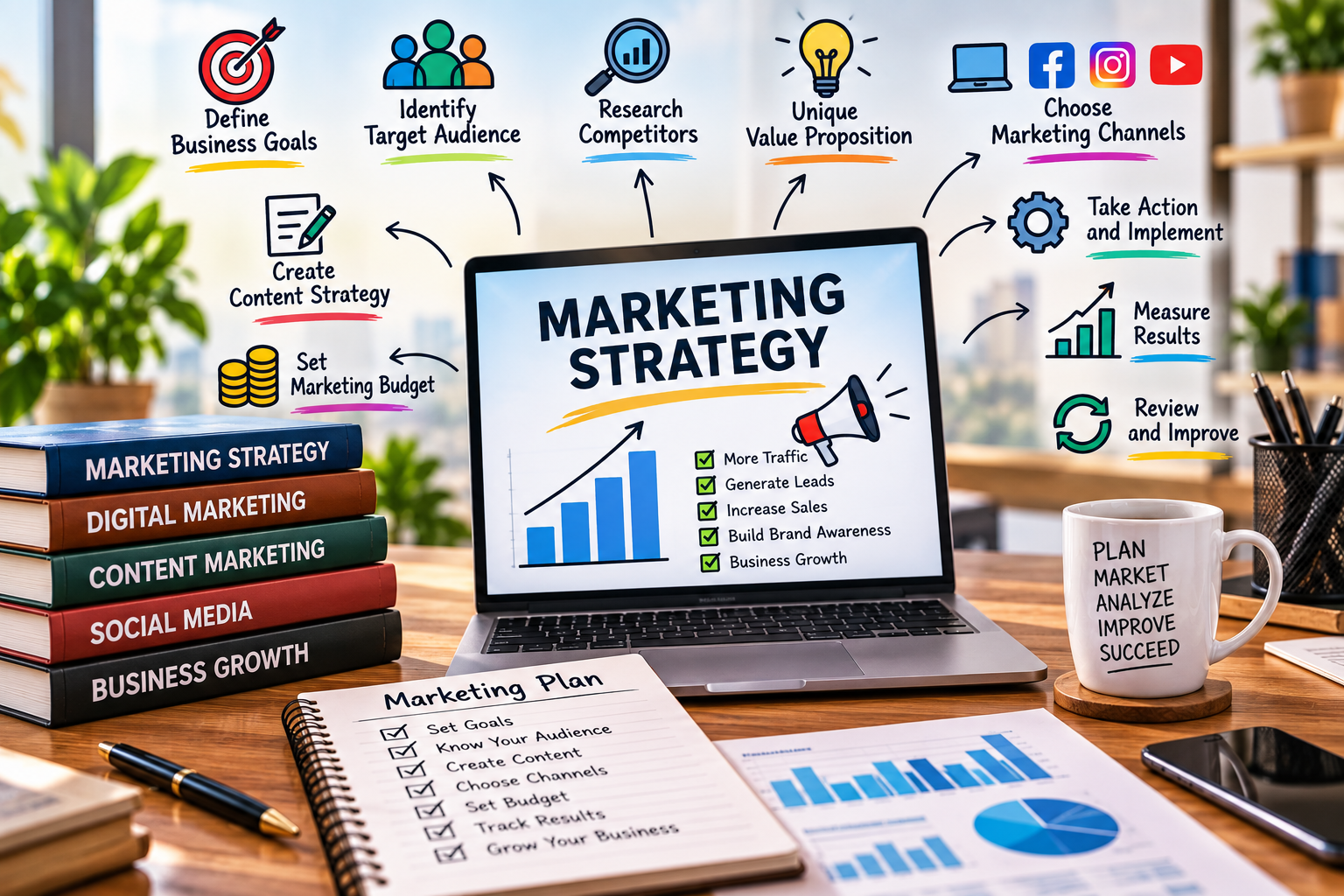
A business can have a great product or service and still struggle to attract customers. One common reason is a lack of direction in its marketing efforts.
A marketing strategy gives your business a clear path. Instead of posting content, running advertisements, or sending emails without a specific purpose, you can connect each activity to a business goal.
The U.S. Small Business Administration recommends defining areas such as your target market, competitive advantage, sales goals, and marketing action plan when developing a marketing plan.
The good news is that a marketing strategy does not have to be complicated. Small businesses can start with a simple plan and improve it as they collect customer feedback and performance data.
This guide explains how to create a practical marketing strategy step by step.
What Is a Marketing Strategy?
A marketing strategy is a plan that explains how a business will reach its target customers, communicate its value, and support its business goals.
It helps answer important questions:
- Who are you trying to reach?
- What problem does your business solve?
- Why should customers choose you?
- Which marketing channels will you use?
- What results do you want?
- How will you measure performance?
A strategy is different from a tactic. For example, social media posting is a tactic, while deciding that social media will be used to reach a specific customer group and generate leads is part of a broader strategy.
Your strategy should also evolve as your business, customers, and market change.
Why Does Your Business Need a Marketing Strategy?
Without a clear plan, marketing can become a collection of disconnected activities. You may spend time and money without knowing whether those efforts are supporting your goals.
A structured strategy can help you:
- Focus on the right customers
- Set measurable objectives
- Choose suitable marketing channels
- Organize your content
- Control marketing expenses
- Track performance
- Improve your campaigns over time
It also creates a useful connection between your overall business plan and your marketing activities.
Learn more about writing a business plan
1. Define Your Business Goals
Start by deciding what you want your marketing efforts to accomplish.
Your goal might be to generate more leads, increase sales, attract website visitors, introduce a new product, or build awareness of your brand.
Avoid vague goals such as “get more customers.” Instead, make the goal specific enough to track.
Set Specific Marketing Goals
| Goal | Example Target |
|---|---|
| Website Traffic | Increase qualified visitors |
| Leads | Generate 100 leads per month |
| Sales | Increase monthly sales |
| Brand Awareness | Reach more potential customers |
These numbers are examples. Your actual targets should reflect your business size, resources, industry, and current performance.
Clear goals make it easier to decide which marketing activities deserve your attention.
2. Identify Your Target Audience
Trying to market to everyone can make your message too general.
Instead, identify the people most likely to need and value your product or service.
Consider factors such as:
- Age
- Location
- Occupation
- Income or budget
- Interests
- Business size
- Buying behavior
- Common problems
- Preferred communication channels
For example, a company selling accounting software to small businesses may focus on business owners who want simpler financial management rather than targeting every internet user.
Create a Simple Customer Profile
Write down:
Customer type: Small business owner
Main problem: Spending too much time managing finances
Desired outcome: Easier financial management
Buying concern: Price and ease of use
Preferred channels: Search engines, business websites, email, and professional networks
This simple profile can guide your messaging and content decisions.
3. Research Your Competitors
Competitor research helps you understand what customers already see in the market.
Look at businesses offering similar products or services. Study their:
- Websites
- Products and services
- Pricing
- Content
- Social media activity
- Customer reviews
- Promotional messages
- Search visibility
The goal is not to copy competitors. Instead, look for opportunities to communicate your value more clearly or serve an overlooked customer need.
Market research can also help businesses understand customers and identify competitive opportunities.
4. Define Your Unique Value Proposition
Your value proposition explains why customers should consider your business.
It should communicate a clear benefit instead of simply listing features.
For example:
“We help small businesses create professional websites without complicated technical processes.”
This statement identifies the audience, the problem, and the benefit.
A strong value proposition should be easy to understand. Customers should quickly know what you offer and how it can help them.
5. Choose the Right Marketing Channels
You do not need to use every marketing channel.
Choose channels based on where your target customers spend time and how they prefer to discover information.
Common options include:
- Website and SEO
- Social media
- Email marketing
- Content marketing
- Paid advertising
- Partnerships
- Referral marketing
- Events and networking
For example, a B2B company may focus heavily on search, email, professional networks, and industry partnerships. A consumer brand may rely more on social media, content, email, and paid advertising.
The right combination depends on your audience and business model.
6. Create Your Content Strategy
Content can help attract potential customers, answer questions, explain your products, and build trust.
Start by identifying the questions your target audience asks before making a purchase.
Useful content formats include:
- Blog posts
- Guides
- Case studies
- Videos
- Social media posts
- Email newsletters
- Product demonstrations
- Frequently asked questions
Create a Simple Content Plan
| Content Type | Purpose |
|---|---|
| Blog Posts | Attract organic traffic |
| Social Posts | Build awareness |
| Case Studies | Build trust |
| Email Content | Maintain relationships |
| Videos | Explain products or services |
Every piece of content should have a purpose. Before publishing something, ask yourself what you want the reader to understand or do next.
7. Set Your Marketing Budget
A marketing strategy should account for available resources.
Your budget may include expenses for:
- Advertising
- Website development
- Content creation
- Design
- Marketing software
- Email platforms
- Events
- Professional services
Start with activities that directly support your most important goals. Track what you spend and compare it with the results you receive.
A smaller business does not necessarily need a large marketing budget. Consistency, clear targeting, and careful measurement can help you use available resources more effectively.
8. Create a Marketing Action Plan
A strategy explains the direction. An action plan turns that direction into specific activities.
For each activity, decide:
- What will you do?
- Who will be responsible?
- Which channel will you use?
- How often will you do it?
- What result are you expecting?
- When will you review the results?
Example Marketing Action Plan
| Activity | Channel | Frequency | Goal |
|---|---|---|---|
| Blog Content | Website | Weekly | Organic Traffic |
| Social Posts | Social Media | 3x Weekly | Awareness |
| Email Marketing | Weekly | Customer Engagement | |
| Promotional Campaign | Paid/Organic | Monthly | Sales |
You can adjust this schedule based on your team, budget, and available time.
9. Measure Your Marketing Results
Marketing decisions become easier when you know what is happening.
Depending on your goals, useful metrics may include:
- Website traffic
- Leads
- Conversion rate
- Sales
- Customer acquisition cost
- Email engagement
- Social engagement
- Return on marketing investment
For example, if your goal is lead generation, tracking website visitors alone may not tell you enough. You should also look at how many visitors become leads.
Similarly, if your goal is sales, focus on metrics connected to purchases and revenue.
Choose a small group of meaningful metrics instead of trying to track everything.
10. Review and Improve Your Strategy
A marketing strategy should not remain unchanged forever.
Review your performance regularly and ask:
- Which activities are producing useful results?
- Which channels are attracting the right audience?
- Which content receives the most attention?
- Where are potential customers leaving?
- Are marketing expenses producing reasonable results?
- Have customer needs changed?
Use these observations to make adjustments.
You may discover that one channel works better than another. A particular type of content might generate more qualified leads. Customer feedback may also reveal that your messaging needs to be clearer.
Testing and improving your approach can make the strategy more useful over time.
Common Marketing Strategy Mistakes
Even a simple marketing plan can become ineffective when basic mistakes are repeated.
Trying Every Marketing Channel
Using every platform can spread your resources too thin. Start with channels that make sense for your audience.
Not Defining the Target Audience
A generic message may fail to connect with the people most likely to become customers.
Setting Vague Goals
“Get more attention” is difficult to measure. Define a result that you can track.
Ignoring Competitors
Understanding the market can help you identify opportunities and avoid repeating common mistakes.
Creating Content Without a Purpose
Every content activity should support a broader business or marketing objective.
Spending Without Tracking Results
A marketing budget should be connected to measurable outcomes whenever practical.
Not Reviewing Performance
Markets, customers, and competitors change. Your strategy should be reviewed and adjusted accordingly.
Marketing Strategy Checklist
Use this checklist when creating your own strategy:
☐ Define business goals
☐ Identify target customers
☐ Research competitors
☐ Define your value proposition
☐ Choose marketing channels
☐ Create a content plan
☐ Set a marketing budget
☐ Create an action plan
☐ Track results
☐ Review and improve the strategy
Important Advertising Consideration
If your strategy includes advertising, make sure your marketing claims are accurate and supported.
The Federal Trade Commission states that advertising claims must be truthful, not deceptive or unfair, and supported by appropriate evidence. These principles can apply to online advertising as well as other forms of marketing.
Businesses should therefore review promotional claims carefully before publishing them.
Advertising and marketing guidance for businesses
FAQs
Q1: What is a marketing strategy?
Ans: A marketing strategy is a plan for reaching target customers, communicating a business’s value, and supporting specific business goals.
Q2: How do I create a marketing strategy for a small business?
Ans: Define your goals, identify your target audience, research competitors, choose suitable marketing channels, set a budget, create an action plan, and measure the results.
Q3: What are the most important marketing channels?
Ans: The right channels depend on your target audience and business model. Common options include SEO, websites, social media, email marketing, content marketing, advertising, partnerships, and referrals.
Q4: How much should a small business spend on marketing?
Ans: There is no single budget that works for every business. Consider your available resources, goals, industry, customer acquisition costs, and expected return when setting a budget.
Q5: How do I measure marketing success?
Ans: Choose metrics that match your goals. Depending on the objective, these may include qualified traffic, leads, conversion rates, sales, customer acquisition cost, and marketing return.
Final Thoughts
A good marketing strategy gives your business a clear direction instead of leaving marketing activities to chance.
Start by understanding your customers and defining what you want to achieve. Then choose a few appropriate channels, create useful content, establish a realistic budget, and track meaningful results.
You do not need to build a complicated strategy on day one. Start with a practical plan, learn from your results, and improve it as your business grows.