
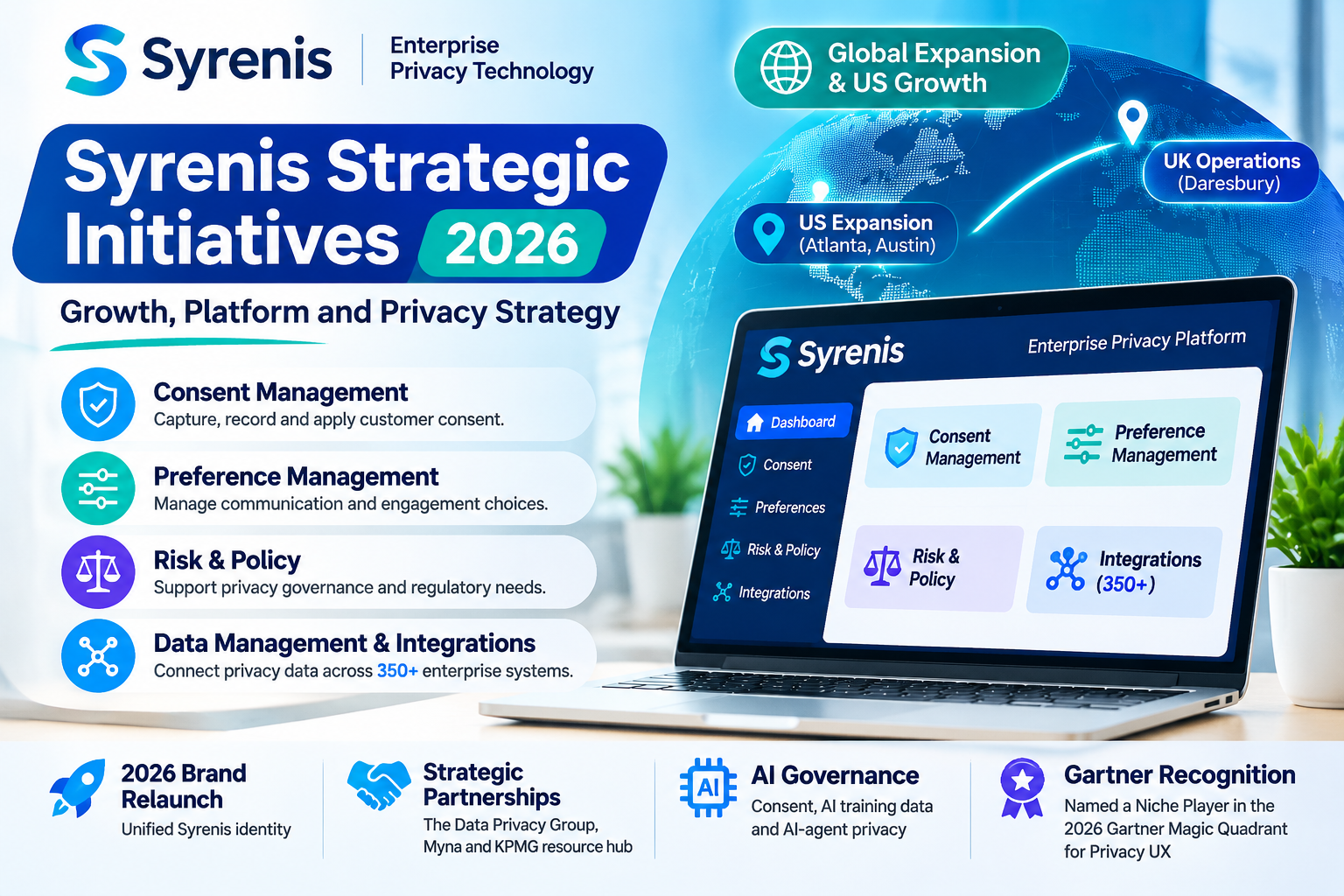
Syrenis strategic initiatives reflect the company’s evolving position in enterprise consent management, customer preference management, and privacy technology. In 2026, the company made several notable developments, including a unified brand relaunch, expansion into North America, continued investment in enterprise privacy capabilities, and greater attention to AI-related data governance.
These developments indicate a broader business direction: helping large organizations manage customer consent and preferences across multiple brands, jurisdictions, digital channels, and enterprise systems.
Rather than treating privacy as an isolated compliance task, Syrenis positions it as an important part of customer experience, data governance, and sustainable business growth.
This guide explores Syrenis’s major business developments, platform capabilities, international expansion, partnerships, leadership, and future opportunities using publicly available company information.
What Is Syrenis?
Syrenis is an enterprise privacy technology company specializing in consent and preference management. Its platform is designed to help organizations capture customer privacy choices, maintain consistent records, and apply those choices across connected business systems.
The company focuses on enterprises operating in complex regulatory and technology environments. These organizations may manage multiple websites, brands, customer identities, marketing platforms, and regional privacy requirements.
For example, an international company might collect customer consent through its website, mobile application, and marketing campaigns. If those systems operate independently, maintaining accurate and consistent consent records can become difficult.
Syrenis aims to address this challenge by providing a connected platform for consent management, preference management, privacy governance, and enterprise integrations.
Its publicly described industry applications include:
- Healthcare and pharmaceuticals.
- Life sciences.
- Financial services.
- Automotive.
- Energy and utilities.
- Retail and eCommerce.
- Media and publishing.
- Legal technology.
The company’s broader mission is to help privacy teams gain better control and visibility over data-related decisions while supporting more consistent customer experiences.
Official website: https://syrenis.com/
What Are Syrenis Strategic Initiatives?
Syrenis Strategic Initiatives is a search phrase used to describe the company’s business priorities, technology development, and growth direction. It is not the name of a separately documented product or an officially published list of company initiatives.
The company’s publicly announced developments provide a useful way to understand its strategic direction.
These developments can be grouped into several connected areas:
- Enterprise platform repositioning and brand development.
- International expansion and North American growth.
- Consent and preference management technology.
- Enterprise integrations and data governance.
- Strategic partnerships and implementation capabilities.
- Privacy UX and AI-related governance.
- Leadership and customer-driven product development.
Together, these areas show how Syrenis is positioning its technology for organizations with increasingly complex privacy and data management requirements.
Syrenis’s 2026 Brand Relaunch and Enterprise Repositioning
One of Syrenis’s most important developments occurred on April 21, 2026, when the company announced a major brand relaunch.
The announcement explained that Syrenis was retiring its legacy product names and bringing its identity together under the unified Syrenis brand.
This development reflected the company’s intention to present its technology as a broader enterprise privacy platform rather than as a collection of separately branded products.
Why Did Syrenis Retire Its Legacy Product Names?
As enterprise organizations grow, their privacy requirements often extend beyond basic website cookie consent.
They may need to manage customer choices across:
- Multiple brands and business units.
- Different countries and regulatory environments.
- Websites and mobile applications.
- Customer relationship management systems.
- Marketing automation platforms.
- Internal data and reporting systems.
A unified brand can make it easier to communicate how different privacy capabilities work together.
Syrenis described its refreshed identity as a reflection of the platform’s development and the complexity of the enterprise customers it serves.
From Cassie Branding to the Unified Syrenis Platform
Older articles frequently discuss Cassie as the company’s current standalone platform identity.
However, the April 2026 announcement changed that positioning. Syrenis stated that it was retiring its legacy product names and consolidating under the unified Syrenis brand.
Therefore, Cassie is best discussed in historical context rather than presented as the current independent brand identity.
For businesses researching the company, this distinction is important when comparing older documentation with current platform information.
What Does the Repositioning Mean for Enterprise Customers?
The brand relaunch communicates a stronger focus on enterprise requirements, including:
- Complex privacy operations.
- Multi-brand environments.
- Multiple regulatory jurisdictions.
- Centralized consent management.
- Connected enterprise systems.
- Scalable data governance.
It also provides a clearer commercial identity for Syrenis as it develops its presence in international enterprise markets.
Syrenis’s Four Major Platform Priorities
Syrenis’s publicly presented platform capabilities can be understood through four connected areas. This is an editorial way of organizing its published capabilities, rather than a claim that the company has formally announced a four-part strategic framework.
1. Consent Management
Consent management is central to the Syrenis platform.
Organizations need reliable ways to capture, record, update, and apply customer privacy choices. This becomes particularly important when information moves between different digital properties and business systems.
Syrenis describes capabilities including:
- Cookie and tracking consent management.
- Cross-domain consent.
- Identity-based consent.
- Web and mobile consent capture.
- Server-side consent capture.
- Consent record management.
- Audit trails.
- Integration with downstream systems.
Cross-domain consent is particularly relevant for businesses operating multiple websites.
For example, a customer might provide a privacy choice on one company website and later visit another digital property belonging to the same organization. A connected consent system can help the organization recognize and apply the relevant choice across those environments.
This approach can reduce inconsistent privacy experiences and improve the visibility of customer decisions.
2. Customer Preference Management
Consent and preferences are related, but they are not identical.
Consent generally concerns permission or other applicable legal grounds for particular data processing activities. Preferences allow customers to express how they want to interact with a business.
For example, a customer might:
- Prefer email communication over SMS.
- Choose particular newsletter categories.
- Reduce marketing communication frequency.
- Select preferred communication channels.
- Update interests and engagement choices.
Syrenis describes preference centers, customer service portals, granular preference controls, and synchronization with customer relationship management systems.
These capabilities can help businesses maintain more consistent communication choices across their customer-facing systems.
3. Risk and Policy Management
Enterprise privacy operations involve more than collecting consent.
Organizations also need visibility into potential risks, internal responsibilities, regulatory requirements, and customer privacy requests.
Syrenis presents capabilities related to:
- Privacy risk visibility.
- Policy management.
- Regulatory mapping.
- Issue management.
- Data subject rights requests.
- Privacy notices.
- Audit documentation.
- Operational reporting.
For large businesses, these capabilities can help connect privacy policies with everyday business processes.
However, using a privacy platform does not automatically make an organization legally compliant. Businesses still need appropriate policies, legal assessments, internal controls, and accountable personnel.
4. Data Management and Enterprise Integrations
Consent and preference information is useful only when the relevant business systems can access and apply it correctly.
Syrenis emphasizes integration with existing enterprise technology.
Its platform information references APIs, connectors, data exports, bulk data loading, and synchronization.
This matters because customer information may be distributed across CRM, marketing, analytics, service, and other business applications.
A connected approach can help reduce conflicting records and make customer privacy choices more consistently available.
How the Syrenis Platform Works
Syrenis describes its platform workflow through five connected activities: Collect, Understand, Manage, Synchronize, and Govern.
These stages provide a useful way to understand how the technology supports enterprise privacy operations.
Step 1: Collect Customer Privacy Decisions
The first stage involves capturing customer consent and preference information.
Customers may interact with an organization through websites, applications, forms, and other digital channels.
The platform is designed to help record relevant privacy decisions from these interactions.
Step 2: Understand Privacy Activity Across Systems
After capturing customer choices, organizations need a clear view of how privacy information is distributed.
Syrenis describes creating a broader view of privacy activity across systems and channels.
This can help privacy and marketing teams understand where information is stored and how customer choices are represented.
Step 3: Manage Privacy Governance
The next stage involves applying privacy policies and governance rules consistently.
Large organizations may operate across different jurisdictions, business units, and brands.
A centralized approach can help teams maintain visibility over the rules governing customer information.
Step 4: Synchronize Customer Choices
Synchronization is important because an updated customer preference must reach the systems that use the relevant information.
For example, if someone withdraws marketing consent, the organization needs its relevant marketing and customer systems to reflect that change.
Syrenis describes real-time synchronization as part of its platform approach.
The actual implementation and timing depend on the connected systems and configuration.
Step 5: Govern Privacy Operations
The final stage involves maintaining visibility, accountability, and oversight.
Organizations need records showing how customer choices were captured, changed, and applied.
This information can support internal governance, operational reporting, and audit preparation.
Syrenis’s Integration and Technology Development Strategy
Enterprise integration is an important part of Syrenis’s market positioning.
The company advertises more than 350 integrations on its platform website. This is a company-published figure rather than an independently audited integration count.
Its published technology ecosystem references platforms and business applications associated with Salesforce, Adobe, HubSpot, Marketo, Oracle, SAP, Microsoft, and Zoho.
More Than 350 Advertised Integrations
A large integration ecosystem can be valuable for businesses that already operate established technology environments.
Rather than replacing every existing application, organizations may be able to connect privacy management capabilities with the systems they already use.
This can support more consistent information flows between marketing, customer service, data, and privacy operations.
API-First Enterprise Connectivity
Syrenis describes its platform as cloud-native and API-first.
APIs and connectors can support communication between different business applications.
For example, an organization may need to transfer consent records from a website into a CRM or marketing platform.
A properly configured integration can help ensure that relevant customer choices are available to downstream systems.
Cross-Domain and Identity-Based Consent
Cross-domain consent is particularly useful for organizations operating several websites or brands.
Identity-based consent also helps connect privacy decisions with the relevant customer identity rather than treating every website session as completely separate.
These capabilities can support more consistent customer experiences across different digital interactions.
Syrenis’s International Expansion and US Growth Strategy
International expansion is another important part of the company’s 2026 development.
Syrenis announced that it had expanded into North America earlier in 2026 through a dedicated US go-to-market operation based in Atlanta.
Its official company information also identifies North American and UK office locations.
This expansion is relevant because enterprise privacy technology companies increasingly serve businesses operating across multiple markets.
Dedicated North American Go-to-Market Operations
The US operation gives Syrenis a more direct commercial presence in North America.
A dedicated go-to-market operation can help a technology company develop customer relationships, understand regional requirements, and support enterprise sales activities.
Syrenis’s brand relaunch announcement specifically connected its unified identity with its international growth strategy.
Serving Global Enterprise Customers
Organizations operating internationally face different privacy requirements across countries and jurisdictions.
For example, businesses may need to consider GDPR in Europe, Canadian privacy requirements, and different US state privacy laws.
A platform designed to centralize consent and preferences can help organizations manage these requirements within connected operational processes.
However, legal compliance still depends on the organization’s actual practices, configuration, policies, and applicable laws.
Syrenis’s Strategic Partnerships and Enterprise Implementation
Partnerships and implementation support can help enterprise technology companies reach customers and deliver more complex projects.
Syrenis has published several partnership-related announcements and resources.
The Data Privacy Group Alliance
In August 2025, Syrenis announced a strategic alliance with The Data Privacy Group.
The announcement provides evidence of a formal collaboration intended to connect privacy expertise and technology capabilities.
This is relevant because enterprise privacy projects often require both software and specialist implementation knowledge.
Myna Consulting and Implementation Partnership
In July 2025, Syrenis announced a partnership with Myna.
The relationship is relevant to consent and preference management implementation and the wider delivery ecosystem.
It also reflects the importance of specialist partners when businesses need to connect privacy technology with existing operational systems.
The KPMG Resource Hub
Syrenis also maintains a dedicated KPMG resource hub.
The page explains that the resource hub was created following a workshop and product demonstration.
It provides information about Syrenis’s consent management, risk portal, integrations, privacy rights portal, and other capabilities.
It is important to distinguish this resource hub from a separately verified announcement of a formal strategic partnership.
Syrenis’s Broader Partner Program
Syrenis’s official company website also describes a partner program that includes:
- Revenue-sharing models.
- Sales enablement resources.
- Co-branded marketing materials.
- Technical training and certification.
- Partner demonstration access.
- Joint go-to-market planning.
These activities can support a wider ecosystem around enterprise privacy technology.
Older partnership announcements should be treated as dated announcements unless their current commercial status is independently confirmed.
Leadership and Customer-Led Product Development
Leadership and product development are also relevant when evaluating a company’s strategic direction.
Adam Binks’s Appointment as CEO
Syrenis identifies Adam Binks as its CEO.
The company’s leadership information states that he joined its board in October 2024 and became CEO in February 2025.
His appointment is connected to the company’s subsequent enterprise repositioning and international growth efforts.
The April 2026 brand relaunch announcement also includes his explanation of why the company’s previous product branding no longer reflected its business direction.
Leadership and Commercial Expansion
Syrenis’s published leadership information identifies responsibilities across product strategy, finance, enterprise sales, and company leadership.
These roles matter because enterprise privacy technology requires coordination between technical development, customer requirements, commercial execution, and regulatory understanding.
A successful enterprise platform needs more than product development alone. It also requires implementation expertise, customer support, and a clear understanding of how large organizations operate.
The Customer Advisory Board
Syrenis describes its Customer Advisory Board as a mechanism for incorporating customer feedback into platform development.
This is relevant because enterprise privacy requirements vary between industries, markets, and business models.
Customer feedback can help technology providers understand practical implementation problems and prioritize improvements.
It also helps connect product development with the operational experiences of the organizations using the platform.
Syrenis’s Approach to Privacy UX and AI Governance
Artificial intelligence is creating new challenges for organizations that collect, process, and use personal information.
Businesses increasingly need to understand whether their data can be used for particular purposes, how it was obtained, and whether appropriate privacy controls are in place.
Syrenis has published educational material addressing consent management and privacy in AI projects.
Why Privacy UX Matters
Privacy UX concerns how people understand and manage their privacy choices during interactions with businesses.
A complicated consent experience can confuse users and make it harder for organizations to record meaningful preferences.
Clear privacy experiences can help customers understand:
- What information is being collected.
- Why their information is being used.
- Which choices are available.
- How preferences can be changed.
- How privacy requests can be submitted.
For enterprises, the challenge is maintaining consistent experiences across multiple websites, brands, and jurisdictions.
Consent and AI Training Data
AI systems may rely on large datasets containing personal information.
Organizations therefore need to consider the legal basis for processing, transparency, data suitability, retention, and governance before using personal information in AI-related activities.
Syrenis published its article, The Clean Data Crisis: Why AI Strategy Is a Consent and Governance Problem, in February 2026.
The article discusses why privacy governance should be considered part of an organization’s AI strategy rather than treated as a separate administrative task.
This is an important area of thought leadership, but it should not be interpreted as proof that every AI-related capability discussed is a commercially available Syrenis product.
Governing AI Agents and Automated Data Use
In October 2026, Syrenis featured a guide titled Consent Without a Human in the Room: Governing AI Agents in 2026.
The resource discusses how organizations can protect consent signals and prepare for AI agents and copilots that perform tasks without direct human involvement at every stage.
This reflects a developing enterprise privacy challenge.
As automated systems interact with customer information, organizations need clear rules about what data can be accessed, how permissions are respected, and how actions are monitored.
Embedded Privacy Guidance
Syrenis’s platform website also describes embedded privacy guidance.
Its published capabilities include plain-language questions, regulatory references, and guidance relevant to different operational contexts.
This is an example of how privacy information can be made more accessible within business workflows.
The company should not be assumed to provide a particular AI-powered feature unless that capability is explicitly identified in its current product documentation.
Industry Applications and Enterprise Use Cases
Syrenis’s technology is relevant to industries where customer information, consent, and regulatory requirements are particularly important.
Healthcare and Life Sciences
Healthcare and life sciences organizations handle sensitive personal information and may operate across several regulatory environments.
They need reliable ways to manage consent across patient, research, marketing, and consumer interactions.
Syrenis describes applications for managing privacy choices across these environments.
Financial Services
Financial institutions manage customer information across onboarding, digital banking, service operations, and marketing.
A centralized consent and preference management approach can help maintain consistent records across these activities.
Automotive
Connected vehicles and digital automotive services generate increasingly complex customer data relationships.
Businesses may need to manage preferences across vehicles, drivers, connected applications, and digital services.
Retail and eCommerce
Retail organizations interact with customers through websites, mobile applications, email, loyalty programs, and physical stores.
Managing communication preferences and consent across these channels can help create more consistent customer experiences.
Energy and Utilities
Energy and utility companies often operate legacy infrastructure alongside newer digital customer services.
Consent management across billing systems, smart meters, digital accounts, and customer platforms can become an important operational requirement.
A Global Life Sciences Case Study
One of Syrenis’s published case studies describes a global life sciences organization operating across more than 100 countries.
According to the company’s July 2026 case study, the organization needed a unified consent infrastructure to support direct-to-consumer expansion across different languages and regulatory environments.
Syrenis describes implementing four core capabilities:
- A Consent Management Platform.
- A geo-aware cookie banner.
- A cross-domain consent solution.
- An identity service.
The case study states that these capabilities helped the organization manage privacy choices across its global digital environment.
It also describes how regional consent experiences could be configured according to the relevant jurisdiction.
Syrenis reports that the customer successfully launched its direct-to-consumer offering globally and continued expanding its footprint.
This is a company-published case study, not an independently audited assessment. Nevertheless, it provides a concrete example of the type of enterprise challenge the platform is designed to address.
Syrenis’s Market Position and Industry Recognition
Syrenis operates in the enterprise consent and preference management market.
Its positioning emphasizes depth in consent and preference management rather than attempting to cover every area of privacy software.
2026 Gartner Magic Quadrant Recognition
In October 2026, Syrenis announced that it had been named a Niche Player in the 2026 Gartner Magic Quadrant for Privacy UX.
This was the first Gartner Magic Quadrant published for the Privacy UX market, according to Syrenis’s announcement.
The recognition is relevant because it provides an additional market-positioning reference for organizations researching privacy technology providers.
However, the Niche Player designation should be interpreted accurately.
It does not mean Gartner named Syrenis the overall market leader, and Gartner’s standard research disclaimer makes clear that its publications do not constitute endorsement of a company, product, or service.
Enterprise Privacy Technology Positioning
Syrenis’s market positioning focuses on several interconnected requirements:
- Complex consent management.
- Customer preference control.
- Cross-system synchronization.
- Multi-jurisdiction privacy operations.
- Enterprise integration.
- Auditability and governance.
This positioning is especially relevant for businesses that need to manage privacy choices consistently across large digital ecosystems.
How Syrenis’s Strategic Initiatives May Benefit Businesses
The company’s technology and commercial developments address several practical enterprise challenges.
Better Customer Trust
Clearer consent and preference experiences can help customers understand and manage how they interact with organizations.
More Consistent Privacy Records
Centralized consent information can reduce inconsistencies between websites, marketing platforms, and customer systems when integrations are properly implemented.
Improved Data Governance
Connected privacy information can help organizations understand how customer choices are recorded and applied.
More Flexible Enterprise Operations
An integration-based architecture can help businesses connect privacy management with existing technology rather than rebuilding their entire infrastructure.
Support for International Operations
Multi-jurisdiction capabilities can help businesses organize privacy operations across different regulatory environments.
These potential benefits depend on implementation quality, organizational policies, system configuration, and the company’s wider data governance practices. No privacy platform independently guarantees legal compliance.
What Could Shape Syrenis’s Future Direction?
Several developments provide useful context for understanding the company’s future opportunities.
Continued International Expansion
Its dedicated North American go-to-market operation provides a foundation for developing relationships with enterprise buyers in the US market.
Future commercial progress will depend on customer adoption, competition, and the company’s ability to support organizations across different regions.
Growing Demand for Enterprise Consent Management
As businesses use more digital channels and customer data systems, maintaining accurate consent and preference records becomes increasingly important.
This creates opportunities for technology providers specializing in privacy orchestration.
Increasing Importance of AI Governance
Organizations deploying AI systems need to consider data suitability, privacy permissions, transparency, and accountability.
Syrenis’s published AI privacy resources demonstrate that the company is actively addressing these industry discussions.
The commercial impact of these developments will depend on how the market evolves and which capabilities are incorporated into its platform.
Stronger Enterprise Integration
As organizations adopt more interconnected applications, privacy information needs to move consistently between systems.
The company’s emphasis on integrations and real-time synchronization aligns with this operational requirement.
Continued Customer-Led Development
Enterprise customers face different challenges depending on their industry, regulatory environment, and technology architecture.
Customer feedback and implementation experience can therefore play an important role in shaping future platform development.
Frequently Asked Questions
Q1. What are Syrenis strategic initiatives?
Ans: They are Syrenis’s business and technology priorities, including enterprise privacy, global expansion, integrations, and consent management.
Q2. What does Syrenis do?
Ans: Syrenis provides enterprise consent and preference management technology that helps organizations manage customer privacy choices.
Q3. Is Syrenis a privacy technology company?
Ans: Yes. Syrenis specializes in enterprise privacy technology, particularly consent and preference management.
Q4. What happened to the Cassie platform?
Ans: In April 2026, Syrenis announced that it was retiring its legacy product names and consolidating under the unified Syrenis brand.
Q5. Why did Syrenis rebrand in 2026?
Ans: The rebranding reflected its broader enterprise platform positioning and international growth direction.
Q6. Why is Syrenis expanding into the United States?
Ans: Syrenis established a dedicated North American go-to-market operation to strengthen its presence in the US market.
Q7. What are the four main areas of the Syrenis platform?
Ans: They are consent management, preference management, risk and policy management, and data management and integrations.
Q8. How many integrations does Syrenis offer?
Ans: Syrenis advertises more than 350 integrations on its official website.
Q9. Which companies have announced partnerships with Syrenis?
Ans: Public announcements include The Data Privacy Group and Myna. Syrenis also maintains a dedicated KPMG resource hub.
Q10. How does Syrenis support AI privacy governance?
Ans: Syrenis publishes resources about consent, AI training data, privacy governance, and emerging AI-agent challenges.
Q11. What is Syrenis’s Gartner recognition?
Ans: Syrenis announced that it was named a Niche Player in the 2026 Gartner Magic Quadrant for Privacy UX.
Q12. Who is the CEO of Syrenis?
Ans: Adam Binks is Syrenis’s CEO. He took the position in February 2025.
Conclusion
Syrenis strategic initiatives reflect a combination of enterprise technology development, international expansion, brand repositioning, and growing attention to privacy governance.
Its 2026 brand relaunch, North American expansion, consent and preference management capabilities, and enterprise integration strategy are important developments in understanding the company’s direction.
The company is also addressing emerging privacy challenges associated with AI, automated systems, and increasingly interconnected customer data environments.
Its published implementation methodology, partnership announcements, industry case studies, and Gartner recognition provide additional context for evaluating its market positioning.
Ultimately, Syrenis’s direction highlights an important shift in enterprise technology: privacy management is becoming increasingly connected to customer experience, responsible data use, and long-term business operations.
For organizations evaluating consent and preference management solutions, the most important consideration is not simply the number of platform features. It is whether the technology can support their actual business processes, integrate with existing systems, and help maintain consistent, accountable privacy practices as the organization grows.