
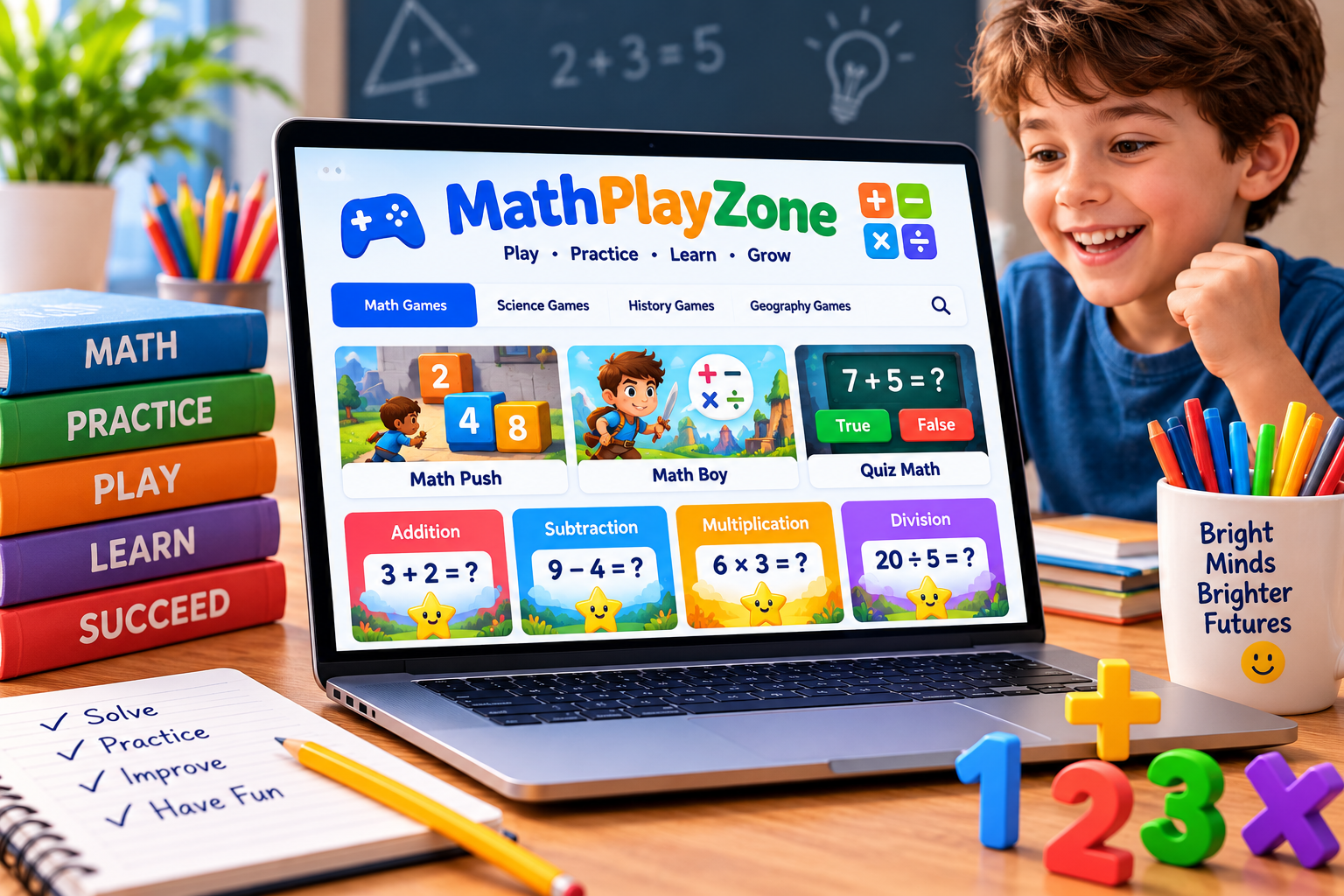
MathPlayZone is an online gaming platform that offers arithmetic games, logic puzzles, science quizzes, and history and geography activities. Its math section includes games such as Math Push, Math Boy, Quiz Math, Addition, Subtraction, Multiplication, and Division.
Whether you are a student looking for extra practice, a parent searching for educational activities, or a teacher exploring digital learning resources, understanding the platform can help you decide how to use it.
This guide explains the available games, the skills they can help learners practice, and practical ways to combine online activities with traditional learning.
What Is MathPlayZone?
MathPlayZone is a browser-based gaming website featuring interactive activities for entertainment and learning. Its collection includes arithmetic challenges, number puzzles, and games covering subjects beyond mathematics.
The math games focus on different types of challenges. Some require players to solve equations quickly, while others involve arranging numbers or reaching a target value. This variety gives learners different ways to practice basic mathematical concepts.
For example, a student who needs more practice with multiplication can choose a multiplication game. Someone who enjoys solving puzzles may prefer an activity that combines numbers with logical thinking.
The main attraction is the interactive format. Rather than simply reading an explanation, players respond to problems and see how their choices affect the game.
However, MathPlayZone should be viewed as a supplementary learning resource, not a complete mathematics curriculum. Students still need clear explanations, structured lessons, and opportunities to understand why an answer is correct.
How Does MathPlayZone Work?
The platform organizes games into categories, making it easier to explore activities according to your interests.
A simple way to get started is to visit the official MathPlayZone website and browse the available math games. Choose an activity that matches your current skill level and read any instructions before beginning.
Most of the listed math activities involve answering questions, selecting numbers, or completing a puzzle. Some games also introduce time limits, which add an extra challenge.
Here is a practical approach to using the platform:
-
Choose a skill: Decide whether you want to practice addition, subtraction, multiplication, division, or logical reasoning.
-
Select a suitable game: Start with a familiar activity instead of choosing the most difficult challenge.
-
Read the instructions: Understand the controls, objective, and rules before playing.
-
Focus on accuracy: Work out each answer carefully, even when the game encourages speed.
-
Review mistakes: Identify the calculation or concept that caused difficulty.
-
Repeat with a purpose: Play again to practice the same skill or move to a harder challenge when ready.
This simple routine makes gaming more purposeful. It also helps learners avoid spending time playing without a clear educational goal.
Popular MathPlayZone Games to Explore
One of the platform’s useful features is its variety of math activities. Each game approaches practice differently, so learners can choose one that fits their current goals.

1. Math Push
Math Push combines number puzzles with logical thinking. Players move numbered blocks to create mathematical expressions that match target values and help clear the way through a level.
Best for: Learners who enjoy puzzles and planning their next move.

2. Math Boy
Math Boy presents arithmetic questions within a fantasy-themed game. Players can choose addition, subtraction, multiplication, division, or a combined mode. Correct answers help the character defend against approaching enemies.
Best for: Practicing arithmetic while enjoying a game-based challenge.

3. Quiz Math
Quiz Math asks players to decide whether an arithmetic equation is true or false. Because decisions must be made quickly, players need to calculate and check answers without spending too much time on each question.
Best for: Building confidence with basic calculations and checking equations.

4. Addition, Subtraction, Multiplication, and Division
These activities focus on individual arithmetic operations. Players solve questions and select answers, often against a timer. Practicing one operation at a time can help learners identify which skills need more attention.
Best for: Students reviewing foundational arithmetic.

5. Let’s Reach 1000 and Let’s Reach Zero
These games challenge players to reach a target total by adding or subtracting numbers. They encourage learners to consider how each calculation changes the running total.
Best for: Practicing number sense and mental arithmetic.
Game availability and features can change, so check the current platform for the latest options and instructions.
What Skills Can Math PlayZone Activities Help Practice?
The phrase math playzone describes the idea of using play-based activities to practice mathematics. When games are matched to a learner’s needs, they can provide additional opportunities to work with numbers and mathematical concepts.
Mental Arithmetic
Games involving addition, subtraction, multiplication, and division give learners repeated opportunities to calculate answers. With regular practice, students may become more comfortable recognizing number relationships and completing familiar calculations.
For example, a learner practicing multiplication can work through problems such as \(7 \times 8\) and \(9 \times 6\). Reviewing incorrect answers helps reinforce the underlying facts rather than relying on guessing.
Accuracy and Attention
Timed games encourage players to pay attention and make decisions. However, speed should not become the only goal.
A student who answers quickly but repeatedly makes mistakes may benefit more from slowing down. Accuracy provides a stronger foundation before introducing faster challenges.
Logical Reasoning
Puzzle-based games require players to think about relationships between numbers, possible moves, and target values. Instead of calculating a single answer, they may need to plan several steps.
These activities can offer useful practice in approaching problems systematically. Still, success in a particular game does not automatically demonstrate mastery of every mathematical skill.
Problem-Solving Confidence
A manageable challenge can encourage learners to try again after making a mistake. When students understand what went wrong and correct it, they gain a clearer picture of how a problem works.
Parents and teachers can support this process by asking learners to explain their answers rather than focusing only on scores.
Benefits of Learning Math Through Games
Online math games can complement traditional learning in several practical ways.
-
More engaging practice: Interactive tasks can provide a welcome change from worksheets and textbooks.
-
Repeated opportunities: Learners can revisit familiar operations and practice until they feel more comfortable.
-
Immediate feedback: Game responses can help players recognize when an answer is incorrect, depending on the activity.
-
Flexible practice: Browser-based activities may be convenient for short practice sessions at home or during supervised learning.
-
Different challenge styles: Arithmetic questions and logic puzzles give learners different ways to work with mathematical ideas.
However, these benefits depend on how the games are used. Playing alone does not guarantee better grades or long-term improvement. Learners still need instruction, feedback, and opportunities to apply what they know to unfamiliar problems.
For additional structured lessons and practice, Khan Academy offers free learning resources covering mathematics and other school subjects. Visit its math learning section to explore lessons and exercises.
Is MathPlayZone Suitable for Children and Students?
MathPlayZone may be useful for learners who enjoy interactive activities, but suitability depends on age, ability, reading level, and the specific game.
Younger learners may benefit from simple arithmetic challenges when an adult helps explain unfamiliar instructions. Older students may prefer activities that combine calculations with logic and strategy.
Before recommending a game to a child, consider these questions:
-
Are the instructions understandable for the learner?
-
Does the activity match the mathematical skills being studied?
-
Is the difficulty appropriate, or does it cause unnecessary frustration?
-
Are advertisements, external links, or other website features suitable for the child’s age?
-
Can the child play safely with appropriate supervision?
Parents should check the actual website and its policies rather than assuming that every game on an educational platform is designed for every age group.
Teachers can also use games as optional practice, provided the activity supports the lesson’s learning objectives.
Tips for Parents and Teachers
To make online math games more useful, connect the activity to a clear learning goal.
Set a specific objective. Before starting, decide what the learner should practice. This might be multiplication facts, subtraction, or solving number puzzles.
Ask learners to explain their answers. After a game, ask how they reached a result. Explaining the steps can reveal whether they understand the concept or simply guessed.
Use mistakes as teaching opportunities. If a student repeatedly struggles with division, review the underlying concept before moving to a harder game.
Balance screen activities with offline practice. Combine games with written calculations, everyday examples, and teacher-led explanations. For instance, a multiplication game can be followed by a few problems on paper.
Keep sessions manageable. Short, focused sessions are often easier to fit into a learning routine than extended gaming periods. Encourage breaks and make sure games do not interfere with sleep, homework, or physical activity.
Monitor the experience. Check whether the activity is genuinely helping the learner practice. If it becomes frustrating or distracting, switch to a simpler task or another teaching method.
These steps help turn gaming into a purposeful learning activity rather than just another screen-time habit.
Online Safety, Privacy, and Screen Time
Before using MathPlayZone, especially with children, take a few minutes to review the website’s safety and privacy considerations.
First, check whether the website uses a clear privacy policy and explains how it handles information. Avoid entering unnecessary personal details, creating accounts without a good reason, or downloading unexpected files.
Next, pay attention to advertisements and external links. A game website may include content or links that are separate from the game itself. Younger children should use online games with suitable adult supervision.
It is also worth setting reasonable screen-time limits. Educational games can be enjoyable, but they should not replace sleep, exercise, social activities, or other important parts of a child’s routine.
Most importantly, distinguish online safety from educational quality. A website may load securely without every educational claim being accurate. Parents and teachers should evaluate both.
MathPlayZone vs. Traditional Math Practice
Online games and traditional exercises can serve different purposes. The best choice depends on the learner’s needs and the learning objective.
| Feature | MathPlayZone games | Traditional practice |
|---|---|---|
| Learning format | Interactive challenges and puzzles | Worksheets, textbooks, and written problems |
| Engagement | Game mechanics may make practice enjoyable | Depends on the activity and teaching approach |
| Feedback | May provide feedback during gameplay | Can include teacher feedback or answer keys |
| Problem-solving | Depends on the selected game | Can cover simple calculations and complex problems |
| Best use | Supplementary practice and reinforcement | Structured learning and detailed working |
Neither method is automatically superior in every situation. A student may use an online multiplication game to practice basic facts and then solve written problems to demonstrate understanding.
Combining both approaches can provide variety while keeping learning focused on the underlying concepts.
How to Get Started With MathPlayZone
If you want to explore the platform, follow this simple routine:
-
Visit the official website and open the math games section.
-
Choose one activity that matches your current skill level.
-
Read the instructions and understand the objective.
-
Complete a short session, concentrating on correct answers.
-
Review any mistakes and practice the relevant skill again.
-
Try another game when you are ready for a different type of challenge.
Students can use this routine independently when appropriate, while parents and teachers can provide guidance when a concept is unfamiliar.
For more business, technology, and educational content, you can also explore Entrepreneur Business Insider.
Frequently Asked Questions
Q1: What is MathPlayZone?
Ans: MathPlayZone is an online gaming platform offering math activities, logic puzzles, and games in other subject areas. Its math section includes arithmetic challenges and number-based puzzles.
Q2: Is MathPlayZone free to use?
Ans: The website lists playable online games, but pricing, advertising, and access conditions can change. Check the current website to confirm whether a particular activity requires payment or registration.
Q3: What games are available on MathPlayZone?
Ans: Examples include Math Push, Math Boy, Quiz Math, Addition, Subtraction, Multiplication, Division, Let’s Reach 1000, and Let’s Reach Zero.
Q4: Can math playzone games help children practice math?
Ans: They can provide additional opportunities to practice calculations and number-based problem-solving. Their usefulness depends on the learner, the game, and whether the activities complement structured instruction.
Q5: Can students use MathPlayZone on different devices?
Ans: Browser-based games may work on computers, tablets, or phones, depending on their design and compatibility. Check the individual game’s controls and display on your device.
Q6: Can online math games replace classroom learning?
Ans: No. Games can supplement mathematics lessons, but they do not replace structured teaching, conceptual explanations, written practice, and feedback from teachers or parents.
Conclusion
MathPlayZone offers a range of interactive activities that let users explore arithmetic, number puzzles, and other educational games. Its different formats may appeal to students who want a more engaging way to practice familiar mathematical concepts.
The key is to use each activity with a purpose. Choose games that match the learner’s ability, focus on accuracy before speed, and review mistakes to understand the reasoning behind each answer.
Whether you call it MathPlayZone or a math playzone learning experience, the goal should remain the same: make practice engaging while building genuine understanding. Used alongside structured lessons and appropriate supervision, online math games can be a useful addition to a balanced learning routine.