
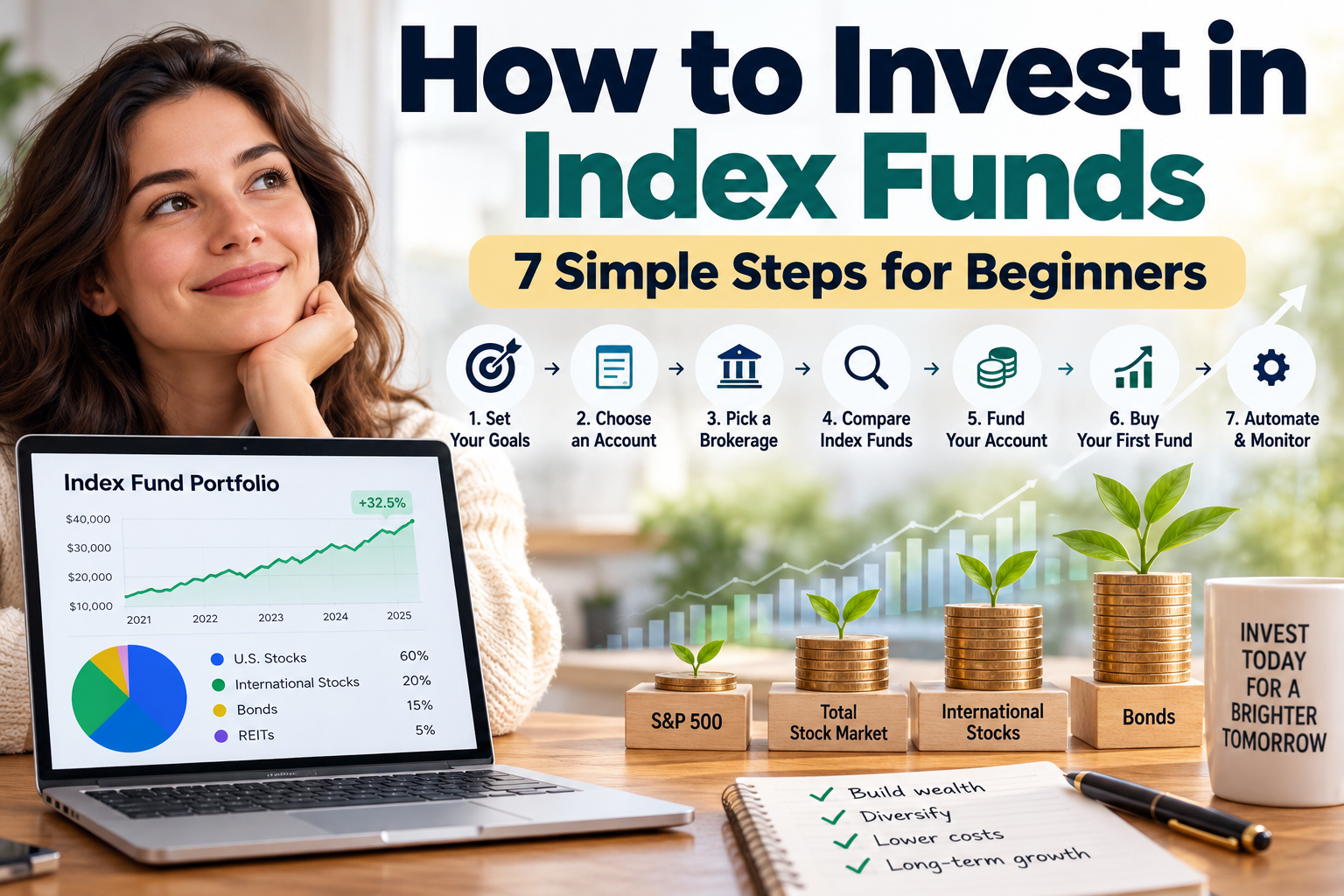
Investing doesn’t have to be complicated. If you’re looking for a straightforward way to build wealth over time, learning how to invest in index funds is an excellent place to start.
Index funds allow you to invest in a collection of stocks or bonds without selecting individual securities. Instead of researching dozens of companies, you can purchase shares in a single fund that tracks a specific market index, such as the S&P 500.
Many investors choose index funds because they offer diversification, relatively low operating costs, and a convenient approach to long-term investing. However, like any investment, they involve risks, and their value can rise or fall with market conditions.
The good news is that getting started doesn’t require advanced financial knowledge. Some investment platforms even allow beginners to purchase eligible index funds with relatively small amounts of money.
In this guide, you’ll learn what index funds are, how they work, how to choose suitable investments, and how to buy your first shares. You’ll also discover common mistakes to avoid and practical strategies for managing your investments over time.
What Are Index Funds?
An index fund is a type of mutual fund or exchange-traded fund (ETF) designed to track the performance of a particular financial market index.
A market index measures the performance of a selected group of securities. For example, the S&P 500 tracks approximately 500 leading publicly traded U.S. companies.
Rather than trying to identify individual winning stocks, an index fund generally aims to replicate the performance of its chosen benchmark.
According to the U.S. Securities and Exchange Commission (SEC), index funds typically follow a passive investment strategy, although their costs, tracking methods, and risks can vary.
How Do Index Funds Work?
Index funds collect money from investors and use it to purchase securities that represent their target index.
For example, an S&P 500 index fund provides exposure to companies such as Apple, Microsoft, Amazon, and other major U.S. businesses included in the index.
Here’s how the process generally works:
-
A fund provider selects an index to track.
-
The fund purchases all or a representative sample of the index’s securities.
-
Investors buy shares in the fund.
-
The value of those shares changes as the underlying investments fluctuate.
-
The fund adjusts its holdings when necessary to maintain its investment strategy.
Suppose you invest $500 in an S&P 500 index fund. Your investment gives you indirect exposure to the companies held by that fund, rather than requiring you to purchase each company’s shares separately.
If the fund’s underlying investments increase in value, your shares may appreciate. Conversely, if market prices decline, your investment can lose value.
Index funds do not perfectly match their benchmarks in every circumstance. Expenses, trading costs, and tracking methods can cause differences between fund and index performance.
Different Types of Index Funds
Not all index funds invest in the same assets. Understanding the main categories can help you choose investments that align with your financial goals.
| Type of index fund | What it typically tracks | Main consideration |
|---|---|---|
| S&P 500 index fund | Large U.S. companies | Concentrated in the U.S. large-cap market |
| Total stock market index fund | Broad U.S. equity market | Wider company-size exposure |
| International stock index fund | Stocks outside the U.S. | Foreign market and currency risks |
| Bond index fund | Government or corporate bonds | Interest-rate and credit risks |
| Sector index fund | Companies within one industry | Greater sector concentration |
For many beginners, broad-market funds are worth understanding first because they can provide exposure to numerous companies through one investment.
However, owning hundreds of stocks does not automatically eliminate investment risk. A stock index fund can still experience substantial losses during market downturns.
Why Invest in Index Funds?
Index funds have become a popular investment option because they combine simplicity with broad market exposure.
Although they are not suitable for every financial situation, several characteristics make them appealing to long-term investors.
1. Diversification Across Multiple Investments
Diversification means spreading investments across different securities to reduce dependence on any single holding.
When you purchase shares in a broad stock market index fund, your money is distributed across numerous companies.
For example, instead of investing your entire budget in one technology company, you could invest in a fund containing hundreds of businesses across multiple industries.
This reduces the impact of a single company’s poor performance on your overall portfolio.
However, diversification cannot prevent losses when the broader market declines.
2. Potentially Lower Investment Costs
Many index funds follow passive investment strategies, meaning they do not rely on frequent decisions by portfolio managers to outperform the market.
As a result, some index funds have lower operating expenses than actively managed alternatives.
One important cost is the expense ratio, which represents a fund’s annual operating expenses as a percentage of its average net assets.
For example:
-
A fund with a 0.05% expense ratio has annual operating expenses equivalent to approximately $5 per $10,000 invested.
-
A fund with a 0.50% expense ratio has annual operating expenses equivalent to approximately $50 per $10,000 invested.
These expenses are generally reflected in the fund’s returns rather than charged as a separate annual bill.
Over long periods, cost differences can have a meaningful impact on investment outcomes.
3. Simpler Long-Term Investment Management
Investing in individual stocks can require extensive research into financial statements, competitive advantages, earnings, and industry developments.
Index funds simplify part of that process by providing exposure to a predetermined collection of securities.
You still need to evaluate the fund’s investment objective, costs, risks, and suitability. However, you generally do not need to research every company held by the fund.
This approach can be particularly useful for investors who prefer a long-term strategy rather than frequent trading.
4. Flexible Investment Amounts
Some index mutual funds have minimum initial investments, while others have no stated minimum. Certain brokerages also support fractional ETF shares.
Consequently, beginners may be able to start investing with $10, $50, or $100, depending on the platform and fund.
The amount you should invest depends on your income, financial obligations, emergency savings, and tolerance for investment losses.
5. Exposure to Long-Term Market Growth
Broad stock index funds participate in the performance of the markets they track.
Historically, diversified stock markets have experienced long-term growth, although returns have varied significantly across periods and markets.
Investors should not assume that historical performance will continue or that positive returns are guaranteed over any particular period.
For additional context, NYU Stern’s historical investment return data provides information about past stock, bond, and Treasury bill returns.
How to Invest in Index Funds in 7 Simple Steps
Now that you understand the basics, it’s time to learn how to invest in index funds.
The process is relatively straightforward. However, making informed decisions before purchasing your first shares can help you avoid unnecessary expenses and investment mistakes.
Step 1: Set Your Investment Goals
Before investing, determine what you want your money to accomplish.
Your financial goal influences the types of index funds you might consider, the level of risk you can reasonably accept, and how long you plan to remain invested.
Common investment goals include retirement, future education expenses, purchasing a home, and building long-term financial security.
For example, someone investing for retirement in 30 years may have a different risk tolerance from someone planning to use their savings for a home purchase in two years.
Consider three important questions:
-
What am I investing for? Identify a specific financial objective.
-
When will I need the money? Establish a realistic investment timeline.
-
How much can I afford to lose? Consider your financial stability and ability to withstand market declines.
Before investing in stock index funds, consider maintaining accessible emergency savings and addressing expensive debt.
Money needed for essential expenses in the near future generally should not depend on unpredictable stock market performance.
Step 2: Choose the Right Investment Account
The next step is selecting an account through which you can purchase index funds.
In the United States, several account types are commonly used.
Taxable brokerage account
A regular brokerage account allows eligible investors to buy and sell investments, including index mutual funds and ETFs.
These accounts generally do not have the annual contribution limits associated with retirement accounts. However, dividends, capital gains distributions, and realized investment gains may create tax obligations.
Traditional IRA
A Traditional Individual Retirement Account is designed for retirement savings.
Depending on eligibility and circumstances, contributions may be tax-deductible. Investment earnings generally receive tax-deferred treatment until withdrawals, and withdrawals may be subject to income taxes and other rules.
Roth IRA
A Roth IRA uses after-tax contributions. Qualified withdrawals can be tax-free, provided applicable requirements are met.
Eligibility and contribution limits depend on factors including income and filing status.
401(k) retirement plan
A 401(k) is an employer-sponsored retirement savings plan. Many plans offer index funds among their investment choices, and some employers provide matching contributions.
For 2026, the IRS lists the standard IRA contribution limit at $7,500 and the basic employee 401(k) elective-deferral limit at $24,500. Additional rules and catch-up provisions may apply.
These account types and tax rules are specific to the United States. Investors elsewhere should review their country’s regulations and available investment accounts.
Step 3: Select a Reliable Brokerage Platform
After choosing an account type, you’ll need a brokerage or investment provider that offers access to suitable index funds.
Well-known U.S. investment providers include:
-
Vanguard
-
Fidelity Investments
-
Charles Schwab
These are examples rather than a ranking or endorsement.
When comparing platforms, evaluate the following factors.
Investment selection: Does the provider offer the index funds or ETFs you’re considering?
Trading costs: Are there commissions, account maintenance fees, or other charges?
Minimum investment: Can you start with your available budget?
Automatic investing: Does the platform support recurring purchases of your chosen fund?
Security and regulation: Is the brokerage properly registered, and what investor protections apply?
Ease of use: Can you access clear fund information, account statements, and educational resources?
Choosing a provider solely because it advertises commission-free trading may overlook other important expenses.
Step 4: Research and Compare Index Funds
This is one of the most important steps in the investment process.
Two index funds can follow similar strategies but differ in expenses, investment minimums, tracking accuracy, and fund structure.
Start by identifying the market exposure you want.
For instance, a broad U.S. stock market fund may suit a different portfolio objective from an international stock fund or a bond fund.
Then examine these characteristics:
| Evaluation factor | What to check |
|---|---|
| Tracked index | Which securities or market segment does the fund follow? |
| Expense ratio | What annual operating costs does the fund charge? |
| Holdings | How diversified or concentrated is the portfolio? |
| Tracking difference | How closely have returns matched the benchmark? |
| Investment minimum | How much money is required to purchase shares? |
| Fund structure | Is it an ETF or mutual fund? |
| Risk disclosures | What could cause the fund to lose value? |
A fund’s expense ratio matters, but it shouldn’t be the only consideration.
For example, a low-cost technology sector index fund may be more concentrated than a slightly more expensive broad-market fund.
The SEC recommends reviewing a fund’s prospectus, investment objectives, risks, and costs before investing.
Step 5: Open and Fund Your Investment Account
Once you’ve selected a brokerage and researched potential investments, you can begin the account-opening process.
Most online brokerages allow eligible customers to apply electronically.
You may need to provide personal identification, tax information, contact details, and other information required by the provider.
After your account is approved, you can generally transfer money from a linked bank account or another supported funding source.
Before transferring funds, confirm that the account supports the investment you want to purchase.
Keep in mind that account approval and deposit availability vary by brokerage.
Step 6: Buy Your First Index Fund
After funding your account, you’re ready to purchase your chosen investment.
First, search for the fund using its name or ticker symbol.
Carefully verify that you’ve selected the correct fund, since some providers offer multiple funds with similar names.
If you’re buying an index ETF, you’ll typically enter the number of shares or, where supported, the dollar amount you want to invest.
You may also need to select an order type.
A market order generally seeks immediate execution at the best available market price, but the execution price is not guaranteed.
A limit order allows you to specify the maximum price you’re willing to pay when buying an ETF. However, the order may not execute if the market does not reach your specified price.
For an index mutual fund, purchases generally execute at the next calculated net asset value rather than at continuously changing intraday market prices.
Before submitting your order, review the investment name, amount, order details, and any applicable fees.
Once the transaction is completed, the purchased shares should appear in your investment account.
Step 7: Automate Investments and Monitor Your Portfolio
Purchasing your first index fund is only the beginning.
Long-term investing also involves managing contributions, reviewing your asset allocation, and responding appropriately when your financial circumstances change.
One approach is to invest a predetermined amount at regular intervals.
For example, you might contribute $100 each month instead of waiting until you believe the market is at its lowest point.
This approach is commonly called dollar-cost averaging.
Regular investing can help establish a consistent savings habit, although it does not guarantee profits or protect against losses. It can also underperform investing an available lump sum immediately when markets rise.
If your brokerage supports automatic purchases, you may be able to schedule recurring investments.
You should also review your portfolio periodically to ensure that it continues to reflect your goals, risk tolerance, and investment timeline.
Avoid making unnecessary changes solely because of short-term market fluctuations.
How to Choose the Right Index Fund
Choosing an index fund involves more than selecting a familiar brand or a fund with strong recent returns.
The most appropriate choice depends on your financial objectives, investment horizon, risk tolerance, and existing investments.
Match the Fund to Your Financial Goals
Begin by understanding what the index fund actually owns.
A fund tracking the S&P 500 provides exposure primarily to large U.S. companies.
A total U.S. stock market fund generally offers broader exposure, including smaller companies.
An international index fund may provide exposure to companies outside the United States, while a bond index fund invests in debt securities.
These funds serve different purposes.
For example, investors seeking broad global stock exposure may consider how U.S. and international investments fit together.
Meanwhile, someone seeking a portfolio with less stock market exposure may examine the potential role of bonds.
No single index fund is automatically appropriate for everyone.
Compare Expense Ratios Carefully
An expense ratio is the percentage of fund assets used to cover annual operating expenses.
Although small percentage differences may appear insignificant, they can affect long-term results.
Consider two hypothetical funds:
| Feature | Fund A | Fund B |
|---|---|---|
| Initial investment | $10,000 | $10,000 |
| Annual expense ratio | 0.05% | 0.50% |
| Approximate first-year expense at an unchanged balance | $5 | $50 |
The comparison assumes the same investment value for illustration. Actual expenses depend on average fund assets, and investment balances fluctuate.
If both funds track the same index and otherwise perform similarly, lower expenses generally leave more of the investment return with shareholders.
However, always examine the complete cost structure.
ETF investors may encounter bid-ask spreads and brokerage transaction costs. Mutual funds may have purchase or redemption charges, depending on the product.
Examine Fund Holdings and Diversification
A fund’s name doesn’t always reveal how diversified it is.
For example, a technology index fund may hold dozens or hundreds of companies but still depend heavily on one industry.
Similarly, two broad-market funds may overlap substantially because they hold many of the same large companies.
Before investing, review the fund’s holdings and sector allocations.
Pay particular attention to whether the largest companies represent a significant percentage of the portfolio.
Understanding these details can help you avoid unintentionally concentrating your investments.
Understand Tracking Error and Tracking Difference
Index funds aim to follow a benchmark, but their results may differ from that benchmark.
Tracking difference describes the difference between the fund’s return and the index’s return over a particular period.
Tracking error measures how much the difference between fund and benchmark returns varies over time.
Several factors can influence tracking performance, including operating expenses, trading costs, portfolio sampling, and cash holdings.
A fund with low expenses may still differ from its index because of these factors.
Read the Fund Prospectus
Before making a final decision, review the fund’s prospectus.
This document explains the investment objective, strategy, principal risks, fees, and other important details.
It can also help you identify restrictions or characteristics that aren’t obvious from a brokerage’s summary page.
A prospectus is particularly important when comparing funds that use similar names but follow different indexes or investment strategies.
Index ETFs vs. Index Mutual Funds: What’s the Difference?
Index funds are commonly available as exchange-traded funds (ETFs) or mutual funds.
Both can follow the same market index, but they differ in how investors buy shares, how prices are determined, and how transactions are processed.
How Index ETFs Work
An index ETF trades on a stock exchange, much like an individual stock.
Investors can generally buy or sell ETF shares during normal market trading hours. Prices fluctuate throughout the day according to market activity.
ETFs may offer flexibility for investors who want to choose their trading prices or purchase fractional shares through supported brokerages.
However, ETF transactions can involve bid-ask spreads, commissions, or other trading costs.
How Index Mutual Funds Work
An index mutual fund also pools investors’ money to track a market benchmark.
Unlike ETFs, traditional mutual fund shares are generally purchased or redeemed at the next calculated net asset value (NAV).
Many mutual funds calculate NAV once each business day after markets close.
Some mutual funds support automatic contributions and dollar-based purchases, making them convenient for investors who want a regular investment routine.
Index ETF vs. Index Mutual Fund Comparison
| Feature | Index ETF | Index mutual fund |
|---|---|---|
| Trading | Throughout market hours | Usually at next calculated NAV |
| Share price | Changes intraday | Calculated periodically, usually daily |
| Minimum investment | Share price or supported fractional amount | Depends on the fund |
| Automatic investing | Depends on brokerage | Often available, depending on provider |
| Trading costs | Possible spreads and commissions | Possible transaction or redemption fees |
| Annual expenses | Vary by fund | Vary by fund |
| Tax efficiency | Often structurally advantageous in taxable accounts | Depends on fund structure and transactions |
Both options can provide diversified, low-cost market exposure.
The SEC explains that ETFs and mutual funds can use either active or passive strategies, and investors should compare their actual costs and characteristics before choosing.
How Much Money Do You Need to Invest in Index Funds?
One common misconception is that investing requires thousands of dollars.
In reality, some index funds and investment platforms allow people to begin with relatively small amounts.
However, minimum investment requirements vary.
Can You Start Investing With $10, $50, or $100?
Yes, it may be possible to start investing with these amounts.
Some index mutual funds have low or no minimum initial investment requirements. Meanwhile, certain brokerages offer fractional ETF shares.
For example, if an ETF costs $200 per share and your brokerage supports fractional investing, you might be able to invest $50 to purchase approximately one-quarter of a share, excluding any applicable costs.
If fractional investing isn’t available, you may need enough money to purchase at least one full ETF share.
Always confirm the requirements of your chosen platform and fund.
How Much Should You Invest Every Month?
The appropriate monthly contribution depends on your financial circumstances.
Instead of selecting an arbitrary amount, consider your income, essential expenses, existing savings, debts, and financial goals.
For example, someone with $150 available after meeting essential obligations might decide to invest a portion while keeping enough money accessible for unexpected expenses.
A manageable contribution schedule is generally more practical than committing money you’ll soon need for necessities.
How Compound Growth Can Affect Long-Term Investments
Compound growth occurs when investment earnings remain invested and can generate additional earnings.
Over time, reinvested returns may contribute substantially to portfolio growth.
Consider a hypothetical example of investing $100 at the end of every month, assuming a constant 7% annual return with monthly compounding.
Illustrative investment growth calculator
Monthly contribution
$100
Investment period
20 years
Hypothetical annual return
7%
Illustrative ending balance
$52,093
Contributions: $24,000
Illustrative growth: $28,093
Hypothetical illustration only. Assumes constant returns compounded monthly and end-of-month contributions. Excludes taxes, fees, inflation, and market volatility. Actual investment returns can be negative and are not guaranteed.
This example demonstrates the mathematical effect of recurring contributions and compound growth. Real markets do not deliver a fixed annual return, and investment balances may experience substantial fluctuations.
How to Build and Manage an Index Fund Portfolio
Buying an index fund is only one part of a long-term investment strategy.
A well-considered portfolio should reflect your financial objectives, risk tolerance, and time horizon.
Understand Asset Allocation
Asset allocation describes how you divide investments among asset classes, such as stocks, bonds, and cash.
Stocks generally offer greater long-term growth potential but can experience substantial volatility.
Bonds may provide income and different risk characteristics, although bond funds can also lose value because of interest-rate changes, credit events, and other factors.
Cash and cash-equivalent investments may be more appropriate for short-term financial needs, depending on the product and its protections.
There is no universally correct allocation. Your financial circumstances should guide the decision.
Should You Invest in One Index Fund or Several?
Some investors prefer a simple portfolio built around one broadly diversified fund.
Others combine multiple index funds to gain exposure to different markets or asset classes.
For example, a portfolio might contain a U.S. stock index fund, an international stock index fund, and a bond index fund.
However, owning more funds doesn’t automatically mean better diversification.
Two funds may contain many of the same companies, creating overlapping exposure.
Review each fund’s holdings and investment objective before adding it to your portfolio.
Reinvest Dividends and Distributions
Some index funds distribute dividends, interest, or capital gains to shareholders.
Depending on the fund and brokerage, you may be able to reinvest eligible distributions automatically.
Reinvestment purchases additional fund shares, allowing future investment performance to apply to those shares as well.
Keep in mind that reinvested distributions may still create taxable income in a regular brokerage account.
Review and Rebalance Your Portfolio
Over time, changes in market prices can shift your portfolio away from its intended asset allocation.
For example, strong stock market performance may increase the percentage of your portfolio invested in stocks.
Rebalancing involves adjusting investments to restore your desired allocation.
You might accomplish this through new contributions or by buying and selling existing holdings.
Before making changes, consider potential transaction costs, taxes, and your investment goals.
Periodic reviews can also help you identify changes in fund expenses, investment strategies, or personal financial circumstances.
Risks of Investing in Index Funds
Although index funds offer several advantages, they are not risk-free.
Understanding the potential disadvantages is essential before committing money.
Market Volatility and Investment Losses
Index funds generally rise and fall with the securities they hold.
A stock index fund may lose substantial value during a market downturn, even when it owns hundreds of companies.
Diversification can reduce exposure to individual companies, but it cannot eliminate overall market risk.
Concentration Risk
Some indexes give larger companies greater portfolio weight.
As a result, a fund containing hundreds of companies may still depend heavily on a relatively small group of major businesses.
Sector-specific index funds can be particularly concentrated.
Tracking Error
An index fund may not perfectly match its benchmark because of operating expenses, portfolio sampling, trading costs, or other factors.
Tracking differences can affect the returns investors actually receive.
Interest-Rate and Credit Risk
Bond index funds have risks that differ from stock index funds.
Rising interest rates can reduce the market value of existing bonds, while credit problems can affect the ability of bond issuers to make required payments.
Currency and International Market Risks
International index funds may be affected by foreign exchange movements, political developments, market regulations, and differences in economic conditions.
These factors can create additional volatility for investors.
The SEC’s index fund guidance explains that index funds carry the risks of their underlying securities, along with potential tracking and cost-related risks.
Common Index Fund Investing Mistakes to Avoid
Beginners sometimes make decisions that increase costs or introduce unnecessary risk.
Recognizing these mistakes can help you develop a more disciplined approach.
1. Choosing Funds Based Only on Recent Performance
A fund’s recent returns may appear attractive, but historical performance does not reliably predict future results.
Evaluate its underlying index, costs, risks, and suitability instead of focusing exclusively on past gains.
2. Ignoring Investment Fees
Even modest recurring expenses can affect long-term investment outcomes.
Compare expense ratios and other charges before purchasing a fund.
3. Investing Money Needed Soon
Stock market investments can decline unexpectedly.
Using money intended for near-term rent, medical expenses, or other essential obligations may create financial difficulties if you need to sell during a downturn.
4. Panic Selling During Market Declines
Sudden price drops can create pressure to sell investments.
However, making decisions based solely on fear may conflict with your original financial plan.
Reassess your goals, risk tolerance, and financial needs before changing your strategy.
5. Buying Too Many Similar Funds
Owning multiple index funds doesn’t guarantee meaningful diversification.
For example, an S&P 500 fund and a total U.S. stock market fund may hold many of the same large companies.
Check for overlapping holdings before adding new funds.
6. Assuming Low-Cost Funds Are Always Safe
A low expense ratio does not make an investment low-risk.
A specialized sector index fund may charge very little while remaining highly volatile.
Evaluate the underlying assets, not just the price of owning the fund.
Faqs
Q1: How Do Beginners Start Investing in Index Funds?
Ans: Beginners can start by identifying their financial goals, choosing a suitable investment account, selecting a regulated brokerage, and researching available index funds. After comparing fees, holdings, and risks, they can fund their account and purchase shares. Regular contributions and periodic portfolio reviews can help maintain a long-term strategy.
Q2: How Much Money Do You Need to Invest in Index Funds?
Ans: The minimum amount depends on the fund and brokerage. Some platforms support fractional ETF shares or index mutual funds with low minimum investments, potentially allowing purchases of $10, $50, or $100. Investors should check specific fund requirements and avoid investing money needed for essential expenses.
Q3: Are Index Funds Good for Beginners?
Ans: Index funds can be suitable for beginners because they provide a relatively simple way to invest in a collection of securities. Broad-market funds may offer diversification and comparatively low expenses. However, suitability depends on the investor’s financial goals, time horizon, and risk tolerance.
Q4: Can You Lose Money in Index Funds?
Ans: Yes. Index funds can lose value when their underlying securities decline. A fund tracking the stock market may experience significant losses during economic downturns. Diversification reduces certain risks but does not guarantee that your investment will maintain its value.
Q5: Is an S&P 500 Index Fund Enough for Diversification?
Ans: An S&P 500 index fund provides exposure to many large U.S. companies across different industries. However, it does not provide comprehensive exposure to smaller companies, international stocks, or bonds. Whether it offers sufficient diversification depends on the investor’s overall portfolio and financial objectives.
Q6: Do Index Funds Pay Dividends?
Ans: Some index funds receive dividends from the companies they hold and distribute income to shareholders. Bond index funds may distribute interest income. Payment amounts and schedules depend on the fund. Eligible distributions may be reinvested automatically if the brokerage or fund offers that option.
Q7: Are Index Funds Better Than Individual Stocks?
Ans: Index funds and individual stocks serve different investment purposes. Broad index funds can reduce company-specific risk by holding multiple securities, while individual stocks provide direct exposure to selected businesses. Neither approach guarantees positive returns, and the appropriate choice depends on the investor’s strategy and risk tolerance.
Q8: Should You Choose an Index ETF or an Index Mutual Fund?
Ans: Both can provide exposure to the same market benchmark. ETFs trade throughout market hours, while traditional mutual funds generally transact at their next calculated NAV. Compare expenses, investment minimums, automatic-investing options, and account compatibility before deciding.
Q9: How Often Should You Invest in Index Funds?
Ans: Some investors contribute monthly or whenever they receive income. Others invest available money in larger amounts. The appropriate schedule depends on cash flow, investment goals, and financial circumstances. Regular contributions can support consistent investing habits, but they do not guarantee profits.
Q10: Do You Pay Taxes on Index Funds?
Ans: Taxes depend on your country, account type, and investment activity. In a U.S. taxable brokerage account, dividends, capital gains distributions, and realized gains may be taxable. Tax-advantaged retirement accounts have different rules. Consult current tax guidance or a qualified professional for your circumstances.
Final Thoughts
Learning how to invest in index funds can make the investment process easier to understand, especially for beginners who want exposure to financial markets without selecting individual stocks.
The essential steps are straightforward: establish your financial goals, choose an appropriate investment account, select a reliable brokerage, compare index funds, and purchase shares that fit your investment strategy.
However, successful investment planning involves more than making an initial purchase.
Understanding fees, diversification, risk tolerance, and asset allocation can help you make informed decisions as your financial circumstances evolve.
You don’t necessarily need a large starting balance. What matters is choosing an investment approach you understand and can reasonably maintain.
Before investing, review the fund’s prospectus, consider your financial obligations, and remember that market returns are never guaranteed.
A thoughtful investment plan, supported by reliable information and periodic reviews, provides a stronger foundation than chasing short-term market performance.
One thought on “How to Invest in Index Funds: 7 Simple Steps for Beginners”