
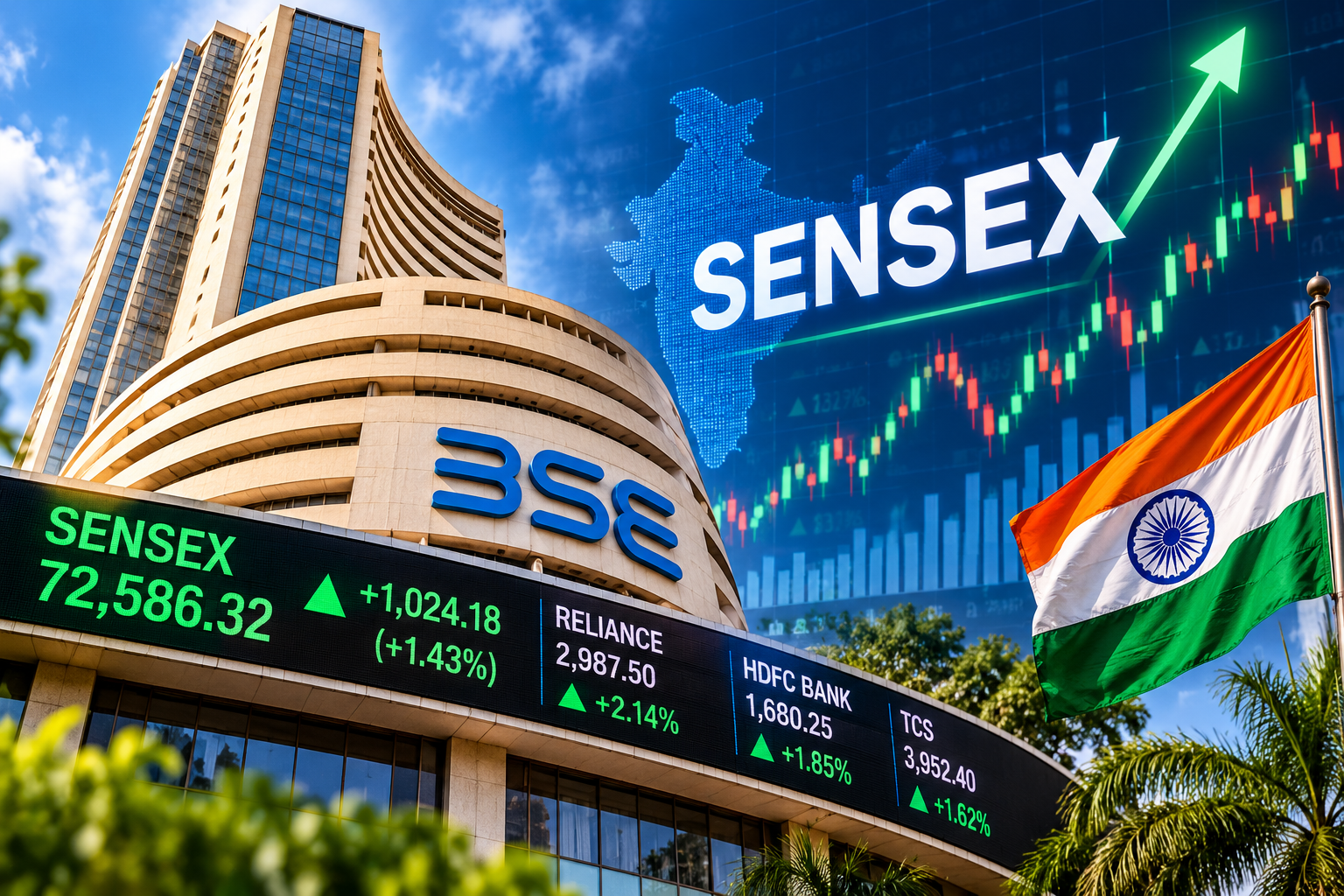
Sensex is the benchmark stock market index of the Bombay Stock Exchange in India. It measures the performance of 30 selected companies listed on the exchange.
These companies represent major parts of the Indian economy, including banking, information technology, energy, consumer goods, and manufacturing. Their share prices influence the index according to their respective weightings.
The Sensex helps investors understand whether the shares of major Indian companies are generally gaining or losing value. When the index rises, it indicates that the combined weighted performance of its constituents has improved. When it falls, the opposite is generally true.
However, the Sensex is not the same as the entire Indian stock market. Thousands of listed companies operate outside this benchmark, and their performance may differ from that of the 30 selected companies.
What Does Sensex Stand For?
The word Sensex comes from “Sensitive Index.” It refers to an index designed to reflect changes in stock prices and investor sentiment.
The BSE launched the Sensex in 1986, using 1978–79 as its base period and 100 as its base value. Since then, it has become a widely recognized reference point for India’s equity market.
Investors and financial news organizations frequently report its daily movements because the index provides a convenient snapshot of major listed companies.
The Sensex also gives investors a historical reference. By examining its performance over different periods, they can study how the market responded to economic growth, financial crises, corporate earnings, and changes in investor confidence.
How Does Sensex Work?
The Sensex follows the performance of 30 selected companies listed on the BSE. Each company’s influence depends on its free-float market capitalization relative to the other companies in the index.
Free-float market capitalization considers shares that are available for public trading rather than all shares issued by a company.
For example, a company with a large number of publicly tradable shares and a high share price may have more influence on the index than a smaller company with fewer tradable shares.
The index value changes as the market prices of its constituent stocks change. If the companies with larger weightings rise, they can have a greater positive effect on the Sensex. Similarly, declines in those companies can place more pressure on the index.
BSE periodically reviews the companies included in the benchmark. Changes help the index reflect developments in the market and maintain its selection criteria.
How Is Sensex Calculated?
The Sensex uses the free-float market capitalization method. This approach considers both a company’s market value and the proportion of its shares available for trading.
Step 1: Calculate Each Company’s Market Capitalization
Market capitalization is the total market value of a company’s outstanding shares.
The basic formula is:
Market capitalization = Share price × Total outstanding shares
Suppose a company has 100 million outstanding shares and its share price is ₹500. Its market capitalization would be ₹50 billion.
Step 2: Calculate Free-Float Market Capitalization
The next step adjusts market capitalization to account for shares available for public trading.
For example, if 60% of the company’s shares are considered free float, its free-float market capitalization would be ₹30 billion.
The remaining shares may be held by promoters or other strategic investors and may not be readily available for normal market trading.
Step 3: Combine the Companies’ Values
The free-float market capitalizations of all 30 constituent companies are combined to determine the index’s overall market value.
Companies with higher free-float market capitalizations generally receive larger weightings.
Step 4: Calculate the Index Value
BSE uses an index divisor and the established base value to convert the combined market value into an index figure. The divisor is adjusted when necessary to maintain continuity following events such as stock splits, constituent changes, and other corporate actions.
As a result, the Sensex can reflect changes in share prices without treating every company equally.
For the official methodology, refer to the BSE index methodology document.
What Factors Affect the Sensex?
The Sensex responds to several economic, financial, and business developments. Understanding these influences can help investors interpret daily movements more carefully.
1. Corporate Earnings
Company earnings provide information about financial performance. When major businesses report stronger revenue, profits, or future expectations, their share prices may rise.
On the other hand, disappointing results or weaker forecasts can lead to selling pressure.
Because the Sensex includes companies from several industries, earnings reports across banking, technology, manufacturing, and consumer businesses can all influence its direction.
2. Interest Rates and Inflation
Interest rates affect borrowing costs, consumer spending, and business investment. Higher borrowing costs can place pressure on companies that depend heavily on loans or credit.
Inflation also matters because rising input costs may reduce profit margins. At the same time, moderate inflation and stable economic conditions may support business activity.
Investors therefore pay attention to decisions by the Reserve Bank of India and other major central banks.
3. Foreign and Domestic Investment
Buying and selling activity by domestic institutions, foreign investors, and individual traders can affect stock prices.
Strong demand for Indian shares may support the index, while large-scale selling can contribute to declines.
However, investor flows are only one part of the picture. Company fundamentals, market valuations, and global conditions also influence prices.
4. Global Markets and Crude Oil Prices
India’s stock market is connected to the wider global economy. Developments in the United States, Europe, and other major markets can affect investor confidence in India.
Crude oil prices are particularly relevant because India imports substantial amounts of oil. Higher prices can increase costs for businesses and put pressure on inflation and the country’s trade balance.
Consequently, international conflicts, supply disruptions, and changes in global demand may influence the Sensex indirectly.
5. Government Policies and Economic Growth
Government budgets, infrastructure spending, taxation changes, and business regulations can affect corporate expectations.
Policies that encourage investment or improve infrastructure may benefit certain industries. Conversely, unexpected regulatory changes or economic uncertainty can weaken sentiment.
Economic indicators such as industrial production, employment, and consumer spending also help investors assess the direction of business activity.
Sensex vs. Nifty 50: What Is the Difference?
The Sensex and Nifty 50 are two major Indian stock market benchmarks. Both help investors monitor large companies, but they belong to different exchanges and track different groups of stocks.
| Feature | Sensex | Nifty 50 |
|---|---|---|
| Exchange | Bombay Stock Exchange (BSE) | National Stock Exchange (NSE) |
| Number of companies | 30 | 50 |
| Main purpose | Track selected large BSE-listed companies | Track selected large NSE-listed companies |
| Methodology | Free-float market capitalization | Free-float market capitalization |
| Common use | Benchmark for major Indian equities | Benchmark for major Indian equities |
Although the two indexes often move in similar directions, their returns may differ. They contain different constituent companies and assign different weights to individual stocks.
For example, a strong move in a company with a larger weighting in one index may affect that index more than the other.
Neither index is automatically better for every investor. The appropriate benchmark depends on the investment strategy and the market segment being evaluated.
How Can Investors Track the Sensex?
Investors can monitor the Sensex through official exchange resources, financial news websites, brokerage platforms, and market-data services.
When reviewing its performance, look beyond the headline index number.
- Current index level: Shows the latest reported value.
- Daily change: Indicates how many points the index has gained or lost.
- Percentage change: Shows the move relative to the previous closing level.
- Trading activity: Helps provide context for market movements.
- Historical charts: Show performance across different periods.
- Constituent performance: Reveals which major companies are contributing to the rise or decline.
You can also compare daily performance with longer-term returns. A strong day does not necessarily indicate a lasting uptrend, just as a single decline does not always signal a prolonged downturn.
For reliable investor education, visit the SEBI Investor website, which explains Indian market indexes and their uses.
Can You Invest Directly in the Sensex?
The Sensex is an index, not a company or a share that you can purchase directly. However, investors can use financial products designed to follow its performance.
Sensex Index Funds
An index fund aims to track a particular benchmark by investing in the relevant securities according to its investment strategy.
A Sensex index fund generally seeks to follow the performance of the index, less expenses and tracking differences.
Exchange-Traded Funds
Some exchange-traded funds, or ETFs, are designed to track the Sensex. These funds trade on an exchange, so investors can buy and sell units through a supported brokerage account.
Before investing, compare expense ratios, tracking differences, liquidity, and other costs.
Buying Individual Stocks
Another option is to purchase individual companies listed in the index. However, doing so does not automatically reproduce the Sensex’s performance.
An investor who buys only a few constituent stocks may experience very different returns from the overall index.
Each investment method has different risks, costs, and requirements. Investors should understand these differences before choosing an approach.
What Are the Risks and Limitations of the Sensex?
Although the Sensex is a useful benchmark, it has several limitations.
First, it covers only 30 companies. Many small, medium-sized, and unlisted businesses are not represented. Therefore, the index cannot describe the performance of every Indian company.
Second, the index is weighted. Companies with larger free-float market capitalizations can have more influence on its movements. A few major stocks may therefore drive much of a day’s change.
Third, stock markets are volatile. Economic shocks, unexpected announcements, and changes in investor expectations can cause sharp declines.
Finally, past performance does not guarantee future returns. A rising index does not mean that every stock is gaining value, and an index that has performed well historically can still experience substantial losses.
Investors should consider their goals, time horizon, and ability to withstand losses rather than making decisions based only on the latest index movement.
Frequently Asked Questions About Sensex
Q1: What Is Sensex in Simple Words?
Ans: Sensex is a stock market index that tracks 30 selected companies listed on the Bombay Stock Exchange in India. It helps investors understand how these major companies are performing overall.
Q2: How Many Companies Are in the Sensex?
Ans: The Sensex contains 30 companies. BSE reviews its constituents periodically according to the index’s selection methodology.
Q3: What Makes the Sensex Rise or Fall?
Ans: The Sensex changes as the share prices of its constituent companies move. Corporate earnings, interest rates, inflation, global markets, investor activity, and economic policies can all influence these prices.
Q4: What Is the Difference Between Sensex and Nifty?
Ans: The Sensex tracks 30 selected companies listed on the BSE, while the Nifty 50 tracks 50 selected companies listed on the NSE. Both are major benchmarks for the Indian stock market.
Q5: Can Beginners Invest in the Sensex?
Ans: Beginners cannot buy the index directly, but they may gain exposure through eligible index funds or ETFs. They should understand investment risks, costs, and product requirements before investing.
Q6: Where Can I Check the Live Sensex?
Ans: You can check current index data through the BSE website, brokerage platforms, and established financial news services. Confirm the timestamp and whether the displayed value is live or delayed.
Conclusion
The Sensex is an important benchmark for understanding the performance of major Indian companies. By tracking 30 selected stocks, it provides investors with a convenient way to assess broad market movements.
Learning how the index is calculated, what influences its value, and how it differs from the Nifty 50 can help readers interpret financial news more effectively.
However, the Sensex represents only a segment of India’s equity market and cannot predict future returns. Investors should combine index data with research, diversification, and an understanding of their own financial goals before making investment decisions.