
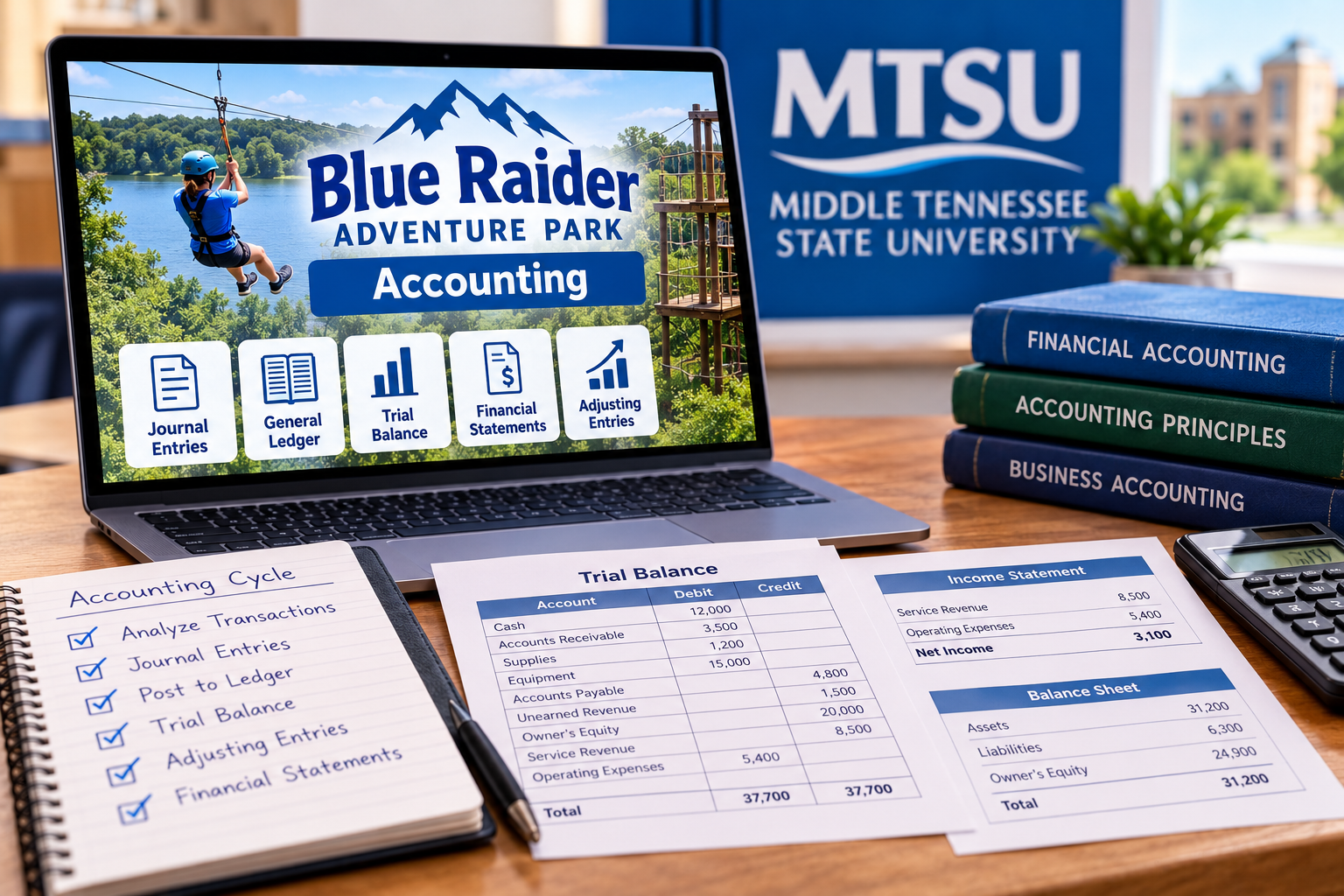
The Blue Raider Adventure Park general ledger is an important topic for students learning financial accounting. It helps explain how business transactions move from the general journal into individual accounts and how those accounts are used to prepare a trial balance.
The Blue Raider Adventure Park scenario is associated with an accounting cycle assignment for ACTG 2110, Principles of Accounting I, at Middle Tennessee State University (MTSU). The assignment provides a business scenario for practicing accounting concepts. However, the exact transactions and amounts must be taken from the student’s original assignment packet.
In this guide, you will learn what a general ledger is, how to post journal entries, how to calculate account balances, and how to identify common accounting errors. You will also see simple examples that demonstrate the process without presenting invented figures as official assignment answers.
What Is the Blue Raider Adventure Park General Ledger?
A general ledger is an organized record of all financial transactions grouped by account. Instead of showing every transaction in one chronological list, it shows how each transaction affects a specific account.
For example, a business might maintain separate ledger accounts for Cash, Equipment, Accounts Payable, Service Revenue, and Operating Expenses. Each account records the relevant debits and credits.
In the Blue Raider Adventure Park accounting scenario, the general ledger connects the journal entries to the trial balance. Therefore, students must understand how to transfer amounts accurately and calculate the ending balance of each account.
A general ledger generally contains the following information:
- Account name and account number, if assigned
- Transaction date
- Journal reference
- Debit amount
- Credit amount
- Running account balance
The precise layout depends on the accounting system or worksheet provided by the instructor.
General Ledger vs. General Journal
Although the general journal and general ledger are closely related, they serve different purposes.
The general journal records transactions in chronological order. The general ledger organizes those transactions by account.
Consider a business that purchases equipment for cash. The journal records the transaction with a debit to Equipment and a credit to Cash. When the entry is posted, the debit appears in the Equipment ledger account, while the credit appears in the Cash ledger account.
| Feature | General Journal | General Ledger |
|---|---|---|
| Main purpose | Records transactions by date | Organizes transactions by account |
| Organization | Chronological | Account-by-account |
| Debits and credits | Shows both sides of each entry | Shows the effect on individual accounts |
| Main use | Documents transactions | Calculates account balances |
| Next accounting step | Posting to ledger | Preparing a trial balance |
Both records must agree. If a journal entry is correct but its amounts are posted to the wrong ledger accounts, the resulting account balances may still be incorrect.
How to Post Journal Entries to the General Ledger
Posting means transferring the debit and credit amounts from the general journal into the appropriate ledger accounts.
Follow these steps when working through a general ledger assignment.
Step 1: Identify the Transaction
Read the transaction carefully and determine which accounts are affected.
For example, a cash purchase of equipment affects two asset accounts: Equipment and Cash. Equipment increases, while Cash decreases.
Do not start posting until you understand the transaction and have identified the correct accounts.
Step 2: Record the Journal Entry
Suppose an adventure park purchases equipment for $2,000 in cash. The following is an illustrative journal entry, not an actual transaction from the Blue Raider Adventure Park assignment.
| Account | Debit | Credit |
|---|---|---|
| Equipment | $2,000 | — |
| Cash | — | $2,000 |
| Total | $2,000 | $2,000 |
Equipment is debited because the asset increases. Cash is credited because the asset decreases.
The debit and credit totals are equal, as required by double-entry accounting.
Step 3: Post the Debit to the Equipment Account
Open the Equipment ledger account and enter the transaction date, journal reference, and $2,000 debit.
If the Equipment account previously had a zero balance, its balance becomes $2,000.
If it already had a debit balance, add the new debit to the existing balance.
Step 4: Post the Credit to the Cash Account
Next, open the Cash ledger account and record the $2,000 credit.
Cash is an asset account, so a credit reduces its balance. If Cash had a debit balance of $10,000 before the transaction, the new balance would be $8,000.
Step 5: Update Both Account Balances
After posting, confirm that both accounts reflect the transaction correctly.
The Equipment account increases by $2,000, while Cash decreases by $2,000. The business has exchanged one asset for another, so the transaction does not automatically change total assets.
Finally, compare the ledger entries with the original journal entry to ensure that neither side has been omitted.
Common Accounts in an Adventure Park General Ledger
The accounts used in an accounting assignment depend on its chart of accounts. The following are examples of accounts that could appear in an adventure park business scenario.
Cash
The Cash account records cash received and cash paid.
Cash received is normally recorded as a debit because it increases an asset. Cash payments are normally recorded as credits because they decrease that asset.
Accounts Receivable
Accounts Receivable records amounts customers owe the business.
When services are provided on credit, Accounts Receivable is generally debited. When a customer pays the outstanding amount, Cash is debited and Accounts Receivable is credited.
Supplies
Supplies may be recorded as an asset when purchased. As the supplies are used, the amount consumed may be recognized as Supplies Expense through an adjusting entry.
The treatment depends on the accounting method and instructions provided.
Equipment
Equipment represents qualifying long-term assets used in business operations. Purchases are generally recorded as debits to Equipment, while disposals and depreciation require their own accounting treatment.
Accounts Payable
Accounts Payable records amounts owed to suppliers and other creditors.
A purchase on account generally increases Accounts Payable through a credit. Paying the outstanding amount generally reduces the liability through a debit.
Owner’s Capital or Other Equity Accounts
The appropriate equity accounts depend on the legal structure of the business and the assignment’s chart of accounts.
For example, an owner’s investment in a sole proprietorship generally increases Owner’s Capital through a credit.
Service Revenue
Service Revenue records income earned from providing services. It generally increases with a credit.
However, cash received before a service is provided may initially be recorded as Unearned Revenue, a liability, rather than earned revenue.
Operating Expenses
Expense accounts record the costs of running the business. Examples may include wages, utilities, insurance, or maintenance.
Expenses generally increase through debits. The actual account names should match the assignment instructions.
How to Calculate General Ledger Balances
Calculating the ending balance is one of the most important parts of preparing a general ledger.
For an asset account such as Cash, the normal balance is a debit. Therefore, the basic calculation is:
Ending debit balance = Beginning debit balance + Debits − Credits
Suppose the Cash account begins with $10,000. During the period, the business receives $3,000 and pays $2,000.
| Cash account activity | Amount |
|---|---|
| Beginning balance | $10,000 |
| Cash received | +$3,000 |
| Cash paid | −$2,000 |
| Ending balance | $11,000 |
The ending Cash balance is $11,000.
For a liability account such as Accounts Payable, the normal balance is a credit. Its ending credit balance can be calculated as:
Ending credit balance = Beginning credit balance + Credits − Debits
Suppose Accounts Payable begins with $4,000. The business purchases another $1,500 on account and pays a supplier $2,000.
| Accounts Payable activity | Amount |
|---|---|
| Beginning balance | $4,000 |
| New credit purchase | +$1,500 |
| Payment to supplier | −$2,000 |
| Ending balance | $3,500 |
The ending Accounts Payable balance is $3,500.
These examples use hypothetical amounts to explain the calculation method. They are not verified Blue Raider Adventure Park figures.
How to Prepare a Trial Balance From the General Ledger
After posting the required transactions and calculating each account’s ending balance, students can prepare the trial balance.
A trial balance lists the general ledger accounts and places each ending balance in either the debit or credit column.
Follow these steps:
- Complete the required journal entries.
- Post every debit and credit to the correct ledger account.
- Calculate the ending balance of each account.
- List the accounts with balances in the trial balance.
- Place each balance in the appropriate column.
- Add the debit and credit columns.
- Investigate any difference before proceeding.
The fundamental check is:
Total Debits = Total Credits
If the two totals agree, the trial balance is mathematically balanced. However, this does not guarantee that every transaction is correct. For example, an entry might have been posted to the wrong expense account while preserving equal debit and credit totals.
For additional explanations of the accounting cycle, see OpenStax Principles of Accounting, Volume 1.
Common General Ledger Mistakes to Avoid
Small posting errors can affect later accounting work. Use the following checks to improve accuracy.
Posting to the Wrong Account
A transaction may be recorded correctly in the journal but transferred to the wrong ledger account.
Always compare the account names in the journal with those in the ledger. Do not rely only on the amounts.
Reversing Debits and Credits
An asset purchase and a liability payment can affect accounts differently. Review the normal balance rules before posting.
Remember that assets and expenses generally increase with debits, while liabilities, equity, and revenue generally increase with credits.
Forgetting a Journal Entry
If a journal entry is not posted, the corresponding ledger balances will be incomplete.
Mark each entry as posted after transferring all its debit and credit amounts. Then verify that every transaction has been processed.
Calculating the Running Balance Incorrectly
Adding credits to a debit-normal account without considering their effect can produce an incorrect balance.
Use the account’s normal balance and calculate the difference between its debit and credit activity carefully.
Using Incorrect Transaction Amounts
A transposed digit can create an error that carries into the trial balance and financial statements.
Compare every posted amount with the original transaction and the journal entry.
Assuming the Trial Balance Proves Everything Is Correct
A balanced trial balance checks the equality of debit and credit totals, not the accuracy of every account classification or transaction.
Review account names, dates, transaction completeness, and the supporting calculations even when the columns agree.
Tips for Completing the Blue Raider Adventure Park General Ledger Assignment
A systematic process is more reliable than trying to complete the entire assignment at once.
First, keep the original assignment packet available. It provides the transaction amounts, dates, account titles, and any special requirements.
Second, finish the journal entries before posting them. This makes it easier to trace each ledger amount to its source.
Third, maintain a running balance for each account. Do not wait until the end to calculate all the balances, because doing so can make errors harder to locate.
Fourth, reconcile the ledger with the trial balance. If the totals differ, trace the affected balances back to the journal instead of changing amounts arbitrarily.
Finally, use a spreadsheet if your instructor permits it. Spreadsheet formulas can reduce arithmetic errors, but they cannot determine whether you selected the correct accounts or interpreted the transaction properly.
The exact requirements may differ by assignment version, so follow the instructor’s directions rather than relying on unofficial answer pages.
Frequently Asked Questions
Q1: What is the Blue Raider Adventure Park general ledger?
Ans: It refers to the general ledger component of an accounting exercise associated online with MTSU’s ACTG 2110 Principles of Accounting I course. The ledger organizes transactions by account and helps students prepare a trial balance.
Q2: What is the difference between a journal and a ledger?
Ans: The general journal records transactions chronologically. The general ledger groups those transactions into individual accounts and calculates their balances.
Q3: How do I post transactions to the general ledger?
Ans: Identify the accounts in each journal entry, transfer the debit and credit amounts to the corresponding ledger accounts, record the relevant date and reference, and update the running balances.
Q4: How do I calculate the ending Cash balance?
Ans: For a typical debit-balance Cash account, add the beginning balance and all debits, then subtract all credits. The result is the ending debit balance, assuming debits exceed credits.
Q5: Why is my trial balance not balancing?
Ans: Possible causes include omitted postings, transposed digits, incorrect arithmetic, or amounts placed in the wrong debit or credit column. Trace the differences back through the ledger and journal.
Q6: Where can I find the exact assignment figures?
Ans: Use the original Blue Raider Adventure Park assignment packet provided through your course. General accounting examples explain the method but cannot establish the exact figures for your version of the assignment.
Conclusion
The Blue Raider Adventure Park general ledger demonstrates how journal entries become organized account balances. Each transaction must be posted to the correct accounts, and every account’s ending balance must be calculated carefully before preparing the trial balance.
By following the accounting process in order, checking each posting, and using the original assignment figures, students can reduce errors and understand how the general ledger supports financial reporting.
The key is consistency: analyze the transaction, record the journal entry, post both sides, calculate the balance, and verify the result before moving to the next accounting stage.