
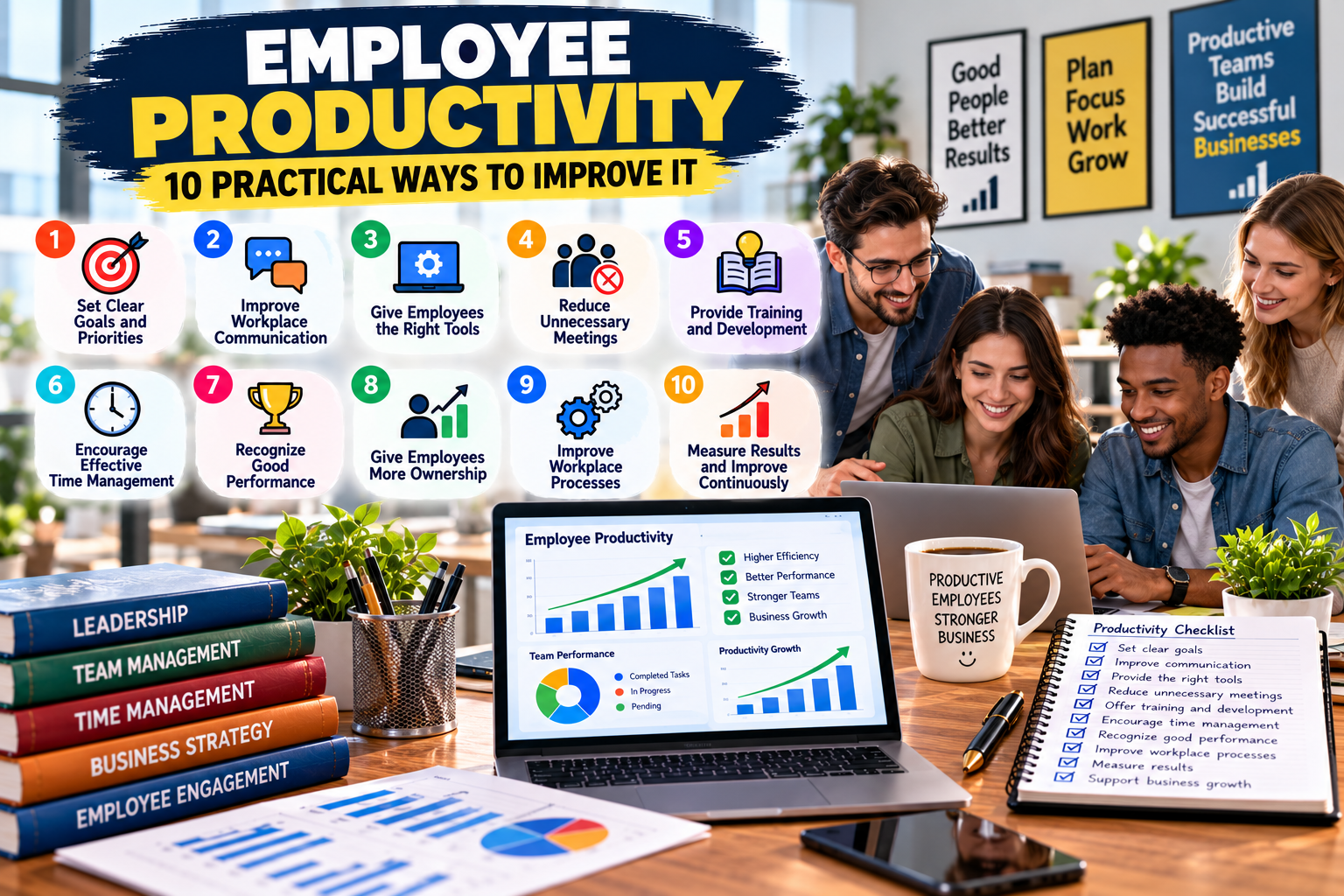
Employee productivity is an important part of running an efficient business. When employees understand their responsibilities, have the right tools, and can focus on meaningful work, businesses can often improve efficiency and achieve better results.
However, improving productivity does not mean simply asking employees to work longer hours. Sustainable performance depends on clear expectations, realistic goals, useful resources, effective management, and a workplace where employees can do their jobs properly.
Gallup’s current workplace research connects employee engagement and wellbeing with productivity, performance, absenteeism, and retention. Its research also highlights clear expectations, realistic goals, and recognition as important management practices.
For small businesses, improving productivity can be especially valuable because limited resources make wasted time and inefficient processes more expensive.
Here are 10 practical ways to improve employee productivity without creating unnecessary pressure.
What Is Employee Productivity?
Employee productivity refers to the amount and quality of useful work employees produce in relation to the time and resources used.
Productivity is not simply about counting how many hours someone spends at a desk. An employee who completes important tasks accurately in six hours may be more productive than someone who spends ten hours working but struggles with unclear priorities and inefficient processes.
A productive workplace usually has:
- Clear responsibilities
- Well-defined priorities
- Effective communication
- Appropriate tools
- Efficient processes
- Useful training
- Constructive feedback
- Reasonable workloads
- Meaningful performance measurements
The goal should be to help employees spend more time on valuable work and less time dealing with unnecessary obstacles.
Why Is Employee Productivity Important?
Improve Business Efficiency
When employees understand what needs to be done and have the resources to complete their work, businesses can reduce unnecessary delays and improve overall efficiency.
Reduce Wasted Time
Poor communication, unnecessary meetings, repetitive manual tasks, and unclear responsibilities can consume valuable working time.
Improving these areas allows employees to focus on higher-value activities.
Improve Customer Service
Productive employees can respond to customers more efficiently, complete orders on time, solve problems faster, and maintain better communication.
Control Operating Costs
Inefficient processes can increase labor costs without producing better results. Improving workflows can help businesses use their resources more effectively.
Support Business Growth
A productive team gives business owners more capacity to serve customers, develop products, improve operations, and pursue new opportunities.
10 Ways to Improve Employee Productivity
1. Set Clear Goals and Priorities
Employees need to understand what is expected of them.
Instead of giving employees a long list of tasks without priorities, explain which responsibilities are most important and when they need to be completed.
For example, a manager could divide weekly responsibilities into:
- High-priority tasks
- Important but flexible tasks
- Routine tasks
- Tasks that can be postponed
Clear goals also make it easier to evaluate progress.
Gallup research emphasizes the importance of employees knowing what is expected of them and having clear expectations around their work.
When priorities change, managers should communicate those changes rather than assuming employees will automatically understand them.
2. Improve Workplace Communication
Poor communication can create delays, duplicated work, mistakes, and frustration.
Businesses can improve communication by establishing simple rules for:
- Team updates
- Project discussions
- Urgent requests
- Documentation
- Customer issues
- Internal approvals
Not every issue requires a meeting. Some updates can be handled through email, project-management software, or written documentation.
The objective is not to communicate more frequently. It is to communicate clearly and at the right time.
3. Give Employees the Right Tools
Employees cannot consistently perform at their best if they lack the tools required to complete their responsibilities.
Depending on the business, useful tools may include:
- Project-management software
- Customer relationship management systems
- Accounting software
- Communication platforms
- Cloud storage
- Scheduling systems
- Industry-specific software
- Automation tools
The U.S. Small Business Administration notes that productivity software can influence employee engagement and productivity and recommends considering the different working styles and needs of employees when selecting tools.
However, adding more software is not automatically better. Too many platforms can create confusion.
Choose tools that solve actual problems and make them easy for employees to use.
4. Reduce Unnecessary Meetings
Meetings can be useful when employees need to make decisions, solve problems, or coordinate important work.
But meetings can also become a major source of lost time when they have no clear purpose.
Before scheduling a meeting, ask:
- Is a meeting necessary?
- Who actually needs to attend?
- What decision needs to be made?
- Can the issue be handled in writing?
- Is there a clear agenda?
When meetings are necessary, keep them focused and end when the objective has been achieved.
This gives employees more uninterrupted time for important tasks.
5. Provide Training and Development
Employees may struggle with productivity because they lack the skills or knowledge required for their responsibilities.
Training can help employees:
- Learn new software
- Improve technical skills
- Understand company processes
- Improve communication
- Reduce errors
- Adapt to new technology
- Develop leadership skills
The SBA notes that job-related training can help employees adapt to workplace changes and operate more safely and efficiently.
Training does not always need to be expensive.
Businesses can use:
- Online courses
- Internal workshops
- Mentoring
- Demonstrations
- Documentation
- Peer training
- Short skill-development sessions
The key is to provide training that solves a real business need.
6. Encourage Effective Time Management
Employees often have multiple responsibilities competing for their attention.
Effective time management can help employees decide where to focus their energy.
Useful practices include:
- Prioritizing important tasks
- Breaking large projects into smaller steps
- Setting realistic deadlines
- Limiting unnecessary interruptions
- Grouping similar tasks together
- Scheduling focused work periods
- Reviewing unfinished work regularly
Employees should also understand which tasks actually contribute to business objectives.
A busy schedule does not necessarily mean productive work.
7. Recognize Good Performance
Recognition can help employees understand which behaviors and results the business values.
Recognition does not always need to involve financial rewards.
Managers can recognize employees through:
- Verbal appreciation
- Written feedback
- Public recognition
- Additional responsibilities
- Professional development opportunities
- Flexible arrangements where appropriate
- Performance-based rewards
Gallup identifies recognition as one of the workplace conditions associated with employee engagement and performance.
Recognition should be specific. Instead of simply saying “good job,” explain what the employee did well and why it mattered.
8. Give Employees More Ownership
Micromanagement can slow down decision-making and make employees dependent on managers for small decisions.
Where appropriate, give employees ownership over their responsibilities.
For example, instead of telling an employee exactly how to complete every task, explain:
- The desired result
- The deadline
- Important limitations
- Available resources
Then allow the employee to determine the best way to complete the work.
This can encourage problem-solving and accountability.
Employees should still have access to managers when they need guidance, but not every minor decision should require approval.
9. Improve Workplace Processes
Sometimes productivity problems are caused by the system rather than the employee.
For example, an employee may take too long to complete a task because the company requires several unnecessary approvals.
Review your workflows and look for repetitive steps, delays, and unnecessary complexity.
| Problem | Possible Solution |
|---|---|
| Repetitive tasks | Automate where practical |
| Unclear responsibilities | Define ownership |
| Slow approvals | Simplify workflows |
| Too many meetings | Use focused updates |
| Repeated errors | Improve training and processes |
The SBA also recommends reviewing business operations to identify opportunities to work more efficiently and cost-effectively.
Small process improvements can create significant savings when they affect tasks employees perform every day.
10. Measure Results and Improve Continuously
You cannot improve productivity effectively if you never measure results.
However, businesses should avoid measuring employees only by the number of hours they work or how frequently they appear online.
Instead, consider meaningful indicators such as:
- Completed projects
- Quality of work
- Customer satisfaction
- Error rates
- Sales results
- Project completion times
- Meeting deadlines
- Production output
The right measurements depend on the employee’s role.
For example, measuring a customer-service representative only by the number of calls handled could encourage rushed conversations. Combining volume with customer satisfaction and issue resolution may provide a more useful picture.
How to Measure Employee Productivity
There is no single productivity measurement that works for every business.
Start by identifying the outcomes that matter most for each role.
For a sales employee, useful indicators might include:
- Qualified leads
- Sales generated
- Conversion rate
- Customer retention
For a customer-service employee:
- Response time
- Resolution rate
- Customer satisfaction
- Number of unresolved issues
For a content employee:
- Completed assignments
- Content quality
- Organic traffic
- Publishing consistency
For an operations employee:
- Production output
- Error rate
- Completion time
- Process efficiency
The objective is to measure meaningful results rather than activity for its own sake.
Common Mistakes That Reduce Employee Productivity
Micromanaging Employees
Constantly monitoring every small decision can slow employees down and reduce their ability to solve problems independently.
Setting Too Many Priorities
If everything is urgent, employees may struggle to determine what deserves attention first.
Set a manageable number of important priorities.
Using Too Many Meetings
Meetings should solve a specific problem or support coordination. Routine meetings without a clear purpose can consume valuable work time.
Ignoring Employee Feedback
Employees often experience operational problems directly. They may know which tools, processes, or procedures are slowing them down.
Ask employees what prevents them from doing their work efficiently and look for recurring patterns.
Measuring Activity Instead of Results
Being online, sending many messages, or attending numerous meetings does not necessarily mean someone is productive.
Focus on outcomes.
Failing to Provide Proper Tools
Employees cannot be expected to work efficiently when essential software, equipment, information, or training is missing.
Employee Productivity Improvement Checklist
Use this checklist to review your workplace:
- ☐ Set clear goals
- ☐ Define priorities
- ☐ Improve communication
- ☐ Review unnecessary meetings
- ☐ Provide useful tools
- ☐ Identify training needs
- ☐ Improve time management
- ☐ Recognize good performance
- ☐ Encourage employee ownership
- ☐ Review inefficient processes
- ☐ Track meaningful results
- ☐ Collect employee feedback
You do not need to change everything at once.
Start with the biggest productivity obstacle and improve it before moving to the next one.
FAQs
Q1: How can I improve employee productivity?
Ans: Set clear expectations, provide the right tools, improve communication, reduce unnecessary work, offer relevant training, and measure meaningful results.
Q2: What affects employee productivity the most?
Ans: Productivity can be affected by unclear priorities, poor communication, inefficient processes, lack of resources, insufficient training, workplace stress, and ineffective management.
Q3: How can small businesses improve productivity?
Ans: Small businesses can focus on simple improvements such as defining responsibilities, eliminating unnecessary tasks, improving workflows, using appropriate software, and training employees.
Q4: Should businesses track employee productivity?
Ans: Yes, but businesses should focus on meaningful outcomes rather than simply tracking hours or online activity. The right metrics depend on each employee’s role.
Q5: Does employee recognition improve productivity?
Ans: Recognition can support engagement and motivation when it is specific, genuine, and connected to meaningful contributions. Gallup’s research identifies recognition as one of the important conditions associated with employee engagement.
Final Thoughts
Improving employee productivity is not about putting more pressure on people. It is about creating an environment where employees understand their responsibilities, have the right resources, and can spend their time on valuable work.
Pay attention to employee feedback as well. Productivity problems sometimes come from processes that make good employees less efficient.
When businesses consistently remove unnecessary obstacles and help employees perform their best, they can build stronger operations and support long-term business growth.
The best productivity strategy is not necessarily the most complicated one. Often, small improvements to everyday processes can make a meaningful difference over time.