
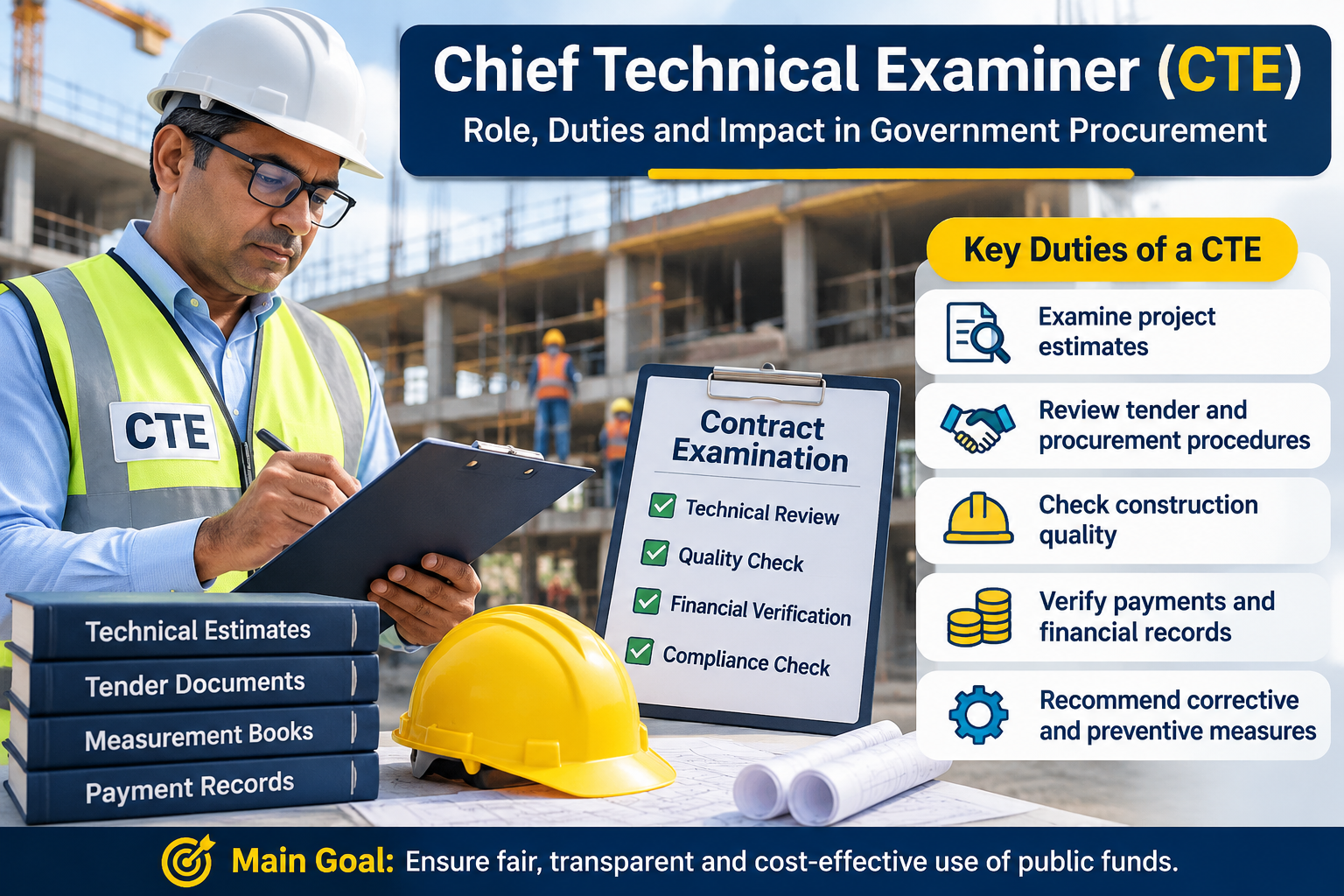
A Chief Technical Examiner (CTE) is a senior technical officer who examines government engineering projects, procurement contracts and related financial irregularities. In India, the Central Vigilance Commission (CVC) oversees the Chief Technical Examiners’ Organisation (CTEO), which examines public contracts and helps government organizations improve transparency.
The CTEO checks technical specifications, contract conditions, construction quality and payment records. Moreover, its examinations help organizations identify irregularities, prevent unnecessary expenditure and strengthen procurement practices.
Chief Technical Examiner: Quick Facts
| Attribute | Details |
|---|---|
| Full form | Chief Technical Examiner |
| Related organization | Chief Technical Examiners’ Organisation (CTEO) |
| Supervising authority | Central Vigilance Commission |
| Establishment | 1957 |
| CVC integration | 1964 |
| Main responsibility | Technical and financial examination |
| Main report | Intensive Examination Report |
| Central pay example | Level 14, ₹1,44,200–₹2,18,200 basic pay |
Note: The salary figures relate to a specific CVC deputation vacancy, not every CTE position in India.
What Is a Chief Technical Examiner?
A Chief Technical Examiner is a senior professional who examines the technical and financial aspects of government contracts.
Unlike a project engineer, who manages project execution, a CTE independently reviews relevant procurement and engineering records. For example, the examiner may compare approved estimates with actual expenditure, inspect construction quality and examine whether contractors followed their agreements.
Furthermore, the CTE evaluates whether public organizations followed the applicable procurement procedures.
What Is the Chief Technical Examiners’ Organisation?
The Chief Technical Examiners’ Organisation (CTEO) operates as the technical wing of India’s Central Vigilance Commission.
According to the CVC Annual Report 2025, two Chief Technical Examiners at Chief Engineer level head the organization. They receive support from Technical Examiners, Assistant Technical Examiners and Junior Technical Examiners.
The CTEO examines several types of government contracts. These include civil construction, engineering services, equipment procurement and other relevant public-sector purchases.
In addition, the organization provides technical advice to the Commission and supports preventive vigilance through professional guidance and training.
CTE, CTEO, CVC and CVO: What Is the Difference?
These terms describe different roles within India’s vigilance framework.
- CTE: A senior technical officer who supervises technical examinations.
- CTEO: The organization that conducts technical examinations.
- CVC: The central statutory authority responsible for vigilance oversight within its jurisdiction.
- CVO: The Chief Vigilance Officer who coordinates vigilance activities within an organization.
Although these authorities work together, each performs different responsibilities.
Are Central and State-Level CTE Positions the Same?
No. Different government authorities may maintain separate technical examination arrangements.
For example, the Government of Kerala issued a recruitment notification in September 2026 for Chief Technical Examiner (Civil) and Assistant Chief Technical Examiner positions.
However, these posts follow state-specific eligibility requirements rather than automatically following central CVC recruitment rules.
Therefore, applicants should always check the relevant government notification before applying.
History of the Chief Technical Examiners’ Organisation
The CTEO began its work in 1957 under the former Ministry of Works, Housing and Supply.
Initially, the organization focused on technical and financial examinations of Central Public Works Department (CPWD) projects. Its main objective was to improve engineering standards, control unnecessary expenditure and strengthen government contract management.
Later, the Santhanam Committee recommended strengthening technical examination and expanding its responsibilities.
Consequently, the government brought the CTEO under the Central Vigilance Commission in 1964.
Since then, the organization has expanded its examination activities beyond traditional construction projects. Today, it also examines various procurement activities involving government departments and public-sector organizations.
Main Duties and Responsibilities of a Chief Technical Examiner
A Chief Technical Examiner performs several responsibilities throughout the government procurement process.
1. Examining Technical Estimates
First, the examiner reviews project estimates and technical approvals.
The examination may cover:
- Estimated project costs and quantities.
- Technical specifications and drawings.
- Applicable construction rates.
- Administrative and technical approvals.
- Changes in the original project scope.
For example, an unusually high project estimate may require a closer review of quantities, rates and supporting calculations.
2. Reviewing Tender and Procurement Procedures
Next, the examiner checks whether an organization followed appropriate procurement procedures.
This examination may include tender advertisements, eligibility conditions, bid evaluations and contract awards.
Moreover, the examiner may investigate unexplained restrictions on competition, inconsistent evaluation methods and unjustified contract variations.
The objective is to determine whether the organization followed fair and transparent procurement practices.
3. Checking Construction Quality
Technical examiners also evaluate whether contractors meet the required engineering standards.
For civil projects, they may examine concrete quality, reinforcement measurements, material specifications and construction records.
Similarly, equipment procurement may require checks of technical specifications, inspection certificates, delivery documents and acceptance tests.
4. Examining Payments and Financial Records
A CTE may compare contractor bills with measurement books, approved quantities and contractual rates.
This process helps identify unsupported payments, calculation errors and discrepancies between recorded work and actual execution.
However, a difference between two records does not automatically prove financial misconduct. The examiner must first examine the supporting evidence.
5. Recommending Improvements
Finally, the examiner may recommend corrective or preventive measures.
These recommendations can include improved recordkeeping, stronger quality controls, recovery of verified overpayments and better contract management.
As a result, technical examinations can help organizations prevent similar problems in future projects.
How Does a CTE Intensive Examination Work?
An Intensive Examination (IE) follows a structured process. It combines document reviews, technical checks, site inspections and follow-up activities.
Step 1: Contract Selection
The CTEO generally selects contracts from Quarterly Progress Reports (QPRs) submitted by Chief Vigilance Officers.
However, other factors can also influence selection. These include project value, complaints, unusual cost increases and recommendations from vigilance authorities.
Step 2: Collecting Documents
Next, the examination team requests relevant project records.
These may include:
- Approved estimates.
- Tender documents.
- Contract agreements.
- Technical drawings.
- Measurement books.
- Quality-test reports.
- Contractor bills.
- Completion certificates.
The team uses these documents to understand the project’s approval, procurement and execution history.
Step 3: Technical and Financial Verification
The examiner compares project records with contractual requirements and applicable technical standards.
For example, the team may compare billed quantities with measurement records. It may also examine whether contractors supplied materials that meet the required specifications.
Where necessary, the team conducts physical inspections and requests additional explanations.
Step 4: Preparing the Examination Report
After completing the examination, the Technical Examiner prepares an Intensive Examination Report (IER).
The report explains relevant observations, supporting evidence and possible irregularities.
The prescribed CTEO authorities review the findings before the organization receives the report through the appropriate channels.
Step 5: Organization Response
The concerned organization examines the observations and submits its response through the prescribed process.
The Chief Vigilance Officer coordinates the Action Taken Report (ATR) and provides relevant explanations.
According to the accessible text of the 2026 Vigilance Manual, the CVO should submit the ATR within two months of receiving the report.
Step 6: Follow-Up and Further Action
Finally, the CTEO and relevant vigilance authorities examine the organization’s response.
Depending on the evidence, the organization may correct errors, recover verified overpayments or improve its procedures.
If the findings indicate a possible vigilance violation, the appropriate authority may initiate further investigation.
Importantly, a technical observation alone does not establish corruption or misconduct.
Updated 2026 CVC Reporting Guidelines
On March 16, 2026, the Central Vigilance Commission issued Circular No. 02/03/26, which revised procurement reporting thresholds for Quarterly Progress Reports.
The circular replaced earlier instructions on the relevant reporting thresholds.
Revised QPR Thresholds
| Procurement category | Reporting threshold |
|---|---|
| Civil works | ₹15 crore |
| Electrical, mechanical and related works | ₹5 crore |
| Horticulture works | ₹20 lakh |
| General goods and equipment | ₹10 crore |
| Medical equipment | ₹2 crore |
| Medicines and vaccines | ₹50 lakh |
| Sale of goods, scrap and land | ₹5 crore |
| Consultancy services | ₹2 crore |
| Non-consultancy services | ₹2 crore |
Important Reporting Exception
The circular also addresses categories where no contract exceeds the prescribed threshold.
In such cases, organizations should report the two highest-value contracts in that category. If they award no contracts, they may submit a Nil QPR.
Furthermore, organizations should use the accepted tender or work-order value rather than the initial estimated project cost.
Does Every Reported Contract Receive an Inspection?
No. Reporting and inspection selection are different processes.
The QPR helps the CTEO identify relevant procurement activities. However, the organization selects contracts for intensive examination according to applicable procedures and other relevant factors.
Therefore, a reporting threshold does not automatically create an inspection requirement.
Documents and Warning Signs a Chief Technical Examiner Checks
A technical examination requires reliable supporting documents. Each record helps the examiner verify a different part of the procurement process.
| Document | What the examiner checks |
|---|---|
| Feasibility report | Project justification |
| Approved estimate | Expected costs and quantities |
| Tender documents | Procurement conditions |
| Bid evaluation records | Bid comparison and selection |
| Contract agreement | Contractor obligations |
| Technical drawings | Approved design |
| Measurement book | Recorded work quantities |
| Quality reports | Material and workmanship standards |
| Payment bills | Financial claims |
| Completion certificate | Project completion records |
The 2025 Hindustan Copper training material discusses these documents as part of practical CTE-type examination.
Common Issues That Require Further Examination
For example, an examiner may investigate unsupported payment quantities, incomplete quality records or unexplained changes in contract terms.
Similarly, inconsistent tender evaluation records may require additional clarification.
However, missing documents or technical differences do not automatically prove misconduct. The examiner must assess the available evidence before recording a conclusion.
What Powers Does a Chief Technical Examiner Have?
A Chief Technical Examiner supervises authorized technical examinations and provides technical findings and advice within the applicable CVC framework.
The examiner can review relevant records, coordinate with officials and identify possible technical or financial irregularities.
However, the CTE does not independently exercise every power associated with criminal investigation or disciplinary punishment.
Instead, the relevant vigilance and administrative authorities follow the prescribed procedures when examination findings require further action.
Can a Chief Technical Examiner Punish Government Officials?
No. A CTE does not independently impose disciplinary or criminal punishment.
The examiner reports technical findings, while the competent authorities handle investigation and disciplinary proceedings under applicable rules.
CTE vs. CVO vs. CVC vs. CAG
Although these institutions support public accountability, their responsibilities differ.
| Authority | Main responsibility |
|---|---|
| CTE | Technical examination of selected contracts |
| CTEO | Organization conducting technical examinations |
| CVO | Vigilance coordination within an organization |
| CVC | Central vigilance oversight |
| CAG | Government financial, compliance and performance audits |
By contrast with the CTEO’s specialized procurement examinations, the Comptroller and Auditor General of India performs constitutional audit functions.
Therefore, readers should not treat CTE examinations and CAG audits as identical processes.
What Does the CVC Annual Report 2025 Reveal?
The CVC Annual Report 2025 provides valuable evidence about the CTEO’s actual work.
During 2025, the organization conducted 84 intensive examinations across 70 organizations.
The combined contract value exceeded ₹15,945.20 crore. Moreover, the report recorded ₹260.90 crore in recoveries by organizations following CTEO observations.
CTEO Examination Results
| Organization category | Organizations | Examinations |
|---|---|---|
| Government departments | 16 | 20 |
| Autonomous bodies | 9 | 11 |
| Public-sector undertakings | 39 | 47 |
| Banks and financial institutions | 6 | 6 |
| Total | 70 | 84 |
These figures show the scale of the CTEO’s examination activities.
However, the combined contract value does not represent financial losses or proven corruption.
CVO-Led CTE-Type Examinations
The CVC report also records separate examinations by Chief Vigilance Officers.
During 2025, 518 reporting organizations recorded:
| Result | Figure |
|---|---|
| CTE-type examinations | 2,129 |
| Recoveries | ₹61.04 crore |
| Vigilance cases | 243 |
| Systemic improvements | 3,191 |
These results belong to the CVO-led examination stream, not the CTEO’s 84 central examinations.
Additionally, the CVC recorded seven CTEO-related referrals for detailed vigilance investigation and technical advice in 126 vigilance or complaint cases.
Chief Technical Examiner Qualifications, Salary and Recruitment
A Chief Technical Examiner generally needs strong engineering knowledge, substantial professional experience and familiarity with government procurement procedures.
However, the exact eligibility requirements depend on the recruiting authority and the specific vacancy.
Educational Qualifications and Experience
A CVC vacancy circular dated December 17, 2025, for Chief Technical Examiner (Store Procurement and Inventory Control) required a graduate engineering degree from a recognized university or institute.
It also specified relevant experience in areas such as contract management, material management, procurement, quality assurance and vigilance.
Furthermore, the notice included eligibility conditions for specified senior government and public-sector engineering grades.
The circular also identified relevant postgraduate engineering and professional qualifications as desirable.
Chief Technical Examiner Salary
The specific central CVC vacancy carried the following pay conditions:
| Attribute | Details |
|---|---|
| Pay level | Level 14 |
| Basic pay range | ₹1,44,200–₹2,18,200 |
| Classification | Group A Gazetted |
| Appointment | Deputation |
| Deputation period | Three years |
| Maximum age | 56 years under that notice |
These figures describe the basic pay matrix, not guaranteed take-home salary.
Moreover, the notice’s application deadline was February 10, 2026, so it does not represent an open vacancy.
State-Level Recruitment Requirements
The Government of Kerala issued a separate notification in September 2026 for a Chief Technical Examiner (Civil) position.
The notification specified a civil engineering degree with at least 60% marks and a minimum of 20 years of post-qualification professional experience, along with the required senior service-grade conditions.
Therefore, central and state-level eligibility requirements can differ considerably.
Applicants should always consult the latest official recruitment notice.
Practical Example: How a CTE Examines a Government Contract
Consider a hypothetical government construction contract worth ₹12 crore.
During an examination, the CTE compares the contractor’s bill with the project’s measurement book.
The contractor claims payment for 1,250 cubic metres of concrete. However, the available measurement records initially support only 1,100 cubic metres.
Assume the contract rate is ₹8,000 per cubic metre.
Step 1: Calculate the Difference
Billed quantity: 1,250 cubic metres.
Recorded quantity: 1,100 cubic metres.
Difference: 150 cubic metres.
Step 2: Calculate the Potential Discrepancy
150 × ₹8,000 = ₹12,00,000.
Therefore, the apparent difference represents ₹12 lakh at the assumed contract rate.
However, this calculation does not establish an actual financial loss.
Step 3: Examine Supporting Records
The examiner should check whether additional measurements, approved variations or other contractual provisions explain the difference.
Moreover, the team may review site records, drawings, quality reports and payment certifications.
Step 4: Record the Finding
If the discrepancy remains unexplained, the examiner can record the observation and request clarification through the prescribed process.
The responsible organization then reviews the evidence and decides the appropriate next steps.
This hypothetical example demonstrates why a CTE must examine supporting records before recommending recovery or further action.
Frequently Asked Questions
Q1: What Is the Full Form of CTE?
Ans: CTE stands for Chief Technical Examiner. The term refers to a senior technical officer responsible for supervising relevant examinations.
Q2: Is a Chief Technical Examiner a Government Officer?
Ans: Yes. Central CTE positions belong to the government service framework and may involve deputation from eligible organizations.
Q3: Does a CTE Investigate Corruption?
Ans: A CTE identifies technical and financial irregularities. However, formal vigilance investigations follow separate procedures.
Q4: Can a CTE Inspect Completed Projects?
Ans: Yes. The CTEO may examine ongoing and completed contracts, depending on the applicable selection and examination procedures.
Q5: Is There a Direct Recruitment Exam for CTE?
Ans: The specific central CVC vacancy discussed here used deputation. Other recruiting authorities may follow different appointment procedures.
Q6: Can a CTE Report Lead to Financial Recovery?
Ans: Yes. Organizations may recover verified overpayments following appropriate examination and administrative action.
Q7: Does a CTE Report Prove Corruption?
Ans: No. An examination observation requires proper assessment and, where necessary, further investigation.
Q8: What Is the Difference Between a Technical Audit and a CTE Examination?
Ans: A technical audit is a broader form of technical assessment. A CTE examination follows the applicable CVC technical and vigilance framework.
Conclusion
A Chief Technical Examiner plays an important role in strengthening accountability across India’s public procurement system.
Through technical scrutiny, contract examination and financial verification, the CTEO helps government organizations identify irregularities and improve procurement practices.
The CVC’s 2025 Annual Report demonstrates the organization’s practical contribution. Meanwhile, the March 2026 reporting changes highlight the importance of keeping procurement procedures current.
For engineers and procurement professionals, understanding the CTE’s responsibilities can improve contract management, technical documentation and compliance.
Ultimately, effective technical examination depends on reliable evidence, fair procedures and appropriate follow-up.