
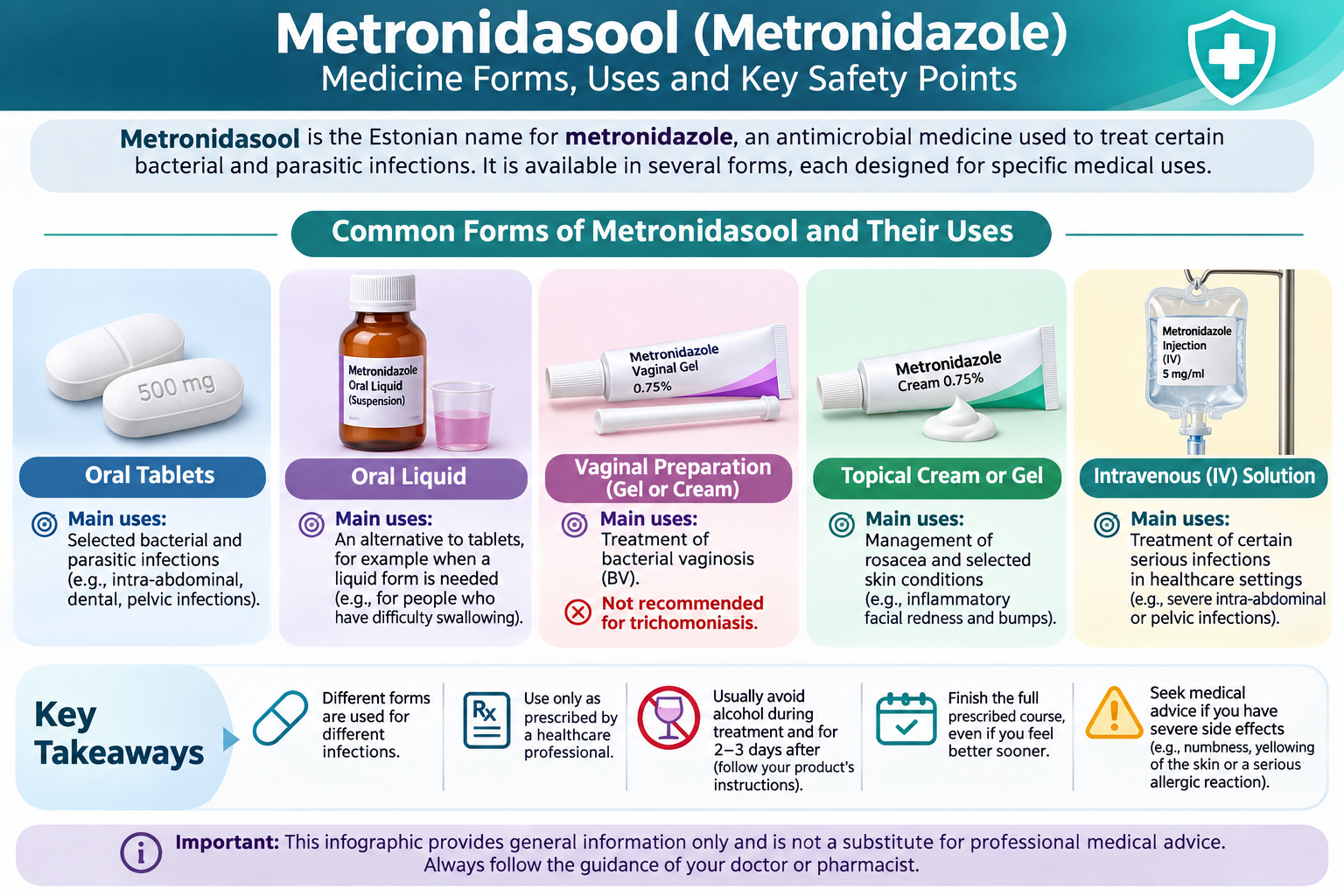
Metronidasool is the Estonian name for metronidazole, a prescription antimicrobial medicine used to treat certain bacterial and parasitic infections. It is available in several forms, including oral tablets, liquids, vaginal preparations, skin treatments and hospital-administered injections. Its appropriate use, dosage and safety precautions depend on the infection, formulation and individual medical circumstances.
The name may look unfamiliar to English-speaking readers, but it is not an invented medicine. Official European pharmaceutical documents recognize Metronidasool as the Estonian equivalent of metronidazole.
Understanding that distinction is useful, particularly when interpreting foreign-language medicine packaging, checking prescriptions or comparing information from different countries.
Metronidasool at a Glance
| Feature | Information |
|---|---|
| Estonian name | Metronidasool |
| English generic name | Metronidazole |
| Drug class | Nitroimidazole antimicrobial |
| Main purpose | Treatment of susceptible bacterial and protozoal infections |
| Available forms | Tablets, oral liquid, vaginal preparations, topical creams and gels, suppositories and injections |
| Example brand names | Flagyl and Rozex, depending on the country and formulation |
| Prescription status | Prescription-only in the UK; local requirements vary |
| Important consideration | Different formulations are not automatically interchangeable |
The European Medicines Agency confirms the Estonian and English terminology. The NHS provides additional information about available forms and common medical uses.
What Does Metronidasool Mean?
Metronidasool is the established Estonian-language name for the active pharmaceutical ingredient known internationally in English as metronidazole.
The European Medicines Agency published a multilingual document on June 29, 2011, listing the active ingredient under its names in different European languages. The document identifies the following equivalents:
| Language | Active ingredient name |
|---|---|
| Estonian | Metronidasool |
| English | Metronidazole |
| German | Metronidazol |
| French | Métronidazole |
| Finnish | Metronidatsoli |
These names describe the same active ingredient, although the medicine’s brand, strength and formulation can differ between products.
Is Metronidasool a Misspelling?
Not in Estonian.
An English-speaking person might initially mistake Metronidasool for an incorrect spelling of metronidazole. However, the term is recognized in official Estonian medicine documentation.
Estonia’s State Agency of Medicines, known as Ravimiamet, uses metronidasool in its pharmaceutical records.
For example, its May 2024 marketing-authorisation information identifies a product called Metronidazole Basi, lists its active ingredient as metronidasool, and describes the product as a 5 mg/ml solution for infusion.
This example demonstrates an important distinction: the product name and the active ingredient name do not necessarily use identical spellings.
How to Identify the Correct Metronidasool Medicine
Recognizing the name is only the first step. Before taking a medicine obtained or prescribed in another country, the exact product must be identified.
Five details are especially important:
- Active ingredient: Confirm that the package identifies metronidasool or metronidazole.
- Strength: Check the quantity of active ingredient, such as the stated milligrams per tablet or concentration per millilitre.
- Dosage form: Identify whether it is a tablet, oral liquid, vaginal preparation, skin treatment or injectable medicine.
- Instructions: Read the approved patient leaflet or obtain a reliable translation.
- Prescription details: Make sure the formulation and directions match those provided by a qualified healthcare professional.
For example, a tablet labelled 500 mg and an intravenous solution labelled 5 mg/ml both contain metronidazole, but they are designed for different methods of administration.
The concentration of a medicine does not independently determine how much a patient should take.
If the packaging is unclear, a pharmacist should verify the product before use.
How Does Metronidasool Work?
Metronidazole belongs to the nitroimidazole class of antimicrobial medicines.
After entering susceptible microorganisms, the medicine undergoes chemical changes that produce substances capable of damaging their DNA. This interferes with essential cellular processes and can lead to the death of susceptible organisms.
Metronidazole is particularly active against certain anaerobic bacteria—organisms that grow in environments with little or no oxygen—and selected protozoan parasites.
However, this does not mean it works against every infection.
Its activity is limited against many other bacteria, and it does not treat viral illnesses such as influenza or the common cold.
Skin formulations used for rosacea also have therapeutic effects that cannot simply be equated with treating an ordinary bacterial infection.
What Infections Can Metronidasool Treat?
Metronidazole has several established medical applications. The choice of treatment depends on the infection’s cause, severity, location and relevant clinical guidelines.
1. Anaerobic Bacterial Infections
Metronidazole may be prescribed for infections caused by susceptible anaerobic bacteria.
These can include certain:
- Intra-abdominal infections and abscesses.
- Pelvic infections.
- Dental and gum infections.
- Skin and soft-tissue infections.
- Postoperative infections.
Some of these conditions involve multiple types of bacteria. In such cases, metronidazole may be used alongside other antibiotics rather than as the only treatment.
A dental abscess, for example, may require drainage or treatment of the affected tooth. Taking an antibiotic alone may not address the underlying cause.
2. Bacterial Vaginosis
Bacterial vaginosis, commonly abbreviated as BV, involves a disruption of the normal bacterial balance in the vagina.
Metronidazole is one of the recommended treatment options for symptomatic BV.
Depending on the patient’s circumstances, a clinician may prescribe an oral preparation or an appropriate vaginal gel.
The US Centers for Disease Control and Prevention (CDC) includes both oral metronidazole and intravaginal metronidazole gel among its recommended treatment regimens.
These options are selected according to the clinical situation; they should not be substituted without professional advice.
3. Trichomoniasis
Trichomoniasis is a sexually transmitted infection caused by the protozoan parasite Trichomonas vaginalis.
Oral metronidazole is an established treatment.
Unlike bacterial vaginosis, trichomoniasis requires particular attention to sexual-partner management because an untreated partner may contribute to reinfection.
An important formulation distinction also applies: the CDC does not recommend metronidazole vaginal gel for treating trichomoniasis. The gel does not reach adequate therapeutic levels in certain affected tissues and is less effective than oral treatment.
This illustrates why two conditions affecting similar parts of the body may require different medication instructions.
4. Certain Intestinal and Parasitic Infections
Metronidazole may be used for selected protozoal infections, including giardiasis and amoebiasis.
Giardiasis is caused by Giardia parasites and can lead to diarrhoea, abdominal discomfort and other digestive symptoms.
Amoebiasis is caused by Entamoeba histolytica and may involve the intestine or other organs, including the liver.
The appropriate treatment depends on the diagnosis. For invasive amoebiasis, additional medicine may be needed to eliminate parasites remaining in the intestine.
These conditions should not be self-diagnosed solely on the basis of stomach symptoms.
5. Rosacea and Selected Skin Conditions
Topical metronidazole is used to manage inflammatory lesions associated with rosacea, a chronic skin condition that can cause facial redness, bumps and irritation.
Creams and gels intended for rosacea are applied to the skin according to their product instructions.
Improvement may take several weeks. A topical rosacea product is not a substitute for oral or intravenous treatment of a serious internal infection.
The NHS lists rosacea among the conditions for which metronidazole may be prescribed.
6. What About Clostridioides difficile Infection?
Some medicine information and historical treatment references list metronidazole for Clostridioides difficile infection, commonly called C. difficile or CDI.
However, listing an infection as a possible indication is not the same as recommending a medicine as the preferred current treatment.
The 2021 IDSA/SHEA adult treatment update favors fidaxomicin for an initial CDI episode, with oral vancomycin remaining an acceptable alternative. The guideline’s discussion places these medicines ahead of metronidazole in routine initial treatment.
This distinction matters because treatment recommendations change as better evidence becomes available.
Metronidasool Forms: Why the Formulation Matters
Metronidazole is available in different preparations because infections occur in different parts of the body.
| Formulation | Typical medical purpose | Important distinction |
|---|---|---|
| Oral tablets | Selected bacterial and parasitic infections | Provides systemic treatment |
| Oral liquid | Infections requiring oral therapy | Requires accurate measurement |
| Vaginal gel | Bacterial vaginosis | Not recommended for trichomoniasis |
| Skin cream or gel | Rosacea and selected skin conditions | Intended for topical application |
| Intravenous solution | Selected serious infections in healthcare settings | Administered by trained professionals |
| Suppositories | Certain infections where this form is prescribed | Availability and instructions vary |
The formulation affects how the medicine reaches the treatment site, how it is absorbed and which precautions apply.
A product intended for skin application should never be swallowed or used vaginally unless it is specifically approved for that route.
Similarly, an oral tablet should not be replaced with a vaginal preparation simply because both contain metronidazole.
For reliable administration guidance, consult the NHS instructions for taking or using metronidazole.
Common Side Effects of Metronidasool
Like other medicines, metronidazole can cause unwanted effects. Their likelihood and severity vary with the formulation, dose, treatment duration and individual patient factors.
Commonly reported effects with oral preparations include:
- Nausea or vomiting.
- Metallic or unpleasant taste.
- Diarrhoea or stomach discomfort.
- Reduced appetite.
- Headache.
- Dry mouth.
Skin preparations may cause local dryness, irritation or discomfort. Vaginal products can also have formulation-specific adverse effects.
Many minor effects are temporary. However, severe or persistent symptoms should be discussed with a healthcare professional.
For some prescribed oral tablets, taking the medicine with or after food may reduce stomach discomfort. Patients should follow their particular product’s instructions rather than assume all formulations are taken in the same way.
Serious Side Effects That Require Medical Attention
Although serious reactions are uncommon, patients should recognize potential warning signs.
Seek urgent medical assessment if symptoms include:
- New numbness, tingling or burning sensations in the hands or feet.
- Problems with balance, coordination or speech.
- Seizures, pronounced confusion or unusual neurological symptoms.
- Severe or blistering skin reactions.
- Yellowing of the eyes or skin, which may indicate liver problems.
- Severe abdominal pain, particularly when accompanied by other concerning symptoms.
Sudden difficulty breathing, throat swelling or collapse may indicate a severe allergic reaction and requires emergency medical assistance.
A patient experiencing a suspected serious reaction should stop the medicine and seek urgent professional advice. In an emergency, contact the local emergency service.
These warnings do not mean that every patient will experience serious complications. They identify symptoms that should not be ignored.
Important Metronidasool Precautions and Interactions
Medical history and other medications can influence whether metronidazole is appropriate.
Before treatment, a clinician or pharmacist should know about relevant allergies, liver disease, neurological conditions, pregnancy, breastfeeding and all medicines or supplements being used.
Can You Drink Alcohol While Taking Metronidasool?
Advice about alcohol and metronidazole is not completely uniform across authoritative medical sources.
The NHS advises avoiding alcohol during treatment with oral metronidazole and for two days after finishing.
Some US oral-tablet labeling recommends avoiding alcohol and products containing propylene glycol during treatment and for at least three days afterward.
However, the CDC’s bacterial-vaginosis treatment guideline reviews the evidence and concludes that convincing evidence of the traditionally proposed disulfiram-like alcohol interaction is lacking.
These statements reflect differences between published guidance and evidence interpretation. They should not be combined into an invented universal rule.
The practical approach is to follow the instructions for the prescribed formulation and consult the prescriber or pharmacist. Patients should not disregard a product’s alcohol warning because another guideline reaches a different conclusion.
Medicines That May Interact With Metronidazole
Some combinations may require avoidance, dose adjustments or additional monitoring.
Examples include:
| Medicine | Potential concern |
|---|---|
| Warfarin | Increased anticoagulant effect and bleeding risk |
| Lithium | Possible increase in lithium levels and toxicity risk |
| Disulfiram | Risk of serious psychiatric reactions when used together |
| Phenytoin or phenobarbital | Potential interaction affecting treatment |
| Certain immunosuppressants and cancer medicines | Possible changes in drug exposure or toxicity |
This is not a complete interaction list.
Patients taking warfarin may require closer INR monitoring. Those using lithium may need clinical assessment and laboratory monitoring.
The exact risks depend on the formulation, other medicines and the patient’s circumstances.
Pregnancy and Breastfeeding
Metronidazole requires individualized assessment during pregnancy and breastfeeding.
The NHS states that metronidazole may be used during pregnancy when appropriate. The CDC recommends testing and treating symptomatic pregnant patients with trichomoniasis regardless of pregnancy stage, based on its assessment of the available evidence.
Some medicine labels contain more restrictive warnings for particular indications or pregnancy stages. These differences reinforce the importance of following current clinical guidance and product-specific instructions.
For breastfeeding, the NHS Specialist Pharmacy Service considers usual short courses compatible with breastfeeding for many patients with healthy, full-term infants, with suitable infant monitoring. Other references recommend additional precautions for certain treatment regimens.
Breastfeeding therefore does not automatically require stopping the medicine or interrupting feeding, but the decision should account for the product, dose, infant’s health and clinical circumstances.
Patients Who Need Additional Caution
People with significant liver disease, certain neurological disorders or a history of serious drug reactions may need additional assessment.
A particularly important warning concerns Cockayne syndrome, a rare inherited disorder. Systemic metronidazole has been associated with severe liver injury in affected patients, and certain oral metronidazole labels list the condition as a contraindication.
Patients should also inform their healthcare team about significant kidney problems, dialysis treatment or relevant blood disorders.
How to Take Metronidasool Safely When Prescribed
There is no single correct metronidazole dose for every patient or infection.
The necessary amount and treatment duration depend on factors such as:
- The confirmed or suspected infection.
- The medicine’s formulation and strength.
- Age and, where relevant, body weight.
- Liver function and other medical conditions.
- Concurrent medicines.
- The prescribed treatment plan.
A tablet labelled 500 mg states the amount of active ingredient in that tablet. It does not establish that 500 mg is the correct dose or frequency for every condition.
Patients should follow the prescribed schedule and not change the amount or duration without professional advice.
What If You Miss a Dose?
For many oral metronidazole regimens, standard advice is to take a forgotten dose when remembered unless the next scheduled dose is nearly due.
If the next dose is close, the missed dose is generally skipped.
Do not take a double dose to compensate for a missed one.
Because instructions can vary by preparation, the patient’s leaflet and pharmacist should take priority.
Should You Finish the Prescribed Course?
Metronidazole should be used for the duration recommended by the prescriber.
Symptoms may improve before the infection has been adequately treated. Stopping early or taking the medicine inconsistently can contribute to treatment failure or recurrence.
At the same time, a patient who develops a serious adverse reaction should not continue merely to finish the course. Urgent medical advice takes priority.
What If Symptoms Do Not Improve or Return?
Some patients begin feeling better within a few days of treatment, while others require longer. Topical treatment for rosacea may take several weeks to show noticeable improvement.
A lack of improvement does not always mean the medicine itself has failed.
Possible explanations include:
- An incorrect or incomplete initial diagnosis.
- An infection not susceptible to metronidazole.
- A complication requiring additional treatment.
- Difficulty following the prescribed regimen.
- Reinfection after successful treatment.
For example, recurrent trichomoniasis can result from exposure to an untreated sexual partner. Persistent bacterial vaginosis has different management considerations, and repeated symptoms may need further examination.
Patients should seek reassessment if symptoms persist, worsen or return rather than automatically repeating an earlier prescription.
Serious symptoms, including severe abdominal pain, marked dehydration or rapidly worsening illness, require prompt assessment.
Frequently Asked Questions About Metronidasool
Q1: Is Metronidasool the Same as Flagyl?
Ans: Metronidasool is the Estonian generic name for metronidazole.
A brand name does not determine whether two products have the same strength, formulation or approved indications.
Q2: Can Metronidasool Treat a Yeast Infection?
Ans: Metronidazole does not treat ordinary fungal infections such as vaginal candidiasis.
Vaginal symptoms can have several causes, including bacterial vaginosis, trichomoniasis and yeast infections. Effective treatment depends on identifying the cause rather than assuming that any vaginal medicine will work.
Q3: Do Sexual Partners Also Need Treatment?
Ans: The answer depends on the diagnosed condition.
For trichomoniasis, CDC guidance recommends concurrent treatment of sexual partners to reduce reinfection.
For bacterial vaginosis, partner-management recommendations are different.
Patients should follow current, condition-specific clinical advice.
Q4: Is Repeat Testing Necessary After Trichomoniasis Treatment?
Ans: The CDC recommends retesting sexually active women approximately three months after initial treatment for trichomoniasis because reinfection is common.
This is different from automatically repeating the medication. Retesting and further treatment should be guided by the clinician.
Q5: Can Metronidasool Be Used for Dental Problems?
Ans: Metronidazole may be prescribed for certain dental or gum infections, sometimes alongside other treatment.
However, an abscess or damaged tooth may require a dental procedure. Antibiotics are not a replacement for necessary dental treatment.
Q6: Is Metronidasool Available Without a Prescription?
Ans: Prescription requirements vary by country and product.
In the United Kingdom, metronidazole is prescription-only. Patients in other countries should check their local medicines authority and obtain treatment through an appropriate licensed healthcare professional.
Final Guidance
Metronidasool is a recognized Estonian name for metronidazole, an antimicrobial medicine with established uses in selected bacterial and parasitic infections.
The most important issue is not the difference in spelling, but identifying the correct active ingredient, strength, formulation and treatment instructions.
Oral, vaginal, topical and injectable preparations serve different purposes. Safety advice may also vary with the individual product and medical circumstances.
Anyone prescribed metronidazole should follow their healthcare professional’s instructions, check potential interactions and seek assessment for persistent symptoms or serious adverse effects.
Reliable medical information can help patients understand their treatment, but it should not replace an individual diagnosis or prescription.