
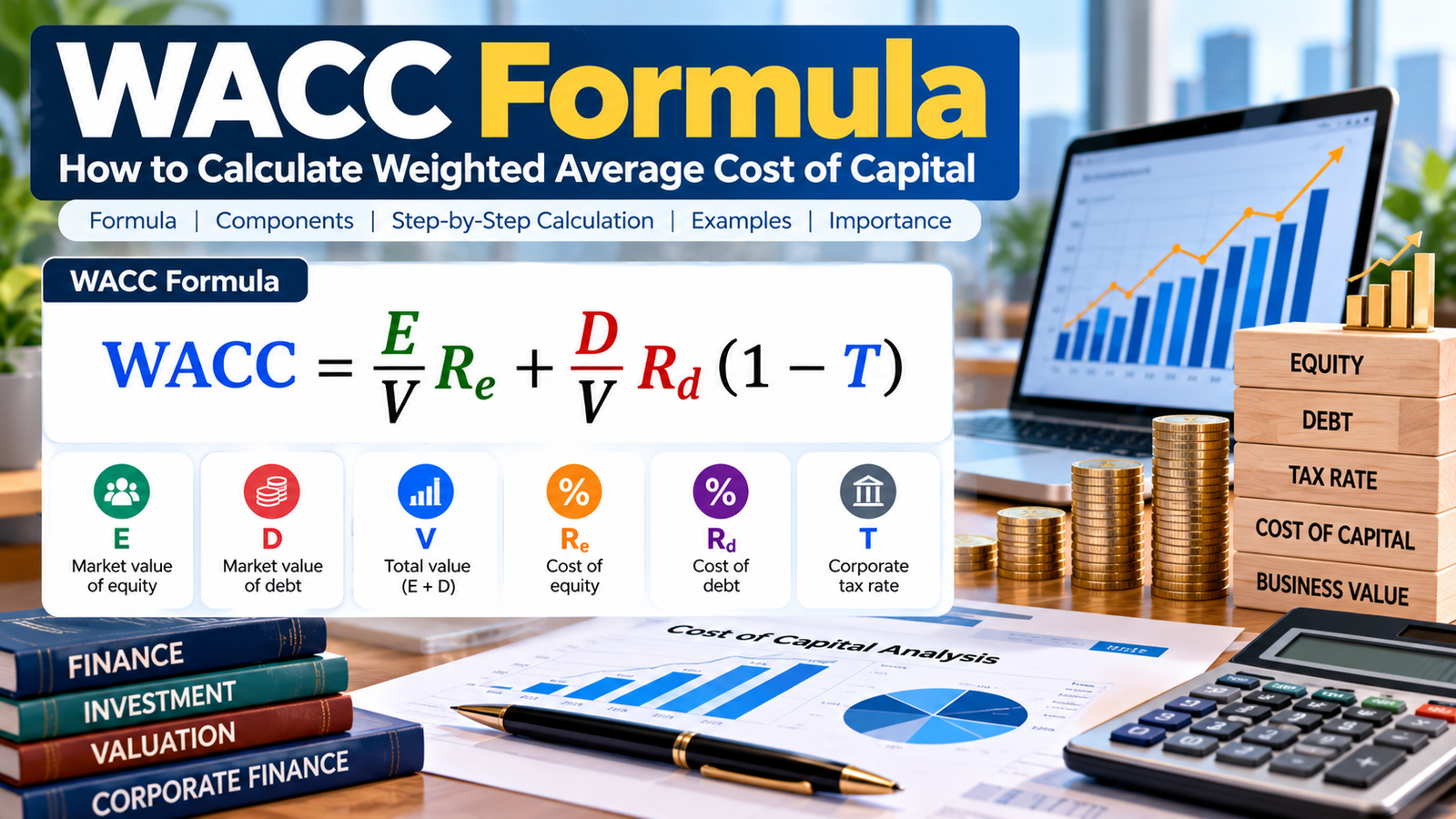
The WACC formula helps businesses and investors understand the average cost of financing a company through debt and equity. WACC stands for weighted average cost of capital. It combines the cost of different funding sources according to their proportions in a company’s capital structure.
Businesses use WACC when evaluating investment opportunities, estimating company value, and deciding whether a project may generate sufficient returns. Investors and financial analysts also use it as a discount rate in discounted cash flow (DCF) valuation, provided it is appropriate for the cash flows and risk being assessed.
Understanding the WACC formula can help business owners make more informed financial decisions. This guide explains the formula, defines its components, demonstrates a calculation with realistic hypothetical figures, and explores common mistakes to avoid.
What Is the WACC Formula?
The WACC formula calculates a company’s weighted average cost of capital by combining its cost of equity and after-tax cost of debt.
The standard formula is:
Here is what each symbol means:
| Symbol | Meaning |
|---|---|
| \(E\) | Market value of equity |
| \(D\) | Market value of interest-bearing debt |
| \(V\) | Total market value of debt and equity (\(D+E\)) |
| \(R_e\) | Cost of equity |
| \(R_d\) | Cost of debt before tax |
| \(T\) | Applicable corporate tax rate |
The formula gives each financing source a weight based on its share of the company’s total capital. It also adjusts the cost of debt for the tax benefit of deductible interest, where that benefit is available.
For example, a company financed through both shareholders’ equity and borrowing must consider the expected return required by shareholders and the interest cost of its debt. WACC brings these costs together into one measure.
Why Is the WACC Formula Important?
The WACC formula is useful because a company needs to earn enough from its investments to compensate the people and institutions providing its capital.
It supports several important financial activities.
1. Business Valuation
Financial analysts often use WACC to discount projected future free cash flows when valuing a company. A higher discount rate generally reduces the present value of the same future cash flows, all else being equal.
2. Investment Decisions
Companies can compare a project’s expected return with an appropriate cost of capital. If the expected return exceeds that cost, the project may create value, although the decision also depends on risk, cash flow timing, and other factors.
3. Capital Budgeting
Business leaders can use WACC as a starting point when assessing major purchases, expansion plans, equipment investments, or new facilities.
4. Financing Decisions
WACC can help companies assess how their mix of borrowing and equity financing affects overall funding costs. However, adding debt does not automatically reduce WACC because borrowing can increase financial risk and the cost of both debt and equity.
How to Calculate WACC Step by Step
Calculating WACC requires reliable inputs for the company’s capital structure, cost of equity, cost of debt, and applicable tax rate.
Step 1: Calculate the Market Value of Equity
Market value of equity represents the current market value of a company’s shares.
For a publicly traded company, you can estimate it by multiplying the current share price by the number of outstanding shares.
Example:
-
Share price: $40
-
Outstanding shares: 2 million
The company’s market value of equity is $80 million.
For private businesses, estimating equity value may require a valuation model or other financial analysis.
Step 2: Determine the Market Value of Debt
Debt includes interest-bearing obligations such as loans and bonds. Where possible, use market values consistent with the valuation approach rather than automatically relying on accounting book values.
Suppose a company has debt valued at $20 million.
Its total capital value is:
The company has $100 million in total debt and equity under these assumptions.
Step 3: Calculate the Cost of Equity
The cost of equity is the return shareholders expect for investing in the company, given its risk.
One common estimation method is the Capital Asset Pricing Model (CAPM):
Where:
-
\(R_f\) is the risk-free rate.
-
\(\beta\) measures the stock’s sensitivity to market movements.
-
\(R_m\) is the expected market return.
-
\(R_m-R_f\) is the expected market risk premium.
Suppose the following hypothetical inputs apply:
-
Risk-free rate: 4%
-
Beta: 1.2
-
Expected market risk premium: 5%
The calculation is:
The estimated cost of equity is 10%.
These figures are illustrative, not current market estimates.
Step 4: Calculate the After-Tax Cost of Debt
The cost of debt represents the rate a company pays to borrow money. The WACC formula adjusts this rate for the tax benefit of deductible interest.
The formula is:
Suppose the company’s cost of debt is 6% and its applicable corporate tax rate is 25%.
The after-tax cost of debt is 4.5%, assuming the company can fully use the interest tax deduction.
Actual tax treatment depends on the company’s circumstances and applicable tax law.
Step 5: Apply the WACC Formula
Now we have all the required inputs:
| Input | Value |
|---|---|
| Market value of equity | $80 million |
| Market value of debt | $20 million |
| Total capital | $100 million |
| Cost of equity | 10% |
| Cost of debt | 6% |
| Corporate tax rate | 25% |
First, calculate the capital weights:
Next, apply the WACC formula:
The company’s weighted average cost of capital is 8.9% under these hypothetical assumptions.
This means the weighted financing cost is 8.9% using the inputs in this example. It does not guarantee that every investment must earn exactly 8.9%; a project’s risk and cash flows must also be considered.
WACC Formula Example: Understanding the Result
The example illustrates how equity and debt contribute differently to the overall financing cost.
Shareholders require a 10% return, but equity accounts for 80% of the capital structure. Consequently, equity contributes 8 percentage points to WACC.
Debt accounts for the remaining 20%. After adjusting the 6% borrowing cost for the assumed tax benefit, debt contributes 0.9 percentage points.
Together, these contributions produce an 8.9% WACC.
WACC calculation breakdown
Equity contribution
8.0%
After-tax debt contribution
0.9%
Total WACC
8.9%
How to Calculate WACC in Excel
Microsoft Excel can simplify the calculation once you have the relevant financial inputs.
You can use the following example:
| Cell | Input | Value |
|---|---|---|
| B2 | Market value of equity | 80000000 |
| B3 | Market value of debt | 20000000 |
| B4 | Cost of equity | 10% |
| B5 | Cost of debt | 6% |
| B6 | Tax rate | 25% |
Enter this formula into another cell:
=(B2/(B2+B3))*B4+(B3/(B2+B3))*B5*(1-B6)Excel should return 8.9% when the values are entered correctly and the percentage inputs are formatted as percentages.
For more complex businesses, the model may need separate debt categories, preferred shares, changing tax assumptions, or different capital weights. Keep the units consistent and check that the formula references the correct cells.
What Is a Good WACC?
There is no single WACC that is ideal for every company. The appropriate rate depends on the company’s industry, financial risk, capital structure, borrowing costs, and market conditions.
A business with predictable cash flows and relatively low risk may have a lower WACC than a company operating in a volatile industry. However, comparisons are most useful when the companies have similar risks and operate under comparable conditions.
Consider these general factors:
-
Business risk: Companies with uncertain earnings may face higher expected returns from investors.
-
Interest rates: Higher borrowing costs can increase the cost of debt.
-
Capital structure: The balance between debt and equity affects the weighted financing cost.
-
Tax treatment: The tax benefit of interest can reduce the effective cost of debt when applicable.
-
Market conditions: Changes in expected returns and financial risk can affect the cost of capital.
A lower WACC can make an investment’s projected cash flows more valuable in a DCF model. Nevertheless, choosing a lower rate simply to make a project look attractive would produce a misleading valuation.
For additional valuation research, Aswath Damodaran’s corporate finance resources provide useful material on risk, valuation, and the cost of capital.
WACC vs. Cost of Equity
WACC and the cost of equity are related financial measures, but they serve different purposes.
| Feature | WACC | Cost of Equity |
|---|---|---|
| Meaning | Weighted cost of debt and equity | Required return on equity |
| Main inputs | Capital weights, cost of equity, cost of debt, tax rate | Risk-free rate, beta, market risk premium, or another suitable model |
| Debt included? | Yes | No |
| Tax adjustment | Applied to debt in the standard formula | No equivalent debt tax adjustment |
| Common use | Discounting appropriate firm-level cash flows | Assessing equity returns and discounting appropriate equity cash flows |
Use WACC when valuing operating cash flows available to all capital providers, provided the rate matches the risk and financing assumptions of those cash flows. Use the cost of equity when valuing cash flows specifically available to shareholders.
The distinction matters because using the wrong discount rate can distort a valuation.
Common Mistakes When Calculating WACC
Even a straightforward WACC calculation can produce misleading results if its inputs or assumptions are incorrect.
1. Using Book Values Without Considering Market Values
The standard approach generally uses market-value weights because WACC is intended to reflect current capital costs. Book values may be a practical approximation in some cases, but analysts should understand the limitations.
2. Forgetting the Tax Adjustment on Debt
The standard WACC formula includes the factor \((1-T)\) for debt. Omitting it overstates the after-tax benefit when interest is deductible and the company can use that deduction.
3. Using Inconsistent Inputs
For example, combining nominal cash flows with a real discount rate can produce an inaccurate valuation. Currency, inflation assumptions, and cash-flow definitions should also be consistent.
4. Treating WACC as the Right Rate for Every Project
A company’s overall WACC may not reflect the risk of a project that differs substantially from its existing business. A riskier or safer project may require a different discount rate.
5. Assuming More Debt Always Lowers WACC
Debt can initially be less expensive than equity, partly because of its tax treatment. However, excessive borrowing can increase default risk and raise both borrowing costs and the return demanded by shareholders.
Before using WACC in a business valuation or investment decision, review the assumptions carefully. If you are preparing financial projections for a company, a clear business plan can help organize your expected costs, financing needs, and growth assumptions.
Frequently Asked Questions About the WACC Formula
1. What is the WACC formula?
Ans: The standard formula is:
It calculates the weighted average cost of equity and after-tax debt, using their respective proportions of total capital.
2. How do you calculate WACC in Excel?
Ans: Enter the market values of equity and debt, the cost of equity, the cost of debt, and the tax rate. Then use:
=(E/(E+D))*Re+(D/(E+D))*Rd*(1-T)Replace each label with its corresponding cell reference. Make sure rates are entered consistently as percentages or decimals.
3. Why is debt adjusted for taxes in WACC?
Ans: Interest expense is often tax-deductible, which can reduce a company’s effective borrowing cost. The factor \((1-T)\) estimates the benefit when the deduction is available and usable.
4. Can WACC be negative?
Ans: A negative WACC is unusual for a typical operating company. It would require unusual input assumptions, such as a negative estimated cost of capital component. If a calculation produces a negative result, review the inputs, capital weights, and formula before drawing conclusions.
5. Is a lower WACC always better?
Ans: Not necessarily. A lower WACC can increase estimated company value, all else being equal, but it may also reflect different risk or financing assumptions. Companies should not pursue a lower rate without considering financial risk and long-term stability.
6. What is the difference between WACC and the discount rate?
Ans: WACC is one type of discount rate. It is commonly used for appropriate firm-level cash flows, while other discount rates may be necessary for different types of cash flows or levels of risk.
Conclusion
The WACC formula helps businesses estimate the weighted cost of financing through debt and equity. By combining the cost of equity, the after-tax cost of debt, and each source’s capital weight, it produces a single measure that supports company valuation and investment analysis.
To calculate WACC accurately, use appropriate market values, estimate financing costs carefully, apply the relevant tax adjustment, and keep assumptions consistent. Remember that WACC is not a universal rate for every business or project.
When used with sound financial judgment, the WACC formula can help business owners and investors evaluate opportunities, compare financing choices, and make more informed decisions.