
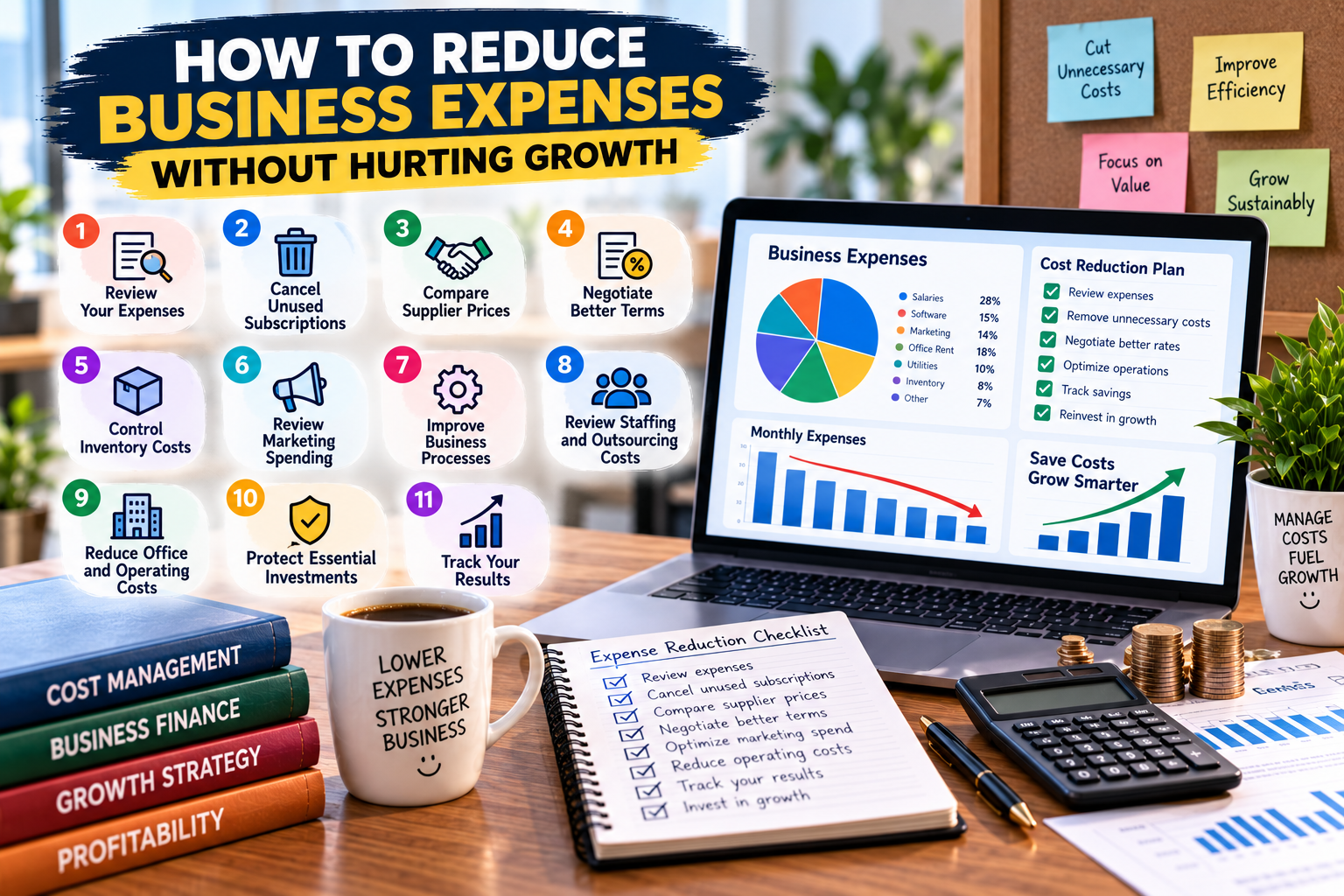
Managing costs is an important part of running a healthy business. However, reducing expenses does not mean cutting every cost possible.
Some expenses support customers, employees, technology, marketing, and revenue generation. Cutting those costs without careful analysis could create bigger problems later.
The better approach is to identify unnecessary spending, improve inefficient processes, negotiate better terms, and regularly review financial performance.
The U.S. Small Business Administration recommends categorizing and analyzing costs, including recurring and nonrecurring expenses, to help businesses understand their financial position.
This guide explains practical ways to reduce costs while protecting the activities that help your business operate and grow.
What Are Business Expenses?
Business expenses are costs associated with operating a business.
Common examples include:
- Rent
- Employee wages
- Software
- Advertising
- Inventory
- Utilities
- Insurance
- Professional services
- Office supplies
- Website and technology costs
The IRS generally describes deductible business expenses as costs that are both ordinary and necessary, although specific tax treatment depends on the business and circumstances.
For financial management purposes, it is also useful to separate expenses into different categories.
Fixed Expenses
These costs tend to remain relatively stable over a period of time.
Examples include:
- Office rent
- Certain software subscriptions
- Insurance premiums
- Some salaries
Variable Expenses
These costs can change depending on business activity.
Examples include:
- Inventory
- Shipping
- Sales commissions
- Advertising
- Transaction fees
Understanding these categories makes it easier to identify where changes may be possible.
Why Should Businesses Control Their Expenses?
Regular expense management can help a business use its available resources more efficiently.
It can help you:
- Improve cash flow
- Protect profit margins
- Create financial flexibility
- Prepare for unexpected costs
- Identify waste
- Make better financial decisions
Cost management is not only about reducing spending. It is also about understanding whether the money being spent is producing enough value.
1. Review Your Expenses Regularly
The first step is to understand exactly where your money is going.
Review your:
- Bank statements
- Accounting records
- Credit card statements
- Software subscriptions
- Supplier invoices
- Advertising costs
- Professional service bills
Look for recurring expenses that you may have forgotten about.
The SBA recommends organizing expenses into one-time and monthly costs when developing a complete financial picture of a business.
Simple Expense Review Table
| Expense | Monthly Cost | Essential? | Possible Action |
|---|---|---|---|
| Software | $200 | Yes | Review plan |
| Office Supplies | $150 | Yes | Compare suppliers |
| Unused Subscription | $50 | No | Cancel |
| Advertising | $500 | Depends | Measure results |
Figures are examples only.
Once you have this information, divide expenses into three groups:
Essential: Necessary for normal operations.
Useful: Helpful but worth reviewing.
Unnecessary: Provides little or no meaningful value.
This classification can reveal opportunities to reduce spending.
2. Cancel Unnecessary Subscriptions
Software subscriptions can quietly become a significant monthly expense.
Review every subscription and ask:
- Is the tool still being used?
- Does another tool provide the same function?
- Are all available features necessary?
- Can the business move to a lower plan?
- Is the subscription producing enough value?
For example, a company may have several tools for project management, communication, file storage, and marketing that overlap in functionality.
Canceling unused services can create savings without affecting important operations.
3. Compare Supplier Prices
Suppliers can have a significant impact on operating costs, especially for businesses that purchase inventory, materials, packaging, or services regularly.
Compare:
- Prices
- Minimum order requirements
- Shipping costs
- Payment terms
- Product quality
- Delivery reliability
The cheapest supplier is not always the best option.
A slightly higher price may be justified if a supplier provides better quality, fewer delays, or more reliable service.
Look at the total value rather than the price alone.
4. Negotiate Better Terms
You may be able to reduce costs by negotiating with suppliers and service providers.
Depending on the relationship, you could ask about:
- Volume discounts
- Annual pricing
- Longer-term agreements
- Lower service fees
- Better payment terms
- Bundled services
Prepare before negotiating.
Review what you currently pay and compare it with available alternatives. A clear understanding of your current costs gives you a stronger basis for discussion.
5. Control Inventory Costs
Inventory can tie up significant amounts of business capital.
Excess inventory may create:
- Storage costs
- Cash flow pressure
- Spoilage
- Obsolescence
- Discounting requirements
Review which products sell quickly and which remain in storage for long periods.
Better inventory planning can help you avoid purchasing more stock than your business can reasonably sell.
For product-based businesses, tracking sales patterns and ordering based on realistic demand can make inventory spending more efficient.
6. Review Marketing Spending
Marketing can support growth, but not every marketing activity produces the same results.
Review:
- Advertising costs
- Lead generation
- Website traffic
- Conversion rates
- Customer acquisition costs
- Sales generated by different channels
Do not automatically eliminate marketing because it costs money.
Instead, identify which activities contribute to your business objectives and which consistently fail to produce useful results.
For example, if one campaign generates qualified leads while another generates little engagement, you may want to investigate why before deciding where to allocate future spending.
7. Improve Business Processes
Inefficient processes can increase costs without appearing as a single line item on your financial statements.
Look for repetitive activities such as:
- Manual data entry
- Repeated customer responses
- Duplicate reporting
- Manual scheduling
- Repetitive administrative tasks
Ask whether the process can be simplified, standardized, or automated.
Automation can be useful when it genuinely reduces repetitive work without reducing service quality.
The goal is not to automate everything. The goal is to remove unnecessary effort.
8. Review Staffing and Outsourcing Costs
Employees and contractors can be among a business’s largest expenses.
That does not mean staffing should be reduced automatically.
Instead, review:
- Workload
- Productivity
- Overtime
- Contractor fees
- Unused capacity
- Outsourced services
- Hiring requirements
For specific short-term tasks, outsourcing may sometimes be more practical than maintaining permanent capacity.
However, businesses should consider quality, reliability, confidentiality, and long-term requirements before making a staffing decision.
9. Reduce Office and Operating Costs
Physical operating costs can also provide opportunities for savings.
Consider reviewing:
- Office space
- Utilities
- Internet services
- Phone plans
- Printing
- Office supplies
- Cleaning services
- Equipment
If your team can work effectively with a smaller office or a hybrid arrangement, reviewing workspace requirements may be worthwhile.
Any change should be evaluated against employee needs, customer requirements, productivity, and business operations.
10. Protect Essential Business Investments
Cost reduction should not become cost cutting without a plan.
Some expenses may directly support the business’s ability to generate revenue or serve customers.
Be careful when reducing spending related to:
- Customer service
- Cybersecurity
- Website maintenance
- Essential software
- Product quality
- Employee training
- Compliance
- Important marketing activities
Before cutting a cost, ask:
What happens if we remove this expense?
If the answer involves lower quality, lost customers, security risks, or reduced revenue, the saving may not be worth the trade-off.
11. Track Your Cost-Cutting Results
After making changes, measure the financial impact.
Example
| Area | Before | After | Monthly Difference |
|---|---|---|---|
| Software | $300 | $220 | $80 |
| Supplies | $400 | $350 | $50 |
| Services | $500 | $400 | $100 |
| Total | $1,200 | $970 | $230 |
Illustrative example only.
The business in this example reduces monthly spending by $230.
However, the analysis should not stop there.
Ask whether the reductions affected:
- Productivity
- Customer satisfaction
- Sales
- Product quality
- Employee workload
The SBA recommends comparing planned financial results with actual results so business owners can identify what needs to change.
Common Mistakes When Cutting Business Costs
Cutting Essential Expenses
Removing an important expense can create larger costs later.
Choosing the Cheapest Supplier
Low prices may come with lower quality, unreliable delivery, or poor support.
Reducing Marketing Without Measuring Results
Marketing costs should be evaluated based on performance rather than removed automatically.
Canceling Useful Tools
A software subscription may appear expensive until you calculate how much time it saves.
Ignoring Customer Service
Reducing support resources can affect customer satisfaction and retention.
Making Short-Term Cuts That Create Long-Term Costs
A small saving today may create a larger repair, replacement, or customer acquisition cost later.
Failing to Monitor the Results
A cost reduction should be reviewed after implementation to determine whether it actually helped the business.
Business Expense Reduction Checklist
Use this checklist when reviewing your costs:
☐ Review recurring expenses
☐ Cancel unused subscriptions
☐ Compare supplier prices
☐ Negotiate contracts
☐ Review inventory costs
☐ Measure marketing spending
☐ Improve business processes
☐ Review staffing costs
☐ Reduce unnecessary operating costs
☐ Protect essential investments
☐ Track savings
FAQs
Q1: How can a small business reduce expenses?
Ans: Start by reviewing recurring costs, canceling unused subscriptions, comparing suppliers, negotiating contracts, improving processes, and measuring the results of each change.
Q1: What business expenses should I cut first?
Ans: Start with unnecessary or low-value expenses rather than essential costs. Review unused subscriptions, duplicate services, inefficient processes, and spending that does not support clear business objectives.
Q1: How often should businesses review expenses?
Ans: Many businesses can benefit from reviewing expenses monthly, while conducting a deeper financial review periodically. The right frequency depends on business size, complexity, and how quickly costs change.
Q1: Should businesses reduce marketing expenses?
Ans: Not automatically. Review marketing performance first and determine which activities contribute to leads, sales, or other important business goals.
Q1: How can I reduce expenses without hurting growth?
Ans: Focus on waste and inefficiency rather than cutting essential activities. Protect customer service, product quality, security, and investments that support revenue.
Final Thoughts
Reducing costs does not mean spending as little as possible.
The goal is to make sure every important expense has a clear purpose and provides reasonable value to the business.
Start by reviewing your current spending. Then identify unnecessary subscriptions, compare suppliers, negotiate better terms, improve processes, and measure the results.
Most importantly, protect expenses that support customers, employees, security, quality, and revenue.
Smart business expenses management can help a company become more efficient while keeping its focus on sustainable growth.