
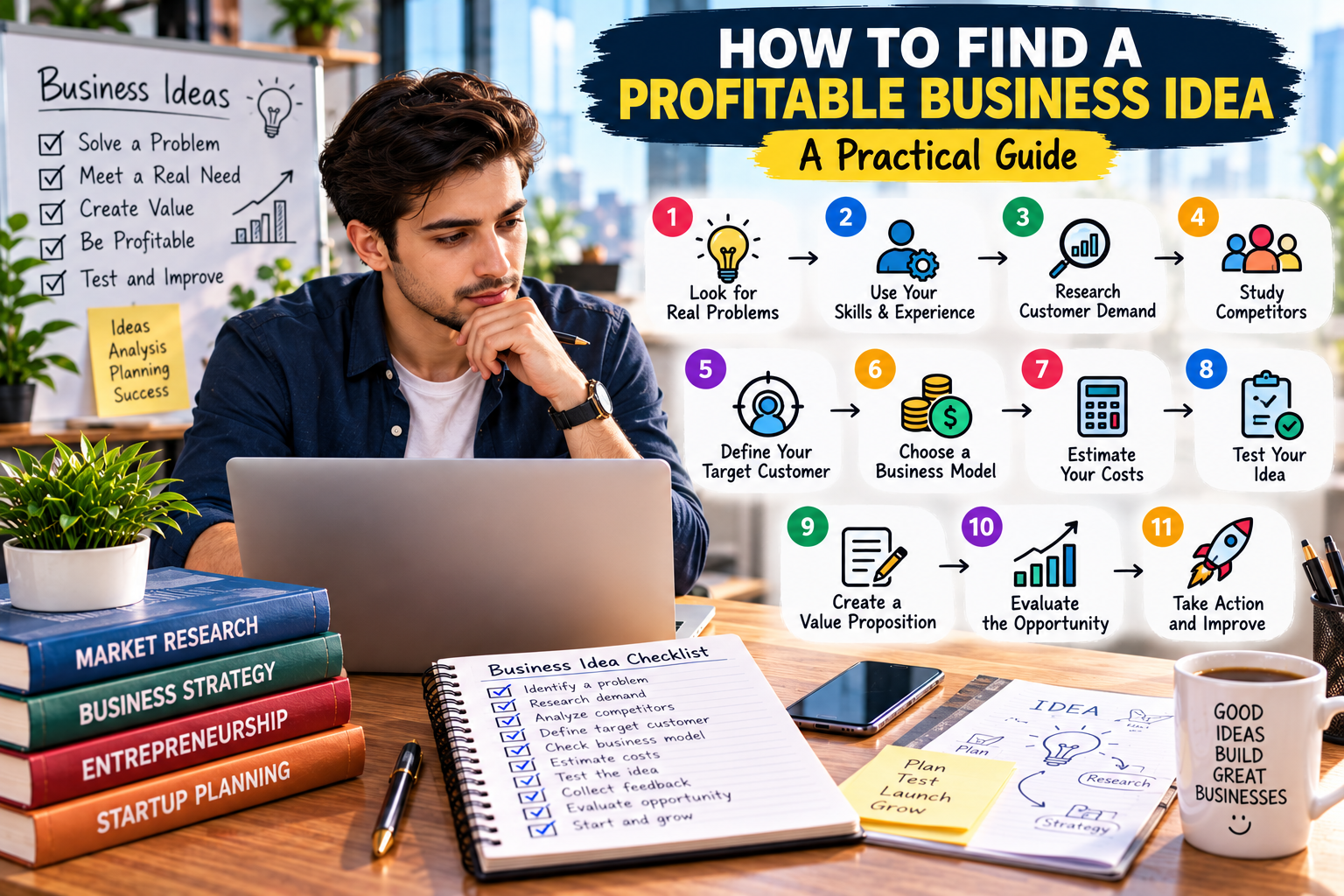
Finding a business idea is often easier than finding an idea that customers actually want.
An interesting concept may sound promising, but that does not automatically mean people will pay for it. A stronger approach is to start with a real problem, identify the people experiencing it, and then research whether a practical solution could become a viable business.
The U.S. Small Business Administration recommends using market research to understand demand, market size, customer characteristics, competition, and pricing before moving forward with a business idea.
You also need to consider your skills, operating costs, competitors, pricing, and the way the business will make money.
This guide explains how to find and evaluate a business idea before investing significant time or money.
What Makes a Good Business Idea?
A useful business idea usually addresses a specific customer need or problem.
Before moving forward, consider whether the idea:
- Solves a real problem
- Has a clearly defined customer
- Provides useful value
- Has potential demand
- Can realistically be delivered
- Has a workable revenue model
- Fits your skills and available resources
No checklist can guarantee that an idea will become profitable. However, researching these areas can help you make a more informed decision.
1. Start With Problems, Not Products
Instead of immediately asking, “What should I sell?” ask:
“What problem can I solve?”
Problems can appear in everyday activities, professional work, shopping, education, technology, communication, and many other areas.
Pay attention when people say things such as:
- “This takes too long.”
- “I can’t find a good option.”
- “This process is confusing.”
- “I wish someone could do this for me.”
- “The current solution is too expensive.”
These observations can lead to potential opportunities.
Examples of Problems Worth Exploring
| Problem | Possible Business Opportunity |
|---|---|
| Small businesses struggle with content | Content service |
| Customers find a process confusing | Consulting or support service |
| Local businesses need online visibility | Digital marketing service |
The examples above are starting points rather than guarantees of demand.
2. Identify Your Skills and Experience
Your existing skills can help you recognize problems that other people might overlook.
Make a list of:
- Professional skills
- Industry experience
- Technical knowledge
- Hobbies
- Certifications
- Personal interests
- Problems you have solved before
Then ask how these skills could help a specific customer.
For example, someone with accounting experience might identify a need for bookkeeping services. Someone with web development skills might notice that local businesses struggle to maintain their websites.
The SBA has also suggested combining interests and commitments with a potential business opportunity when identifying startup ideas.
Your experience does not have to determine your business idea, but it can give you a useful starting point.
3. Research Customer Demand
Once you have an idea, investigate whether people actually need the solution.
Research can include:
- Online discussions
- Customer reviews
- Search behavior
- Industry reports
- Competitor websites
- Surveys
- Interviews
- Questionnaires
The SBA notes that market research can help entrepreneurs assess demand, market size, customer characteristics, competition, and pricing.
Questions to Ask Potential Customers
If possible, talk directly with people who match your target audience.
Ask:
- What problem are you trying to solve?
- How do you currently solve it?
- What do you dislike about the current solution?
- Would you pay for a better solution?
- What would make you choose one provider over another?
Listen carefully to the answers.
A customer saying an idea sounds “great” is useful feedback, but it is not the same as someone showing genuine willingness to purchase.
4. Study Your Competitors
Competition is not necessarily a reason to abandon an idea.
In many cases, existing competitors indicate that customers already spend money on solutions in that market. The more important question is whether you can provide a useful reason for customers to consider your offer.
Research competitors’:
- Products
- Services
- Pricing
- Customer reviews
- Marketing
- Strengths
- Weaknesses
- Target customers
The SBA recommends competitive analysis to understand what other businesses are doing and identify opportunities to develop a competitive advantage.
Competitor Research Table
| Area | What to Study |
|---|---|
| Products | What they offer |
| Pricing | What customers pay |
| Reviews | Customer satisfaction and complaints |
| Marketing | How they attract customers |
| Weaknesses | Areas that could be improved |
Look for gaps rather than simply copying what competitors already do.
5. Define Your Target Customer
A business idea becomes easier to evaluate when you know exactly who might buy it.
Avoid starting with “everyone.”
Instead, define a specific customer group based on factors such as:
- Age
- Location
- Occupation
- Business size
- Budget
- Interests
- Needs
- Buying behavior
For example, instead of targeting “businesses,” you could target:
Small local restaurants that need help improving their online visibility.
A specific audience can make your product development, messaging, and marketing decisions more focused.
6. Check the Business Model
A business needs a way to generate revenue.
Your business model explains how the company creates value for customers and earns money from its products or services.
Common models include:
- One-time product sales
- Subscription services
- Consulting
- Freelance services
- Commissions
- Advertising
- Memberships
- Licensing
Simple Business Model Example
Customer → Problem → Solution → Price → Revenue
For example:
Small business owner → Needs professional website content → Content writing service → $300 package → Service revenue
The numbers in this example are for illustration only.
Your model should also consider delivery costs, customer acquisition, payment processing, staff, software, and other expenses.
7. Estimate Startup and Operating Costs
An idea can have strong demand and still be difficult to operate profitably if the costs are too high.
Separate expenses into two groups.
Startup Costs
These are expenses you may face when getting the business started.
Examples include:
- Equipment
- Website setup
- Initial inventory
- Business registration
- Branding
- Initial marketing
- Professional services
Recurring Costs
These are expenses that continue as the business operates.
Examples include:
- Software subscriptions
- Hosting
- Rent
- Salaries
- Advertising
- Insurance
- Inventory
- Utilities
The SBA recommends separating one-time expenses from monthly expenses when estimating business costs.
Create a basic estimate before committing significant money.
8. Test Your Business Idea Before Investing Heavily
One of the most useful steps is testing the idea with real potential customers.
You could:
- Create a simple version of the product.
- Offer a small pilot service.
- Build a basic landing page.
- Interview potential customers.
- Accept early orders where appropriate.
- Offer a limited service package.
- Collect feedback.
The purpose is to learn.
You might discover that customers want a slightly different solution, prefer another pricing structure, or have a problem you had not considered.
Testing also helps distinguish genuine customer interest from positive opinions.
9. Create a Simple Value Proposition
Your value proposition explains what you offer, who it helps, and why the solution is useful.
A simple formula is:
We help [target customer] solve [problem] with [solution].
For example:
We help small businesses improve their online visibility with practical SEO services.
A good value proposition should be clear enough for a potential customer to understand quickly.
Avoid filling it with complicated industry terminology.
10. Evaluate the Opportunity
Before moving forward, review the idea from several angles.
| Factor | Question |
|---|---|
| Demand | Do people need the solution? |
| Competition | Who already serves the market? |
| Pricing | Will customers pay enough? |
| Costs | Can you operate profitably? |
| Skills | Can you deliver the solution? |
| Growth | Can the business expand? |
You can use this table as a simple discussion framework rather than assigning arbitrary scores.
If several areas remain unclear, conduct more research before making a major investment.
Common Mistakes When Choosing a Business Idea
Choosing an Idea Only Because It Seems Exciting
Personal excitement can be useful, but customer demand also needs to be investigated.
Ignoring Customer Problems
A product that does not solve a meaningful problem may struggle to attract paying customers.
Spending Too Much Before Testing
Building an expensive product before understanding customer demand can create unnecessary risk.
Copying Competitors Without Differentiation
Entering an existing market with exactly the same offer may make it difficult to explain why customers should choose you.
Underestimating Operating Costs
Remember to account for both startup expenses and ongoing costs.
Targeting Everyone
A broad audience can make your message less specific and make customer research harder.
Confusing Compliments With Demand
People may like an idea without being willing to pay for it.
Ignoring Customer Feedback
Early feedback can reveal problems with your product, pricing, positioning, or target audience.
Business Idea Validation Checklist
Use this checklist before moving forward:
☐ Identify a real problem
☐ Define your target customer
☐ Research customer demand
☐ Study competitors
☐ Identify your competitive advantage
☐ Choose a business model
☐ Estimate startup costs
☐ Estimate recurring costs
☐ Test the idea
☐ Collect customer feedback
☐ Review the opportunity
FAQs
Q1: How do I find a good business idea?
Ans: Start by identifying problems that people or businesses regularly experience. Then research demand, competitors, potential customers, costs, and possible revenue models.
Q2: How do I know if a business idea is profitable?
Ans: Research whether customers are willing to pay, estimate your revenue and operating costs, study competitors, and test the idea before making a large investment.
Q3: Should I start a business based on my skills?
Ans: Your skills can provide a useful starting point because they may help you solve problems more effectively. However, customer demand and business economics should also be considered.
Q4: How can I test a business idea?
Ans: Talk to potential customers, create a simple version of your offer, run a small pilot, build a basic landing page, or test whether people are willing to pay for the solution.
Q5: What should I research before starting a business?
Ans: Research your target customers, market demand, competitors, pricing, startup costs, recurring expenses, regulations, and potential revenue model.
Final Thoughts
A strong business idea usually starts with a real problem rather than a product created without a clear customer need.
Research your audience, study competitors, understand the costs, and think carefully about how the business will generate revenue.
Most importantly, test the idea before making a major investment. Real customer feedback can help you improve the concept and discover whether the opportunity is worth pursuing.
You do not need to have every answer at the beginning. Start with a problem, gather evidence, test your assumptions, and refine the idea as you learn.