
Growing a successful company takes more than a great product and a strong business plan. As a business expands, founders face difficult decisions about hiring, fundraising, leadership, entering new markets, and building a company that can operate at a larger scale.
The right mentor can help entrepreneurs approach these challenges with greater confidence. However, finding someone who understands the demands of scaling a business is not always easy.
That is where the Endeavor mentorship program structure becomes important. Endeavor connects selected entrepreneurs with experienced business leaders, industry experts, investors, and other founders who can offer practical guidance throughout their growth journey.
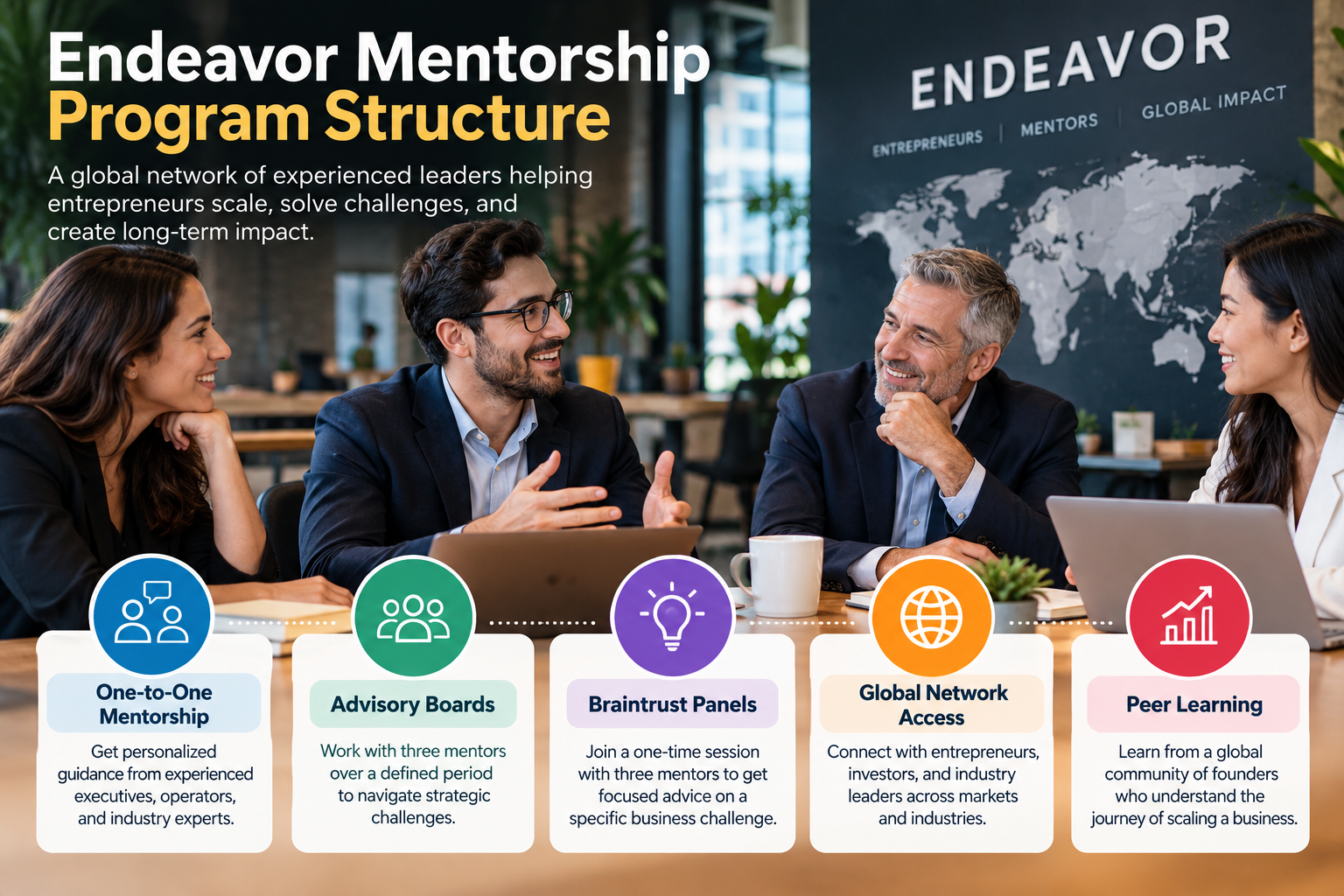
Unlike a simple mentoring arrangement, Endeavor combines one-to-one mentoring, Advisory Boards, Braintrust Panels, peer learning, and a global professional network. Each resource serves a different purpose, helping entrepreneurs explore strategic decisions and identify opportunities for growth.
In this guide, you will learn how the program works, who it is designed for, how its mentoring formats differ, and what entrepreneurs should understand before pursuing this opportunity.
What Is the Endeavor Mentorship Program?
Endeavor is a global entrepreneurship organization that supports founders with the potential to build high-impact, scalable companies. Its model focuses on entrepreneurs who want to grow their businesses, create economic opportunities, and contribute to the next generation of founders.
The organization does not operate like a general coaching service that provides the same package to every business owner. Instead, Endeavor selects entrepreneurs through a formal process and connects them with resources that match their business priorities.
According to Endeavor’s official entrepreneur experience overview, selected entrepreneurs can access curated mentorship, industry expertise, peer communities, fundraising guidance, and connections across its global network.
Who Is the Program Designed For?
The program is primarily designed for founders building companies with substantial growth potential. These entrepreneurs may already have established products, customers, revenue, or a business model that could scale into larger markets.
For example, a technology founder preparing to expand internationally may need advice about market entry, leadership, and hiring. A consumer brand founder might need guidance on distribution, operational capacity, or fundraising.
Endeavor’s model is intended to help entrepreneurs address these types of growth challenges with experienced guidance.
However, not every startup or small business automatically qualifies. The organization evaluates entrepreneurs and their companies through a selective process. Founders should review the current criteria and contact the relevant Endeavor office to understand whether their business may be a suitable candidate.
How Is the Endeavor Mentorship Program Structured?
The Endeavor mentorship program structure combines different mentoring formats with broader professional support. Rather than depending on one advisor for every business question, selected entrepreneurs can access different people and resources according to their needs.
1. One-to-One Mentorship
One-to-one mentorship gives entrepreneurs an opportunity to discuss specific business challenges with experienced executives, operators, and industry specialists.
These conversations can help founders examine their assumptions, identify risks, and consider options they might have overlooked.
For instance, imagine a founder whose company is growing quickly but struggling to maintain product quality. A mentor with experience in operations could help the founder examine processes, management responsibilities, and ways to support further growth.
Similarly, an entrepreneur considering an acquisition might seek advice from someone familiar with mergers, financial planning, or post-acquisition integration.
The purpose is to provide relevant perspectives, not a guaranteed solution. Founders remain responsible for evaluating advice and making decisions based on their company’s circumstances.
2. Advisory Boards
Endeavor describes Advisory Boards as a mentoring format that brings together three mentors to guide an entrepreneur through a strategic challenge on a regular basis over a defined period.
This arrangement allows a founder to receive input from people with different experiences and revisit progress as the business develops.
Consider a company preparing to enter a new market. Its founder may need to evaluate customer demand, distribution partnerships, financial resources, and hiring requirements.
An Advisory Board can help the founder examine these connected issues rather than treating each decision separately. The mentors may challenge assumptions, identify overlooked risks, and suggest areas that require further research.
The value of this format lies in structured discussion and ongoing guidance. It is not a replacement for detailed financial analysis, legal advice, or market research when those services are needed.
3. Braintrust Panels
Braintrust Panels are designed for a different purpose. Endeavor describes this format as bringing together three mentors for a one-time discussion of a specific strategic challenge.
A founder might use this type of session to explore a potential partnership, consider a new business model, or evaluate an important growth decision.
For example, a software company considering a move into enterprise sales may want to understand longer sales cycles, customer expectations, and the resources required to support larger clients.
A focused panel can bring several experienced perspectives into one conversation without requiring an ongoing advisory arrangement.
The key distinction is straightforward: Advisory Boards provide guidance on a regular cadence over a defined period, while Braintrust Panels address a specific challenge in a one-off session.
4. A Dedicated Endeavor Point Person
After entrepreneurs are selected, Endeavor provides a dedicated point person who serves as a trusted partner and helps connect founders with relevant resources.
This person can help identify useful introductions based on an entrepreneur’s priorities. For example, a founder preparing for international expansion may benefit from connections with experienced operators or entrepreneurs familiar with the target market.
Another founder may need support with leadership development, fundraising, or operational growth.
Rather than expecting entrepreneurs to navigate every possible connection independently, this role helps direct them toward relevant expertise within the network.
The exact resources available depend on the entrepreneur’s needs and the opportunities offered through the relevant Endeavor office.
5. Peer-to-Peer Learning
Experienced mentors are valuable, but entrepreneurs can also learn from other founders who have faced similar challenges.
Endeavor supports a community in which selected entrepreneurs can exchange experiences, discuss business decisions, and learn from peers across industries and markets.
This can be particularly useful when a founder faces a problem that is difficult to explain to someone who has never managed a growing company.
For example, an entrepreneur moving from a small founding team to a larger leadership structure may benefit from hearing how another founder handled delegation, management accountability, and communication.
Peer learning adds another perspective to formal mentoring because it combines professional advice with the practical experiences of people who have navigated similar transitions.
How Does the Endeavor Selection Process Work?
Endeavor’s mentorship resources are connected to its entrepreneur selection process. The organization looks for founders and companies with the potential to scale and create meaningful economic impact.
Although the precise process can vary by office, the global selection journey generally involves several stages.
Step 1: Candidate Identification
Endeavor identifies potential entrepreneurs through research, recommendations, and self-nominations.
The organization looks for founders whose ambitions and business potential align with its mission. A compelling idea alone is not enough; the company must demonstrate a credible opportunity for growth.
Step 2: Initial Review
The team reviews the candidate’s background and business to determine whether further evaluation is appropriate.
This stage helps establish whether the founder and company appear suitable for the selection process.
Step 3: Mentorship and Further Reviews
Candidates who progress may participate in interviews and mentoring sessions with experienced business leaders.
These discussions examine the company’s strategy, growth potential, innovation, and the entrepreneur’s leadership qualities. The process also gives candidates opportunities to receive feedback and reflect on their business decisions.
Step 4: Selection Panels
Candidates who advance may participate in local selection panels and an International Selection Panel.
At the international stage, global business leaders evaluate the candidates. Endeavor states that candidates must receive unanimous approval from the panel to become Endeavor Entrepreneurs.
The process is selective, so completing an application or participating in mentoring sessions does not guarantee acceptance.
For current eligibility details and application guidance, visit Endeavor’s official website and check the relevant office’s requirements.
What Business Challenges Can Endeavor Mentorship Help Address?
Mentorship is most useful when it connects a founder with relevant experience. Endeavor’s network can help selected entrepreneurs explore several challenges that commonly arise during business expansion.
Fundraising and Investor Relationships
Raising capital requires more than preparing a pitch deck. Founders need to understand their financial needs, growth assumptions, investor expectations, and the implications of accepting outside investment.
Endeavor provides fundraising-related guidance and can facilitate introductions to investors and service providers through its network.
A founder preparing for a funding round may benefit from feedback on the company’s strategy, financial projections, and fundraising approach.
However, introductions do not guarantee investment. Investors make independent decisions based on factors such as business performance, market opportunity, risk, and investment criteria.
Hiring and Leadership Development
A founder’s responsibilities change as a company grows. The skills required to launch a business are not always the same as those needed to manage a larger organization.
Entrepreneurs may need to recruit experienced leaders, delegate decisions, establish clear responsibilities, and develop systems that support consistent performance.
Mentors who have managed growing teams can help founders examine these challenges and consider different approaches.
For example, a founder who approves every decision personally may need to establish clearer management roles so the company can grow without creating unnecessary bottlenecks.
Entering New Markets
International expansion can create opportunities, but it also introduces unfamiliar customers, competitors, regulations, and operating costs.
A founder planning to enter another country needs to evaluate whether demand exists, how the product should be positioned, and what local partnerships may be necessary.
Endeavor’s international network can help selected entrepreneurs connect with relevant offices, experts, and founders who have experience in other markets.
These connections can provide useful perspectives, but entrepreneurs should still conduct independent market research and seek qualified professional advice where necessary.
Improving Business Strategy and Operations
As sales increase, a company may discover that its existing processes are no longer sufficient. Customer support can become overloaded, inventory management can become more complicated, or hiring may not keep pace with demand.
Mentorship can help founders identify bottlenecks and decide which problems require attention first.
A useful mentoring conversation should lead to clearer questions, practical next steps, or a better understanding of the risks involved.
What Are the Main Benefits of Endeavor’s Mentorship Model?
The program combines several resources that can help selected entrepreneurs approach growth decisions more thoughtfully.
Access to experienced professionals: Founders can receive input from business leaders who have dealt with operational, strategic, or industry-specific challenges.
Multiple perspectives: Advisory Boards and Braintrust Panels allow entrepreneurs to examine a decision through different professional viewpoints.
A broader network: Connections across industries and markets can help founders discover expertise beyond their immediate professional circles.
Peer learning: Entrepreneurs can exchange lessons with other founders who understand the demands of scaling a business.
Tailored support: A dedicated point person helps connect entrepreneurs with resources that align with their priorities.
Fundraising guidance: Relevant mentoring and network connections can help founders better understand fundraising and investor relationships.
These benefits depend on the entrepreneur’s circumstances and how effectively they use the available resources. Mentorship can strengthen decision-making, but it cannot remove business risk or guarantee a successful outcome.
Endeavor Mentorship vs. Traditional Business Mentoring
Entrepreneurs comparing mentorship options should understand that different programs provide different levels of support.
| Feature | Endeavor model | Traditional mentoring |
|---|---|---|
| Mentor access | Curated connections across a global network | Often centered on one mentor |
| Group guidance | Advisory Boards and Braintrust Panels | Depends on the program |
| Peer community | Local, regional, and international founder connections | Varies by provider |
| Support coordination | A dedicated point person for selected entrepreneurs | Often coordinated directly by the participants |
| Entry requirements | Formal, selective process | Depends on the arrangement |
| Fundraising connections | Available through relevant network resources | Depends on the mentor or program |
This is a general comparison, not a rule for every mentoring service. Some traditional programs also offer group mentoring, investor introductions, and extensive professional networks.
The defining feature of Endeavor is its combination of selective entrepreneur support, curated mentoring, and a global community focused on high-growth businesses.
How Can Entrepreneurs Prepare to Benefit From Mentorship?
Getting value from a mentor requires more than attending meetings. Entrepreneurs should approach each conversation with a clear objective and a willingness to evaluate feedback.
Define the Problem Before the Meeting
Identify the decision you need help with. Instead of asking how to grow a business generally, explain the specific obstacle, what you have already tried, and what options you are considering.
This gives the mentor a clearer picture of the situation.
Share Relevant Business Information
Depending on the topic, useful information may include revenue trends, customer feedback, hiring plans, market research, or operational challenges.
Be honest about weaknesses and uncertainty. Mentorship is more productive when the discussion reflects the real situation rather than an idealized version of the business.
Ask Follow-Up Questions
If a mentor recommends a particular approach, ask why it may work, what risks to consider, and what assumptions need to be tested.
You do not have to accept every suggestion. The goal is to understand the reasoning behind the advice and decide whether it fits your circumstances.
Turn Feedback Into Action
After each session, summarize the main lessons and identify practical next steps.
For example, you might conduct additional customer research, review a financial forecast, or clarify responsibilities within your leadership team.
At the next meeting, share what you learned. This makes mentoring more useful than repeatedly discussing a problem without testing possible solutions.
Frequently Asked Questions
Q1: What is the Endeavor mentorship program structure?
Ans: It combines curated one-to-one mentorship, three-mentor Advisory Boards, one-off Braintrust Panels, peer networks, and tailored connections through a dedicated Endeavor point person for selected entrepreneurs.
Q2: Does Endeavor provide one permanent mentor to every founder?
Ans: Not necessarily. The organization describes multiple mentoring formats and curated connections based on entrepreneurs’ priorities. The specific arrangement depends on the challenge and resources available.
Q3: What is the difference between an Advisory Board and a Braintrust Panel?
Ans: An Advisory Board provides guidance on a regular cadence over a defined period. A Braintrust Panel brings together three mentors for a one-off discussion of a specific strategic challenge.
Q4: Who can apply to become an Endeavor Entrepreneur?
Ans: Endeavor looks for founders whose companies demonstrate meaningful growth potential and the ability to scale. Applicants should review the current criteria with the relevant Endeavor office because eligibility requirements can vary.
Q5: Does Endeavor mentorship guarantee funding?
Ans: No. Endeavor can provide fundraising guidance and facilitate relevant introductions, but investors make their own decisions. Mentorship does not guarantee capital.
Q6: Is the Endeavor mentorship program available internationally?
Ans: Endeavor operates through a global network of offices and supports entrepreneurs across multiple markets. The resources, application process, and local availability depend on the relevant office.
Q7: Is Endeavor suitable for someone with only a business idea?
Ans: The program is primarily designed for entrepreneurs with companies that demonstrate significant growth potential. Someone at the idea stage should review the official selection criteria before deciding whether to apply.
Final Thoughts
The Endeavor mentorship program structure combines expert guidance, peer learning, and professional connections to help selected entrepreneurs navigate the challenges of scaling a business.
One-to-one mentoring provides targeted advice, Advisory Boards offer ongoing strategic guidance, and Braintrust Panels bring several perspectives to a specific decision. The broader network also creates opportunities to learn from experienced founders and connect with relevant expertise across markets.
For entrepreneurs considering Endeavor, the most important next step is to review the official selection criteria and understand whether their company aligns with the organization’s focus on high-growth, high-impact businesses.
Mentorship is not a substitute for execution, research, or sound financial planning. Its value comes from asking better questions, learning from relevant experience, and applying useful insights to real business decisions.