
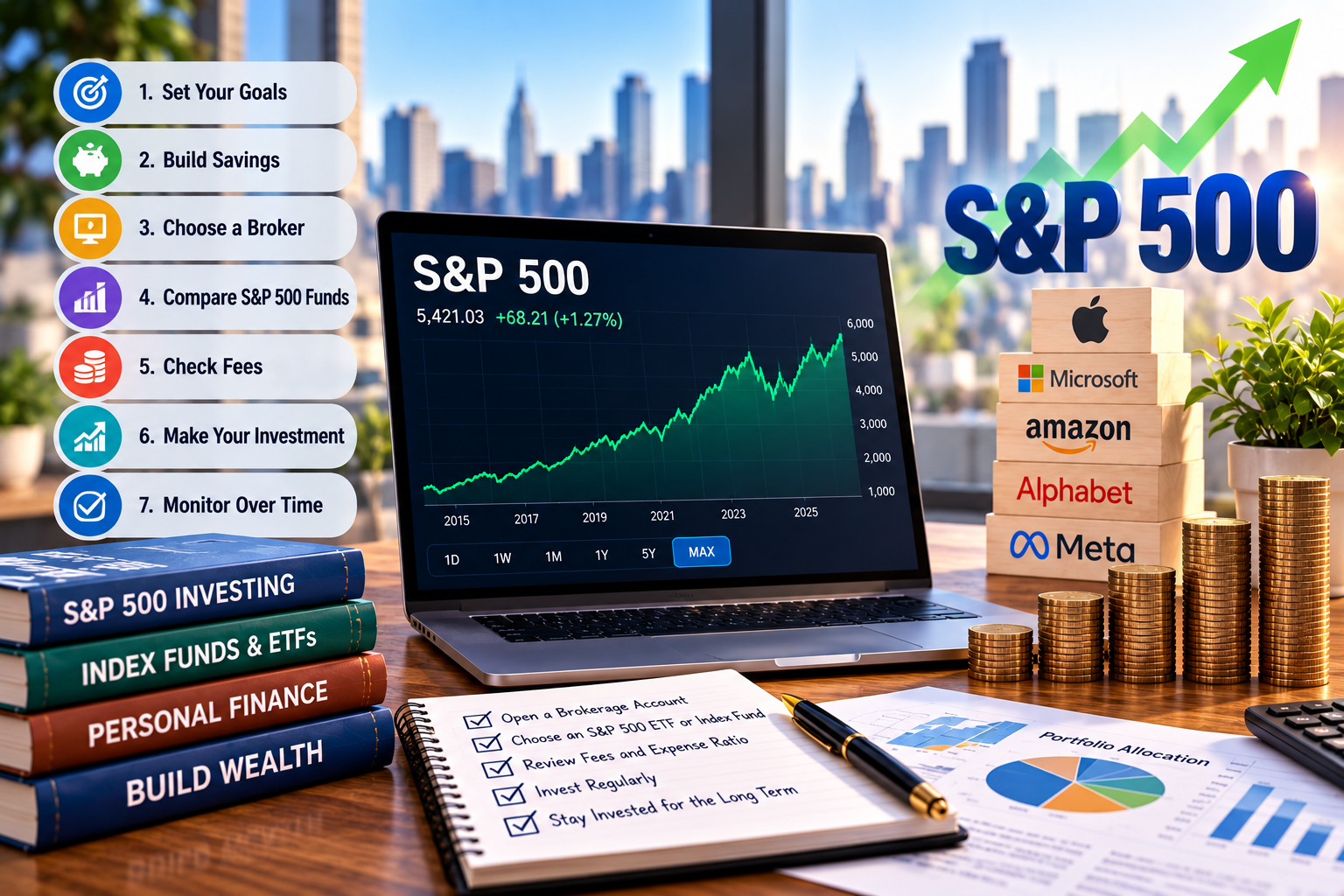
The S&P 500 is one of the most widely followed stock market indexes in the United States. It tracks the performance of approximately 500 leading companies and provides a useful way to understand how large U.S. businesses are performing.
For beginners, investing in the S&P 500 can offer a straightforward way to gain exposure to many companies through a single investment fund. Instead of selecting individual stocks, investors can choose an index fund or exchange-traded fund (ETF) designed to track the index.
However, investing in the S&P 500 does not guarantee profits. Its value can fall during market downturns, and investors may lose money, especially over shorter periods.
Before investing, it is important to understand how the index works, how to select a suitable fund, what fees to consider, and how to build an investment strategy that matches your financial goals.
This guide explains how to invest in the S&P 500 step by step, including considerations for beginners and international investors.
What Is the S&P 500?
The S&P 500 is a stock market index designed to represent the performance of large U.S. companies across multiple industries. It is maintained by S&P Dow Jones Indices and is widely used as a benchmark for the U.S. large-cap stock market.
How Does the S&P 500 Index Work?
The index uses a market-capitalization weighting method adjusted for shares available to public investors. This means larger eligible companies generally have a greater influence on its performance than smaller companies.
You cannot purchase the index itself. Instead, you can invest through a fund designed to track the S&P 500 index.
Which Companies Are Included in the S&P 500?
The index includes companies from different sectors, such as technology, healthcare, financial services, consumer goods, and industrials.
Its composition changes over time as companies grow, shrink, merge, or no longer meet the index’s eligibility requirements.
Although the index includes many businesses, it does not represent every publicly traded company in the United States. It focuses on large-cap stocks, and its performance can be heavily influenced by its largest constituents.
Why Do Investors Follow the S&P 500?
Investors use the S&P 500 to assess the performance of large U.S. companies and compare investment results against a widely recognized benchmark.
Funds tracking the index can also provide exposure to many companies through one investment. This may be more convenient than researching and purchasing hundreds of individual stocks.
However, broad exposure to large U.S. companies does not eliminate market risk or provide complete diversification across every asset class and country.
How to Invest in the S&P 500 Step by Step
1. Understand Your Financial Goals
Start by deciding why you want to invest.
You might be saving for retirement, building long-term wealth, or preparing for another future financial goal. Your timeline matters because stock market investments can lose value, including over periods lasting several years.
Write down your investment goal, expected timeline, and the amount you can reasonably contribute.
2. Build an Emergency Fund
Before investing, consider setting aside accessible savings for unexpected expenses.
An emergency fund can help you avoid selling investments during a market downturn to pay for urgent bills. You should also consider high-interest debt and other financial obligations before committing money to stocks.
Money needed for near-term expenses generally belongs in a more accessible, lower-risk savings arrangement rather than a volatile stock investment.
3. Choose an Appropriate Brokerage Account
A brokerage account allows you to buy and sell investments such as ETFs and mutual funds.
When comparing providers, review:
-
Trading and account fees
-
Available S&P 500 funds
-
Minimum investment requirements
-
Fractional-share availability
-
Regulatory status and investor protections
-
Deposit and withdrawal methods
-
Currency-conversion costs
-
Tax documents and customer support
If you live outside the United States, confirm that the broker accepts residents of your country. You should also understand the tax rules and any restrictions that apply to international investors.
Do not select a broker based only on an advertisement or a promise of easy profits.
4. Compare S&P 500 Index Funds and ETFs
Investors generally access the index through index mutual funds or exchange-traded funds designed to track its performance.
Both can provide similar market exposure, but their trading methods, costs, minimum investments, and account requirements can differ.
| Feature | S&P 500 Index Mutual Fund | S&P 500 ETF |
|---|---|---|
| Trading | Generally priced once daily | Trades during market hours |
| Minimum investment | Depends on the fund | Depends on share price and broker |
| Fees | Vary by fund | Vary by fund |
| Fractional investing | Depends on provider | Depends on broker |
| Market exposure | Tracks the index if designed to do so | Tracks the index if designed to do so |
Neither structure is automatically better for every investor.
Compare the actual funds available to you, including their investment objectives, holdings, costs, and eligibility requirements. The U.S. Securities and Exchange Commission explains the characteristics and risks of index funds in its investor education materials.
5. Review Fees and Fund Expenses
Investment fees can reduce the amount of money that remains invested and compounds over time.
Check the fund’s expense ratio, which represents its annual operating expenses as a percentage of its average assets. Also consider brokerage commissions, bid-ask spreads, currency-conversion charges, and applicable taxes.
For example, suppose you invest $1,000 in a fund with an annual expense ratio of 0.10%. The approximate annual fund expense would be $1, assuming the balance remained $1,000 throughout the year.
Actual costs vary with the investment balance, fund expenses, and other charges.
Compare costs carefully using the fund’s official documents. Even relatively small fee differences can affect long-term results.
6. Decide How Much to Invest
There is no single amount that every beginner needs to invest in the S&P 500.
Your starting amount depends on your financial circumstances, brokerage requirements, and whether fractional shares are available.
Before choosing an amount, make sure you can cover essential expenses, maintain appropriate emergency savings, and meet your other financial obligations.
Some investors prefer to contribute regularly rather than invest a large amount at once. Regular contributions can help establish a consistent habit, but they do not guarantee a profit or protect against market declines.
7. Place Your First Investment
Once you have selected a suitable fund and brokerage account, the process generally involves these steps:
-
Open and verify your brokerage account.
-
Deposit money using an approved payment method.
-
Search for the specific fund by its name and ticker symbol.
-
Review its investment objective, holdings, costs, and risks.
-
Decide how much to invest.
-
Check the order details before submitting.
-
Confirm that your order was executed.
Be careful to select the fund you researched. Different funds can use similar names but have different fees, structures, or investment strategies.
Avoid leveraged or inverse products unless you fully understand their risks; these products are not the same as conventional funds designed to track the index.
8. Monitor Your Investment Over Time
After investing, review your portfolio periodically to check whether it still fits your goals.
You do not need to react to every daily price movement. Instead, consider your investment timeline, overall financial situation, fund costs, and any major changes in your circumstances.
Remember that past performance does not guarantee future results. An S&P 500 fund can decline substantially during a market downturn.
How Much Money Do You Need to Invest in the S&P 500?
The minimum amount depends on the fund, broker, share price, and whether fractional investing is supported.
Some platforms allow you to purchase a fraction of an ETF share, while others require you to buy whole shares. Mutual funds may have their own minimum initial investments.
Example of Regular Investing
Suppose you contribute $100 each month for one year.
| Item | Amount |
|---|---|
| Monthly contribution | $100 |
| Number of months | 12 |
| Total contributions | $1,200 |
| Investment gain or loss | Depends on performance |
| Final account value | May be above or below $1,200 |
This example does not assume a guaranteed return. Your final balance will depend on market performance, fees, and other factors.
The main lesson is to choose a contribution you can sustain without putting essential expenses or emergency savings at risk.
What Are the Risks of Investing in the S&P 500?
Stock Market Volatility
The index can fall during recessions, financial crises, and periods of uncertainty. Even a diversified fund can experience significant losses.
Concentration in Large Companies
Although the index includes hundreds of companies, larger businesses have greater weight under its market-capitalization methodology. This can make its performance more dependent on a relatively small group of very large companies.
Inflation and Economic Risks
Inflation, interest rates, changing consumer demand, and economic slowdowns can affect company earnings and stock valuations.
Currency and Tax Considerations for International Investors
If your home currency differs from the currency of your investment, exchange-rate changes can affect your returns.
International investors should also investigate local tax rules, possible withholding taxes, fund domicile, and account eligibility before investing.
Common Mistakes to Avoid
Expecting Guaranteed Returns
The S&P 500 has experienced both strong gains and substantial declines. No fund tracking it can guarantee positive returns.
Investing Money Needed Soon
A market decline may happen when you need to withdraw money. Match your investments to your financial timeline.
Ignoring Expense Ratios
Compare the total costs of similar funds rather than choosing one solely because its name includes S&P 500.
Panic Selling During Market Declines
Emotional decisions can undermine a long-term plan. Review your goals and risk tolerance before changing your investments.
Assuming the S&P 500 Covers Every Investment Type
The index focuses on large U.S. companies. It does not replace exposure to every international market, bond category, or other asset class.
How to Build a Long-Term S&P 500 Investing Strategy
A practical strategy should be understandable, affordable, and consistent with your financial goals.
-
Set a realistic timeline. Decide when you expect to need the money.
-
Choose an appropriate fund. Compare its index-tracking approach, holdings, fees, and risks.
-
Consider regular contributions. Invest only amounts that fit your budget.
-
Understand diversification. An S&P 500 fund provides large-cap U.S. stock exposure, not complete diversification.
-
Review taxes and fees. These can affect your final returns.
-
Avoid short-term speculation. Do not rely on market predictions or social media tips.
-
Review your plan periodically. Make changes when your financial circumstances or goals change.
If you are new to the wider stock market, read our guide to investing in stocks for more foundational concepts.
FAQs
Q1: Can beginners invest in the S&P 500?
Ans: Yes. Beginners can invest through eligible index funds or ETFs after reviewing their financial goals, costs, account requirements, and risk tolerance.
Q2: Can I invest in the S&P 500 with $100?
Ans: Potentially, yes. Some brokers offer fractional ETF shares or funds with low minimum investments, but availability depends on the provider and your country.
Q3: Can I buy the S&P 500 directly?
Ans: No. The S&P 500 is an index, not a directly purchasable security. Investors generally use funds designed to track it.
Q4: Are S&P 500 index funds and ETFs the same?
Ans: Not exactly. An index fund describes an investment strategy, while an ETF describes a fund structure. An ETF can be an index fund, and an index mutual fund can also track the S&P 500.
Q5: Does the S&P 500 pay dividends?
Ans: The index itself does not pay investors directly. Companies included in it may pay dividends, and funds holding those companies may distribute the income according to their policies.
Q6: Can I lose money investing in the S&P 500?
Ans: Yes. The index can decline, and a fund tracking it can lose value. Diversification across many companies does not eliminate broad stock market risk.
Q7: Can international investors invest in the S&P 500?
Ans: Some international investors can access eligible S&P 500 funds through brokers that accept residents of their countries. Availability, taxes, currency exposure, and legal requirements vary.
Final Thoughts
Investing in the S&P 500 can be a straightforward way to gain exposure to many large U.S. companies through a single fund. However, the simplicity of the approach does not remove investment risk.
Start by understanding your financial goals, choosing an eligible brokerage account, comparing funds, and reviewing fees. Invest only money that fits your financial circumstances, and remember that stock market returns are never guaranteed.
A sensible long-term strategy focuses on informed decisions, manageable costs, diversification, and realistic expectations—not quick profits.