
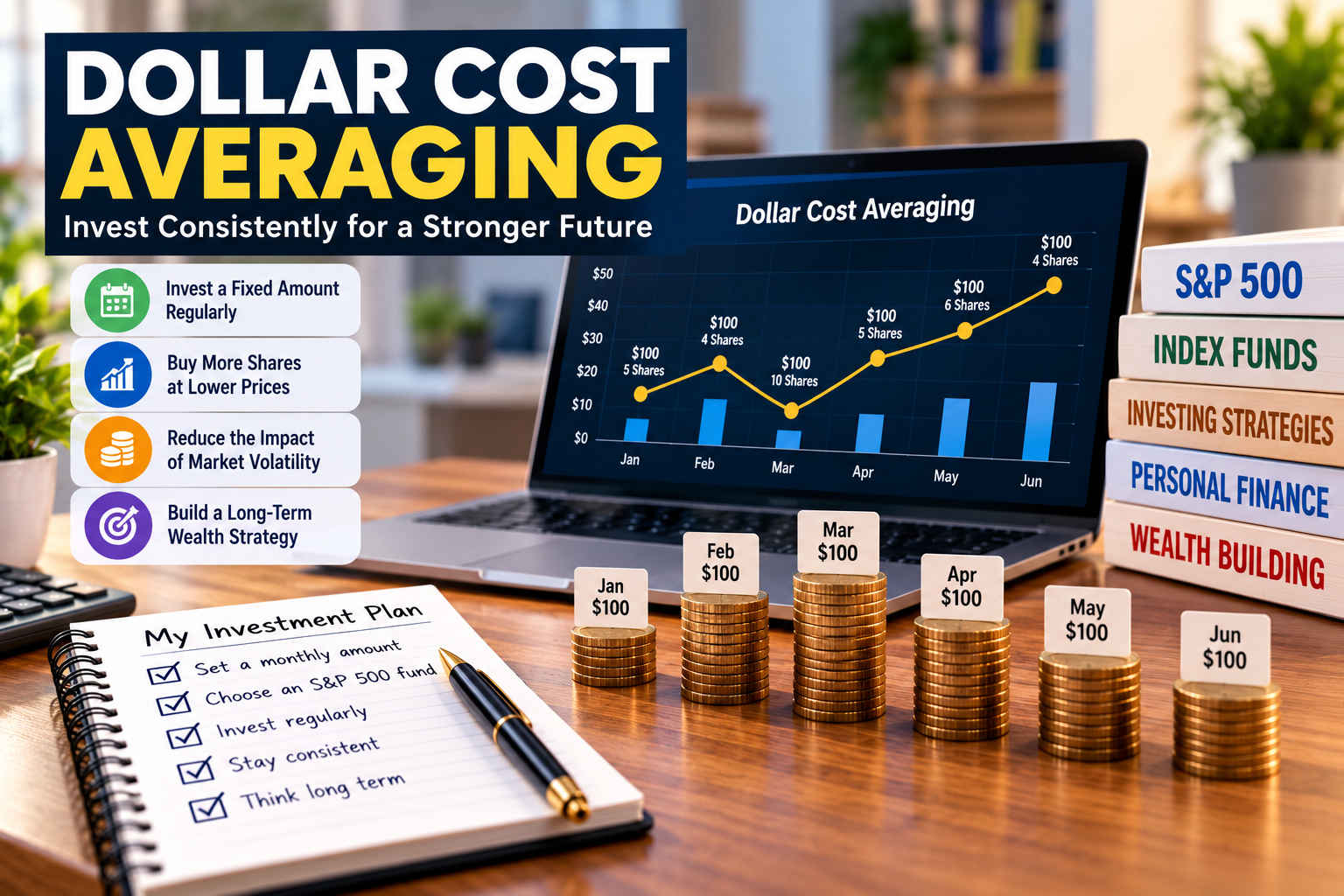
Investing regularly can be challenging when stock prices rise and fall unpredictably. Some investors wait for the perfect time to buy, while others invest all their available money at once. Dollar cost averaging offers another approach: investing a fixed amount at regular intervals, regardless of market conditions.
This strategy can make investing easier to plan and help investors develop consistent habits. Instead of trying to predict short-term market movements, you follow a schedule and gradually purchase investments over time.
However, dollar cost averaging does not guarantee profits or prevent losses. Your investments can still decline in value, and investing a lump sum earlier may produce better results in a rising market.
In this guide, you will learn how dollar cost averaging works, see a practical example, compare it with lump-sum investing, and understand how to use the strategy as part of a long-term financial plan.
What Is Dollar Cost Averaging?
Dollar cost averaging is an investment strategy in which you invest equal amounts of money at regular intervals, regardless of whether the market is rising or falling.
For example, you might invest $100 every month in an eligible stock fund rather than investing $1,200 all at once.
When prices are lower, your fixed contribution purchases more shares. When prices are higher, it purchases fewer shares.
Over time, this can spread your purchases across different market prices. It does not mean that every purchase will be profitable or that your overall investment will avoid losses.
How Does Dollar Cost Averaging Work?
The process is straightforward:
-
Choose an investment that fits your financial goals.
-
Decide how much you can afford to invest regularly.
-
Select a schedule, such as weekly or monthly contributions.
-
Invest the planned amount at each interval.
-
Review your portfolio and financial goals periodically.
You do not need to change your contribution every time the market moves. Following a consistent schedule can reduce the pressure to predict short-term price movements.
Dollar Cost Averaging vs. Investing a Lump Sum
Dollar cost averaging spreads an investment across multiple purchases. Lump-sum investing puts an available amount into the market at one time.
Suppose you have $1,200 available for long-term investing. You could invest the entire amount immediately or contribute $100 per month for 12 months.
With dollar cost averaging, some money remains uninvested until future contributions are made. That can help spread the timing of purchases, but it also means some money may miss market gains while waiting to be invested.
The better approach depends on your circumstances, risk tolerance, investment timeline, and market performance. Neither method guarantees a positive return.
Why Do Beginners Use This Strategy?
Beginners may find dollar cost averaging useful because it creates a repeatable investing routine.
Instead of trying to determine whether the market is currently cheap or expensive, they follow a schedule that fits their budget.
The strategy may also make it easier to invest from regular income. For example, an employee could contribute a portion of each paycheck to an eligible investment account.
Consistency can be helpful, but the investment itself still needs to be appropriate for the investor’s goals and risk tolerance.
How Dollar Cost Averaging Works: A Practical Example
Imagine an investor contributes $100 each month to an investment whose share price changes over four months.
| Month | Investment | Share Price | Shares Purchased |
|---|---|---|---|
| January | $100 | $20 | 5.00 |
| February | $100 | $25 | 4.00 |
| March | $100 | $10 | 10.00 |
| April | $100 | $20 | 5.00 |
| Total | $400 | — | 24.00 |
Illustrative example assuming fractional shares and excluding fees and taxes.
The investor contributes $400 and purchases 24 shares. The average purchase price is approximately $16.67 per share, calculated by dividing the total contributions by the number of shares purchased.
Notice what happens in March: when the price falls to $10, the same $100 contribution buys 10 shares instead of the four shares purchased in February at $25.
This is one of the central features of dollar cost averaging. A fixed contribution purchases more shares at lower prices and fewer shares at higher prices.
However, the average purchase price does not determine whether the investment is profitable by itself. Profit or loss depends on the investment’s market value when you evaluate or sell it, as well as applicable costs.
Benefits of Dollar Cost Averaging
Build a Consistent Investing Habit
A regular investment schedule can help turn investing into a routine rather than an occasional decision.
For example, you might schedule a contribution after receiving your monthly income. This approach can make your investing plan easier to follow and budget for.
Reduce the Pressure of Timing the Market
Predicting the best day to buy stocks is difficult. Prices can change because of economic data, company announcements, interest rates, and investor expectations.
Dollar cost averaging removes the need to make a fresh timing decision for every contribution. You continue investing according to your plan instead of waiting indefinitely for the perfect price.
This does not eliminate market risk, but it can reduce dependence on a single purchase date.
Make Investing Easier to Budget
Regular contributions allow you to plan around your income and expenses.
For example, an investor who can comfortably set aside $75 each month may find it easier to maintain that schedule than to accumulate a large amount before beginning.
The contribution should remain affordable. Essential expenses, emergency savings, and high-interest debt deserve consideration before committing money to investments.
Buy More Shares at Lower Prices
When prices decline, a fixed contribution purchases more shares. When prices increase, the same contribution purchases fewer shares.
This can result in a lower average purchase price than making all purchases at a single higher price. However, it is not guaranteed to outperform other investment approaches.
Reduce Emotional Decision-Making
Fear and excitement can influence investment decisions. Investors sometimes stop buying when prices fall or rush to buy after a strong rally.
A predefined schedule can help reduce these emotional reactions by establishing rules before market conditions change.
Still, investors should review their financial circumstances and investment choices when meaningful changes occur.
Risks and Limitations of Dollar Cost Averaging
It Does Not Guarantee Investment Returns
Dollar cost averaging is a method of deciding when to invest, not a guarantee that the investment will increase in value.
A stock, ETF, or mutual fund can lose value regardless of how regularly you purchase it.
Markets Can Continue Falling
Buying more shares at lower prices can be useful when an investment later recovers. However, prices can continue falling, and some investments may never recover their previous values.
Do not assume every decline creates a bargain. The quality, risks, and long-term prospects of the investment still matter.
Fees Can Reduce Returns
Regular purchases may involve repeated transaction costs, depending on your brokerage and investment product.
Before investing, review commissions, account fees, currency-conversion charges, and fund expenses. The SEC explains that investment fees reduce investment returns and that costs vary among funds.
If each transaction carries a fixed fee, making frequent small purchases can be relatively expensive. A suitable contribution frequency should account for these costs.
Lump-Sum Investing May Outperform
If you already have money available to invest, spreading it across future months leaves part of that money uninvested during the waiting period.
When markets rise during that period, investing the lump sum earlier may produce a higher return. Dollar cost averaging may feel more manageable to some investors, but it is not automatically the financially superior option.
Regular Investing Does Not Eliminate Market Risk
Even if you purchase shares at different prices, your portfolio can still decline when the broader market falls.
Your results depend on the investments you choose, how much you contribute, the prices at which you buy, and how the investments perform afterward.
Dollar Cost Averaging vs. Lump-Sum Investing
| Factor | Dollar Cost Averaging | Lump-Sum Investing |
|---|---|---|
| Timing | Invests over multiple intervals | Invests the available amount at once |
| Cash availability | Money is contributed gradually | Available money is invested immediately |
| Buying prices | Purchases occur at different prices | Purchase occurs at the prevailing price |
| Investing routine | Supports regular contributions | May require fewer initial decisions |
| Rising markets | Some money may miss early gains | More money participates from the start |
| Falling markets | Purchases may occur at lower prices later | The initial investment may decline in value |
| Fees | Repeated transactions may add costs | Fewer transactions may reduce some costs |
Neither approach is guaranteed to deliver better results in every market.
If you receive income regularly, dollar cost averaging may fit naturally into your financial routine. If you already have a large amount available, compare the potential benefits and risks of investing it immediately versus spreading purchases over time.
Your decision should reflect your financial situation rather than a belief that you can predict the market.
How to Use Dollar Cost Averaging Step by Step
1. Set a Realistic Investment Budget
Review your monthly income, essential expenses, debt payments, and savings needs.
Choose an amount you can maintain without relying on credit or sacrificing essential financial commitments. Your contribution can be small initially and adjusted if your income or circumstances change.
2. Choose Suitable Investments
Dollar cost averaging can be applied to different eligible investments, including stocks, index funds, and ETFs.
Research the investment before committing money. Consider its holdings, fees, risk level, and suitability for your goals.
A consistent schedule cannot compensate for choosing an investment you do not understand or one that is unsuitable for your financial circumstances.
3. Decide How Often to Invest
Common schedules include weekly, biweekly, or monthly contributions.
Choose a frequency that aligns with your income and keeps transaction costs reasonable. There is no universal schedule that works best for every investor.
4. Automate Contributions Where Appropriate
Some brokerage accounts allow recurring deposits or scheduled investments.
Automation can reduce the effort required to maintain a routine. Before enabling it, confirm the contribution amount, schedule, available balance, and any transaction fees.
Keep enough money available to cover essential expenses and avoid overdrafts.
5. Review Fees and Account Requirements
Check whether your broker charges for each purchase and whether your chosen fund has ongoing expenses.
Also confirm minimum investment requirements and whether fractional shares are available. These details can influence the most practical contribution size and schedule.
6. Monitor Your Long-Term Plan
Review your investment periodically rather than changing your schedule whenever prices move.
Check whether your goals, financial situation, and risk tolerance remain the same. If they change, reconsider your contribution amount or investment choices.
The purpose is to follow a sensible plan, not to continue investing blindly regardless of your circumstances.
Dollar Cost Averaging With S&P 500 Funds
Dollar cost averaging can be used to invest regularly in an S&P 500 index fund or ETF. These funds are designed to track the performance of the S&P 500, an index of large U.S. companies.
For example, an investor might contribute $100 each month to an eligible S&P 500 fund instead of investing a larger amount all at once.
When the fund’s share price falls, the contribution buys more shares. When the price rises, it buys fewer shares.
Before using this strategy, consider the following:
-
Fund costs: Review the expense ratio and any brokerage charges.
-
Diversification: An S&P 500 fund provides exposure to large U.S. companies but does not cover every market or asset class.
-
Investment timeline: Stock funds can experience substantial declines, so consider when you will need the money.
-
Contribution amount: Choose a schedule that fits your budget.
-
Risk tolerance: Regular contributions do not protect you from market losses.
You can also read our guide to investing in stocks to understand the basics before choosing an investment.
Common Dollar Cost Averaging Mistakes
Investing Money Needed for Essential Expenses
Do not invest money you may need for rent, bills, medical expenses, or other near-term obligations. Market declines can make it difficult to withdraw the full amount you invested.
Ignoring Investment Fees
Small transaction charges can accumulate when you make repeated purchases. Compare your broker’s fee schedule and the fund’s ongoing expenses before choosing a contribution frequency.
Changing the Plan Because of Short-Term Market Movements
A falling market can create anxiety, while a rising market can encourage investors to contribute more than they can afford.
Review your original goals and risk tolerance instead of making impulsive changes based only on recent prices.
Assuming Lower Prices Always Mean Better Investments
A lower share price does not necessarily mean an investment is undervalued. Research the investment’s fundamentals and risks rather than relying only on price movements.
Failing to Review Financial Goals
Your financial priorities may change because of a new job, family responsibilities, debt, or an upcoming major expense.
Review your plan periodically to ensure that your contribution amount and investment choices remain appropriate.
FAQs
Q1: What is dollar cost averaging in simple terms?
Ans: Dollar cost averaging means investing a fixed amount at regular intervals, regardless of market prices. This results in purchasing more shares at lower prices and fewer shares at higher prices.
Q2: Is dollar cost averaging good for beginners?
Ans: It can help beginners develop a consistent investing habit and reduce the pressure of timing the market. However, it does not guarantee profits or eliminate investment risk.
Q3: How often should I invest using dollar cost averaging?
Ans: You can invest weekly, biweekly, or monthly. Choose a schedule that fits your income, budget, investment goals, and transaction costs.
Q4: Can dollar cost averaging reduce investment risk?
Ans: It spreads purchases across different prices and dates, reducing dependence on a single purchase point. However, it does not eliminate market risk or guarantee smaller overall losses.
Q5: Is dollar cost averaging better than lump-sum investing?
Ans: Neither strategy is always better. Investing a lump sum earlier can outperform when markets rise, while spreading purchases over time may feel more manageable and reduce the risk of investing everything immediately before a decline.
Q6: Can I use dollar cost averaging with an S&P 500 ETF?
Ans: Yes, if your brokerage and chosen ETF support the required purchases. You can contribute regularly, but your investment can still lose value when the market declines.
Final Thoughts
Dollar cost averaging is a straightforward way to establish a regular investing routine. By investing a fixed amount at consistent intervals, you can spread purchases across different market prices without trying to predict every market movement.
However, consistency alone does not guarantee success. Your results still depend on your investment choices, market performance, costs, and financial circumstances.
Start with a realistic budget, choose investments carefully, understand the fees, and review your plan periodically. Most importantly, do not invest money you need for essential expenses.
A disciplined approach can make investing easier to manage, but the strategy should always support your broader financial goals rather than replace sound financial planning.