
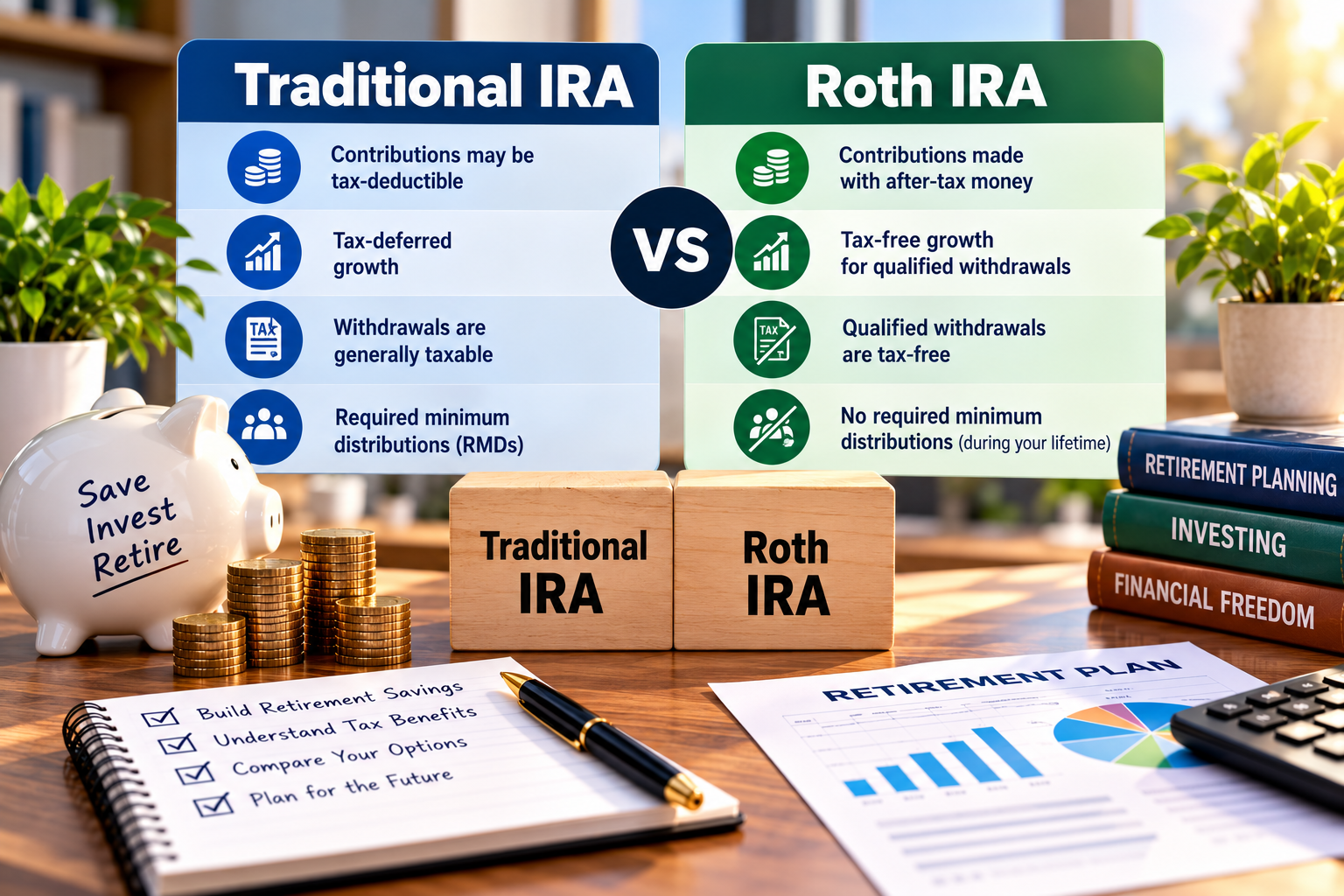
Roth IRAs and traditional IRAs are two popular retirement savings options in the United States. Both can help you invest for the future, but they treat taxes differently. Understanding these differences can help you choose an account that fits your income, financial goals, and expectations for retirement.
A traditional IRA may allow you to deduct eligible contributions from your taxable income today, while a Roth IRA uses after-tax contributions and can provide tax-free withdrawals in retirement when the applicable requirements are met. Neither account guarantees investment profits, and your results depend on the investments you choose.
If you are starting your retirement planning, learning how these accounts work is an important first step. This guide explains their key differences, contribution rules, benefits, potential drawbacks, and how to decide which option may be right for you.
What Is an IRA?
An Individual Retirement Account (IRA) is a tax-advantaged account designed to help people save and invest for retirement. Depending on the account type, it may provide tax benefits when you contribute, while your investments grow, or when you withdraw money.
Unlike a regular taxable brokerage account, an IRA follows specific IRS rules covering contributions, eligibility, withdrawals, and taxes.
Common investments held inside an IRA include:
-
Stocks and exchange-traded funds (ETFs)
-
Mutual funds and index funds
-
Bonds and other eligible investments
-
Cash or money market investments offered by the provider
Opening an IRA does not automatically invest your money. You generally need to select investments after funding the account.
There are several types of retirement accounts, but traditional IRAs and Roth IRAs are particularly relevant for individuals who want to manage their own retirement savings.
What Is a Traditional IRA?
A traditional IRA allows eligible individuals to contribute money toward retirement while potentially receiving a tax deduction for their contributions.
The main advantage is that a deductible contribution may reduce your taxable income for the year in which you make it. Investments can then grow tax-deferred, meaning you generally do not pay tax on investment gains each year inside the account.
Taxes usually become due when you withdraw money in retirement.
However, not every traditional IRA contribution is tax-deductible. Your eligibility for a deduction may depend on your income, filing status, and whether you or your spouse participates in a workplace retirement plan.
Traditional IRAs also generally require required minimum distributions (RMDs) to begin at a specified age. The applicable rules depend on your circumstances and current tax law.
Example of a Traditional IRA
Suppose you contribute $5,000 to a traditional IRA and qualify for a full deduction. Your taxable income may be reduced by $5,000, subject to the applicable rules.
If your investments grow over time, you generally do not pay annual income tax on those gains within the account. When you eventually withdraw the money, the taxable portion is generally taxed as ordinary income.
Your actual tax savings depend on your tax bracket and whether your contribution qualifies for a deduction.
What Is a Roth IRA?
A Roth IRA is a retirement account funded with after-tax money. You do not receive an upfront federal income-tax deduction for your contributions, but qualified withdrawals can be tax-free.
This structure may be attractive if you expect your tax rate to be higher in retirement or prefer to pay taxes on your contributions now rather than potentially owe taxes on withdrawals later.
Roth IRAs have income eligibility rules. If your modified adjusted gross income exceeds the applicable limit, your ability to contribute directly may be reduced or eliminated.
Another important feature is that original Roth IRA contributions can generally be withdrawn at any time without income tax or an early-withdrawal penalty. Investment earnings have different rules, and withdrawing them early may trigger taxes or penalties unless an exception applies.
Example of a Roth IRA
Imagine you contribute $5,000 to a Roth IRA using money on which you have already paid income tax.
You invest the money and the account grows over several decades. If you meet the requirements for qualified distributions, you can generally withdraw your contributions and earnings tax-free.
The potential benefit is that eligible investment growth can be withdrawn without additional federal income tax. However, your investment returns are not guaranteed, and you do not receive an upfront deduction for the contribution.
Traditional IRA vs. Roth IRA: 7 Key Differences
Both accounts are designed for retirement, but their tax treatment and withdrawal rules can lead to different outcomes. Here is a side-by-side comparison.
| Feature | Traditional IRA | Roth IRA |
|---|---|---|
| Contributions | May be tax-deductible | Made with after-tax money |
| Investment growth | Tax-deferred | Tax-free withdrawals when qualified |
| Retirement withdrawals | Generally taxable | Qualified withdrawals are generally tax-free |
| Income eligibility | No general income limit to contribute, but deduction rules apply | Income limits apply to direct contributions |
| Required minimum distributions | Generally begin at age 73 under current rules | Not required during the original owner’s lifetime |
| Early withdrawals | Taxes and penalties may apply | Contributions are generally accessible, but earnings have restrictions |
| Main tax advantage | Potential tax break today | Potential tax-free withdrawals later |
These differences are based on general federal tax rules. Individual circumstances, account history, and future changes in tax law can affect the result. The IRS explains the rules for traditional and Roth IRAs.
1. Tax Treatment of Contributions
The biggest difference is when you receive the tax benefit.
With a traditional IRA, eligible contributions may reduce your taxable income for the year. However, if you or your spouse participates in a workplace retirement plan, income restrictions may affect your deduction.
Roth IRA contributions are made with money that has already been taxed. You do not receive an upfront deduction, but qualified withdrawals can be tax-free.
Which matters more? If reducing your current taxable income is important, a deductible traditional IRA may be attractive. If you prefer the possibility of tax-free retirement withdrawals, a Roth IRA may be worth considering.
2. Investment Growth and Retirement Taxes
Both account types can hold investments such as stocks, bonds, mutual funds, and ETFs. Their tax treatment differs.
Traditional IRA investments generally grow tax-deferred. Taxes usually apply when you withdraw taxable amounts.
Roth IRA investments can also grow over time. When a withdrawal qualifies under IRS rules, both the contributions and investment earnings can generally be withdrawn tax-free.
For example, imagine an account grows from $10,000 to $40,000. The $30,000 increase represents investment growth, not guaranteed profit. In a traditional IRA, taxable withdrawals are generally taxed as ordinary income. In a Roth IRA, a qualified withdrawal can include the growth without additional federal income tax.
Investment performance, fees, and the timing of contributions all influence your final balance.
3. Income Eligibility Rules
Traditional and Roth IRAs have different eligibility considerations.
For a traditional IRA, you generally need taxable compensation to contribute. Your ability to deduct contributions may be limited by your income and workplace retirement plan coverage.
For a Roth IRA, your ability to contribute directly depends on your modified adjusted gross income (MAGI), filing status, and other applicable rules.
For the 2026 tax year, the general annual contribution limit is $7,500, increasing to $8,600 for people aged 50 or older. Your combined contributions to traditional and Roth IRAs cannot exceed the applicable limit or your taxable compensation for the year, whichever is lower. Roth IRA contributions may be further restricted by income limits.
These figures can change, so check the rules for the specific tax year before contributing.
4. Withdrawal Rules and Penalties
Traditional IRA withdrawals are generally taxable to the extent the money has not already been taxed. Taking money out before age 59½ may also trigger an additional 10% tax unless an exception applies.
Roth IRAs work differently. Regular contributions are generally withdrawn before conversions and earnings under the IRS ordering rules, so you can usually access your original contributions without income tax or an early-withdrawal penalty.
However, Roth IRA earnings are not automatically available tax-free at any time. Qualified distributions generally require the five-year holding period to be satisfied and an applicable qualifying condition, such as reaching age 59½.
Certain exceptions may apply to early withdrawals from either account, but the details matter. Before taking money out, review the applicable IRS withdrawal rules.
5. Required Minimum Distributions
Required minimum distributions (RMDs) are amounts account owners must withdraw from certain retirement accounts once they reach the applicable age.
Traditional IRA owners generally must begin RMDs at age 73 under current federal rules. These withdrawals are usually taxable, subject to exceptions for amounts that have already been taxed.
Original Roth IRA owners do not have lifetime RMD requirements. That can offer more flexibility when planning retirement withdrawals. Beneficiaries who inherit Roth IRAs may still have distribution requirements.
6. Tax Planning for Retirement
Your current tax bracket and expected future tax bracket can help guide your choice.
A traditional IRA may be useful if you qualify for a deduction today and expect to pay a lower tax rate when you withdraw the money in retirement.
A Roth IRA may be attractive if you are in a relatively low tax bracket now and expect your tax rate or income to rise later. Paying taxes upfront could allow you to take qualified withdrawals without additional federal income tax.
Still, future tax rates are uncertain. Consider your income, filing status, workplace retirement benefits, and overall savings plan rather than relying on one assumption.
7. Flexibility and Long-Term Planning
Roth IRAs offer a useful level of flexibility because regular contributions can generally be withdrawn without taxes or penalties. That does not make a Roth IRA an ideal emergency fund, though. Withdrawing money reduces the amount available for long-term growth, and earnings have separate rules.
Traditional IRAs can also support long-term financial planning, particularly for people who benefit from an eligible deduction. However, required distributions and taxes on withdrawals should be considered as retirement approaches.
For either account, maintaining separate emergency savings can help you avoid selling investments or withdrawing retirement money when unexpected expenses arise.
IRA Contribution Limits and Eligibility
Before opening or funding an account, check the current contribution limits and eligibility requirements.
For 2026, the general IRA contribution limits are:
| Age | Annual combined contribution limit |
|---|---|
| Under 50 | $7,500 |
| 50 or older | $8,600 |
These are combined limits for traditional and Roth IRAs, not separate limits for each account. You also generally cannot contribute more than your eligible taxable compensation for the year. Special rules may apply to certain situations, including spousal IRAs and rollover contributions.
For Roth IRAs, the 2026 income phase-out ranges are:
-
Single filers and heads of household: $153,000–$168,000 in modified adjusted gross income.
-
Married couples filing jointly: $242,000–$252,000.
-
Married individuals filing separately who lived with their spouse during the year: special restrictions apply, with a phase-out range generally between $0 and $10,000.
These thresholds determine when direct Roth IRA contributions are reduced or unavailable. Traditional IRA deduction limits depend on factors such as income, filing status, and participation in a workplace retirement plan.
Traditional IRA vs. Roth IRA: Which Is Better for You?
There is no single answer for everyone. The right choice depends on your present circumstances and your retirement goals.
When a Traditional IRA May Make Sense
A traditional IRA may be worth considering if:
-
You qualify for a tax deduction on contributions.
-
You want to reduce taxable income in the current year.
-
You expect to be in a lower tax bracket during retirement.
-
You are comfortable paying taxes on taxable withdrawals later.
Remember that the deduction is not automatic. Review your income and workplace retirement plan situation before assuming a contribution will reduce your taxes.
When a Roth IRA May Make Sense
A Roth IRA may be worth considering if:
-
You meet the income eligibility rules.
-
You can pay taxes on contributions now.
-
You value the potential for tax-free qualified withdrawals.
-
You expect your income or tax rate to be higher later.
-
You want to avoid lifetime RMDs on your own Roth IRA.
These are planning considerations, not guarantees. Your future income and tax situation may change.
Can You Have Both Accounts?
Yes. You can generally own both a traditional IRA and a Roth IRA if you meet the applicable rules. However, your annual contributions to both accounts share one combined limit.
For example, if your applicable annual limit is $7,500, contributing $4,000 to a traditional IRA would generally leave $3,500 available for a Roth IRA, assuming you have enough eligible compensation and meet the Roth IRA income requirements.
You should also check whether traditional IRA contributions will be deductible before deciding how to divide your contributions.
Common IRA Mistakes to Avoid
Retirement accounts offer useful tax advantages, but mistakes can create unnecessary costs. Keep these points in mind:
-
Assuming all traditional IRA contributions are deductible: Eligibility depends on your circumstances.
-
Exceeding contribution limits: Remember that traditional and Roth IRA contributions share an annual limit.
-
Withdrawing earnings too early: Roth IRA earnings have specific tax and penalty rules.
-
Ignoring fees: Account maintenance charges, fund expenses, and trading costs can reduce your returns.
-
Investing without a plan: Choose investments based on your time horizon, risk tolerance, and financial goals.
-
Forgetting beneficiaries: Review your beneficiary designations after major life changes.
You can also explore the basics of investing in stocks to understand how investments may fit into a broader long-term financial plan.
How to Open an IRA or Roth IRA
Opening an account is usually straightforward, but taking a few minutes to compare options can help you make a better decision.
-
Review your goals. Decide when you expect to retire and what you want your savings to accomplish.
-
Check your eligibility. Review compensation requirements, income limits, and the current contribution rules.
-
Compare providers. Consider investment choices, account fees, customer support, and ease of use.
-
Open your account. Complete the provider’s application and verify your identity.
-
Fund the account. Contribute an eligible amount within the applicable annual limit.
-
Choose investments. Select suitable investments rather than assuming the deposited cash will be invested automatically.
-
Review your plan regularly. Monitor your contributions, investment mix, fees, and progress toward retirement.
If you already have a workplace retirement plan, compare its features with those of an IRA before making a decision.
Frequently Asked Questions
Q1: Is a Roth IRA better than a traditional IRA?
Ans: A Roth IRA may suit someone who prefers tax-free qualified withdrawals and meets the eligibility requirements. A traditional IRA may be more attractive to someone who qualifies for a deduction today. Your current and expected future tax situations matter.
Q2: Can I withdraw Roth IRA money at any time?
Ans: Regular contributions can generally be withdrawn without income tax or an early-withdrawal penalty. Earnings follow separate rules, and a withdrawal may not be qualified if the applicable requirements have not been met.
Q3: Do traditional IRAs have required minimum distributions?
Ans: Yes. Traditional IRA owners generally must begin taking required minimum distributions at age 73 under current federal rules. Roth IRA owners do not have lifetime RMD requirements for their own accounts.
Q4: Can I contribute to an IRA if I have a 401(k)?
Ans: Generally, yes, if you meet the IRA contribution requirements. However, participation in a workplace retirement plan can affect whether traditional IRA contributions are deductible. Roth IRA eligibility is subject to separate income rules.
Q5: How much money do I need to open an IRA?
Ans: The minimum opening deposit depends on the financial institution and the investments you select. Some providers allow you to open an account without a large initial deposit, while certain investments may have minimum purchase requirements.
Q6: Are IRA investments guaranteed to make money?
Ans: No. IRAs are account types, not investments themselves. Stocks, bonds, ETFs, and mutual funds can rise or fall in value. Your returns depend on the investments you choose, market conditions, fees, and how long you remain invested.
Conclusion
Traditional IRAs and Roth IRAs can both support long-term retirement savings, but they offer different tax advantages. A traditional IRA may provide an eligible tax deduction today, while a Roth IRA offers the possibility of tax-free qualified withdrawals in retirement.
Before choosing, compare your current income, expected retirement tax bracket, contribution eligibility, withdrawal needs, and investment options. Check the latest IRS rules and consider consulting a qualified tax professional if your situation is complex.
The most suitable retirement account is one that fits your financial circumstances and supports a consistent, long-term savings strategy.