
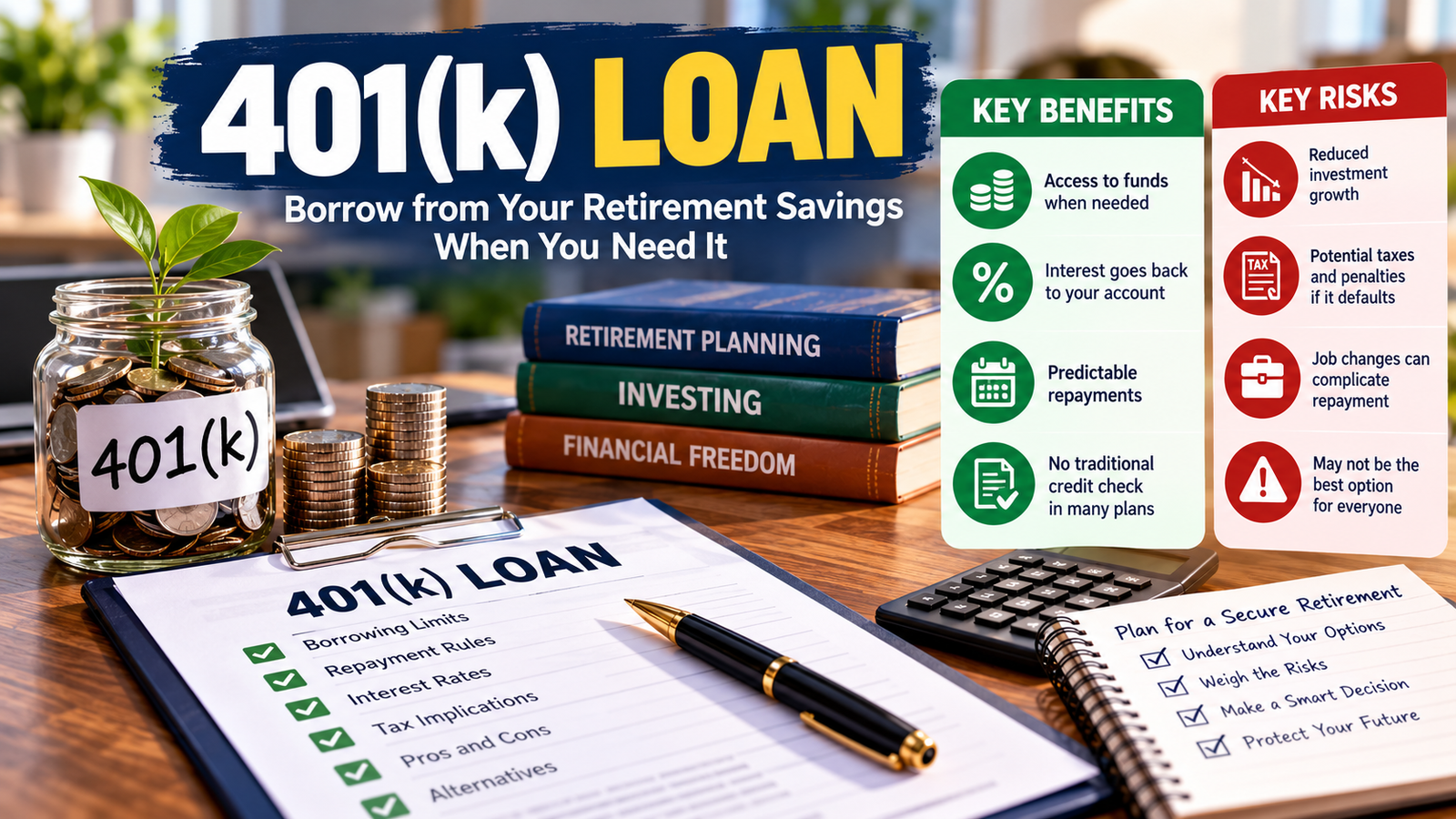
A 401k loan can give you access to money from your workplace retirement savings when you need funds for an unexpected expense, home improvement, or another major financial goal. Instead of applying for a traditional bank loan, you borrow from your own retirement account and repay the money according to your employer’s plan rules.
However, borrowing from your retirement savings is not always the best financial decision. Although a properly structured 401k loan generally avoids immediate income tax when issued, it can reduce investment growth and create repayment problems if your financial circumstances change.
Before taking out a 401k loan, understand how much you can borrow, how repayments work, and what happens if you leave your job before paying off the balance. Comparing the advantages and disadvantages can help you decide whether borrowing is appropriate for your situation.
What Is a 401k Loan?
A 401k loan is a loan taken against your vested balance in an employer-sponsored retirement plan. If your employer’s plan allows borrowing, you may be able to access a portion of your retirement savings without making a permanent withdrawal.
Unlike a conventional bank loan, the money comes from your retirement plan. You generally repay the loan, including interest, over a specified period. Repayments usually return to your retirement account under the plan’s rules.
Not every 401k plan permits loans. Employers can establish their own borrowing procedures, repayment requirements, and administrative fees within applicable legal limits.
A 401k loan is also different from an early withdrawal. With a loan, you are expected to repay the borrowed amount. An early withdrawal permanently removes money from the account and may trigger income tax and an additional tax.
Important: Borrowing from a 401k reduces the amount of money invested in your retirement account while the loan is outstanding. That can affect your long-term savings, particularly if investments increase in value during that period.
How Does a 401k Loan Work?
The process is usually straightforward, although details vary by plan.
-
Check your plan rules. Contact your plan administrator or review your benefits portal to confirm that loans are permitted.
-
Review your available balance. Your vested account balance helps determine the maximum amount you may borrow.
-
Submit a loan request. Follow your plan’s application process and provide any required information.
-
Review the terms. Check the interest rate, repayment period, fees, and consequences of missed payments.
-
Receive the funds. If approved, the plan distributes the loan proceeds according to its procedures.
-
Repay the loan. Payments are generally made at least quarterly and are commonly deducted from your paycheck.
-
Monitor your account. Keep track of your outstanding balance and confirm that repayments are being processed correctly.
Before applying, consider whether you can comfortably afford the repayments alongside rent or mortgage payments, bills, emergency savings, and other financial commitments.
401k Loan Rules and Borrowing Limits
The IRS sets general limits on how much you can borrow from a 401k plan. Your employer’s plan may offer a lower limit or additional restrictions.
Generally, the maximum loan is the lesser of $50,000 or 50% of your vested account balance. An exception may allow a loan of up to $10,000 when 50% of your vested balance is less than $10,000, but the plan is not required to offer this exception. Existing or recent loans can also reduce the amount available.
Here are the main rules to understand:
-
Borrowing limit: Generally, the lesser of $50,000 or 50% of your vested balance, subject to applicable exceptions and adjustments.
-
Repayment period: Usually five years, with a possible longer term for a loan used to purchase your principal residence.
-
Payment schedule: Payments must generally be made in substantially equal installments, including principal and interest, at least quarterly.
-
Plan requirements: Your employer must permit loans under the plan for you to borrow.
-
Tax treatment: A loan that follows the applicable rules is generally not taxable when issued. A default or failure to meet the requirements may result in a taxable distribution.
Example: How Much Could You Borrow?
Suppose your vested 401k balance is $60,000.
-
50% of your vested balance is $30,000.
-
The general $50,000 maximum is higher than $30,000.
-
Your potential maximum loan would therefore generally be $30,000, assuming no other restrictions or adjustments apply.
This is only an illustration. Your plan administrator must confirm the actual amount available to you.
For official details, review the IRS 401k loan rules before making a decision.
7 Pros and Cons of a 401k Loan
A 401k loan can provide access to money, but it also creates obligations that can affect your future finances. Consider both sides before borrowing.
Potential Benefits
1. Access to money without a traditional loan application
Many plans let participants request a loan directly through the plan administrator. The process may be simpler than applying for a conventional loan, although the actual procedures depend on your plan.
2. Interest generally goes back into your account
Rather than paying interest to a bank, you generally pay interest back into your retirement account. However, this does not mean the loan is free: fees may apply, and your borrowed money may miss investment gains.
3. Predictable repayments
Payments are often deducted automatically from your paycheck. This can make budgeting easier and reduce the chance of forgetting a payment.
4. Potentially flexible use of funds
Unlike a hardship withdrawal, a plan loan generally does not have to be based on a qualifying financial hardship. Your plan may allow borrowing for a variety of purposes, subject to its rules.
Potential Drawbacks
5. Reduced investment growth
Money borrowed from your 401k is not invested in the same way while the loan remains outstanding. If the market rises, you could miss potential gains. Market returns are unpredictable, so the actual opportunity cost cannot be known in advance.
6. Taxes and penalties may apply if the loan defaults
If you fail to repay the loan under the applicable rules, the outstanding amount may be treated as a distribution. The taxable portion is generally included in income, and an additional 10% tax may apply if you are under age 59½ and no exception is available.
7. Job changes can complicate repayment
If you leave your employer, your plan may require you to repay the remaining balance sooner than expected. If you cannot meet the terms, the unpaid amount may trigger tax consequences. This makes job security and your ability to repay important factors to consider.
401k Loan Repayment Rules
Before accepting a loan, understand the repayment schedule and how it will fit into your monthly budget.
How Are Payments Made?
Repayments are generally made in regular installments that include both principal and interest. Many employers arrange payroll deductions, although the process depends on the plan.
For most loans, the repayment term cannot exceed five years. A loan used to purchase your principal residence may qualify for a longer repayment period under the plan’s rules.
What Interest Rate Will You Pay?
Your plan determines the loan’s interest rate according to its written terms. You should also check for application, setup, or maintenance fees.
Even if interest is credited back to your retirement account, compare the total cost of borrowing with other options. The money used to repay the loan also comes from your income, which may affect how much you can save elsewhere.
What If You Miss a Payment?
Missing a payment does not always mean the loan immediately defaults. The plan may have a limited period to correct missed payments, but you should not assume that you have extra time.
Contact your plan administrator as soon as possible if you cannot make a scheduled payment. Ask about the correction process, any fees, and the tax consequences if the loan cannot be brought back into compliance.
What Happens If You Leave Your Job With a 401k Loan?
Leaving your job while a 401k loan is outstanding can create complications. Depending on your plan, you may be required to repay the remaining balance or face a loan offset.
If the outstanding balance becomes a taxable distribution, you may owe income tax on the previously untaxed amount. An additional 10% early-distribution tax may also apply if you are under age 59½ and no exception is available.
However, some qualifying plan loan offsets can be rolled over to an eligible retirement account by the federal income tax return due date, including extensions, for the year of the offset. Other situations may have different deadlines.
Before changing jobs, ask your plan administrator:
-
Will I need to repay the loan immediately?
-
Can repayments continue after I leave?
-
What happens if I cannot repay the remaining balance?
-
Could the unpaid amount create a taxable distribution?
-
Am I eligible for a rollover, and what deadline applies?
Planning ahead can help you avoid an unexpected tax bill during a job transition.
401k Loan vs. Early Withdrawal
A loan and an early withdrawal both provide access to retirement savings, but they work differently.
| Feature | 401k Loan | Early Withdrawal |
|---|---|---|
| Repayment | Generally required | Not required |
| Immediate income tax | Generally none if rules are met | Usually applies to previously untaxed amounts |
| Additional 10% tax | May apply if the loan becomes a taxable distribution and no exception applies | May apply before age 59½ unless an exception applies |
| Retirement balance | Borrowed money is expected to be repaid | Withdrawn money permanently leaves the account |
| Main risk | Repayment problems and missed investment growth | Taxes, possible penalties, and reduced retirement savings |
Neither option is automatically better. The appropriate choice depends on your financial needs, plan rules, and ability to repay or absorb the cost of a withdrawal.
Alternatives to a 401k Loan
Before borrowing against retirement savings, compare other options. A different source of funds may be more suitable, depending on the interest rate, repayment terms, and your circumstances.
1. Use an Emergency Fund
If the expense is unexpected and your savings can cover it without leaving you financially vulnerable, using an emergency fund may help you avoid taking on debt or disrupting retirement investments.
However, preserve enough cash for essential expenses and future emergencies.
2. Compare Personal Loans
A personal loan from a bank or credit union may offer a fixed repayment schedule. Compare the annual percentage rate (APR), fees, total interest, and monthly payments rather than focusing only on the advertised rate.
3. Negotiate a Payment Plan
If you need money for medical bills, tuition, or another large expense, ask the provider whether it offers installment payments or financial assistance. A payment arrangement may cost less than borrowing from your retirement account.
4. Review Your Monthly Spending
Look for expenses you can temporarily reduce before taking on a new financial obligation. Creating a realistic personal budget can help you identify available cash, prioritize essential bills, and determine whether you can afford repayments.
5. Consider Other Borrowing Options Carefully
Home equity loans and lines of credit may be options for eligible homeowners, but they put your home at risk if you cannot repay. Compare their costs and risks with a 401k loan before making a decision.
When Does a 401k Loan Make Sense?
A 401k loan may be worth considering when you have a necessary expense, a reliable repayment plan, and no more suitable alternative at a reasonable cost.
For example, you might consider one if you need to cover an essential expense and can repay the loan comfortably without abandoning other financial priorities.
On the other hand, borrowing may be a poor fit if:
-
You expect to change jobs soon.
-
Your income is unstable.
-
You already struggle to cover monthly expenses.
-
You would need another loan to repay the first one.
-
The repayments would prevent you from building emergency savings.
-
You would have to borrow a large portion of your retirement balance.
Before proceeding, review the Department of Labor guidance on retirement plans and loans. Consider consulting a qualified financial professional if the decision could significantly affect your retirement plans.
Frequently Asked Questions
Q1: How much can I borrow from my 401k?
Ans: Generally, the maximum is the lesser of $50,000 or 50% of your vested account balance, subject to applicable exceptions and adjustments for existing or recent loans. Your plan may impose a lower limit.
Q2: Does a 401k loan affect my credit score?
Ans: A loan from your retirement plan generally does not work like a conventional loan reported to credit bureaus. However, plan-specific procedures and your overall financial situation may affect your finances in other ways.
Q3: Do I pay taxes on a 401k loan?
Ans: A properly structured 401k loan that follows the applicable rules is generally not taxable when issued. If the loan defaults or becomes a taxable distribution, you may owe income tax and potentially an additional 10% tax.
Q4: Can I take a 401k loan while still employed?
Ans: You may be able to if your employer’s plan permits loans and you meet its requirements. Not all plans offer this feature, so check with your plan administrator.
Q5: What happens if I cannot repay my 401k loan?
Ans: The plan may treat the unpaid amount as a taxable distribution if the loan defaults under the applicable rules. You may owe income tax and, depending on your age and circumstances, an additional tax. Contact your plan administrator promptly if you anticipate repayment difficulties.
Q6: Is a 401k loan better than a personal loan?
Ans: It depends on the interest rate, fees, repayment terms, investment opportunity cost, and employment stability. Compare the total costs and risks of both options before deciding.
Conclusion
A 401k loan can provide access to funds without immediately withdrawing retirement savings, and interest generally goes back into your account. However, it can reduce potential investment growth and create tax complications if repayments fail or you leave your job.
Before borrowing, check your plan’s limits, interest rate, repayment schedule, and rules for employment changes. Compare alternatives and make sure the monthly payments fit your budget.
The best borrowing decision is one that addresses your current financial needs without unnecessarily putting your long-term retirement goals at risk.