
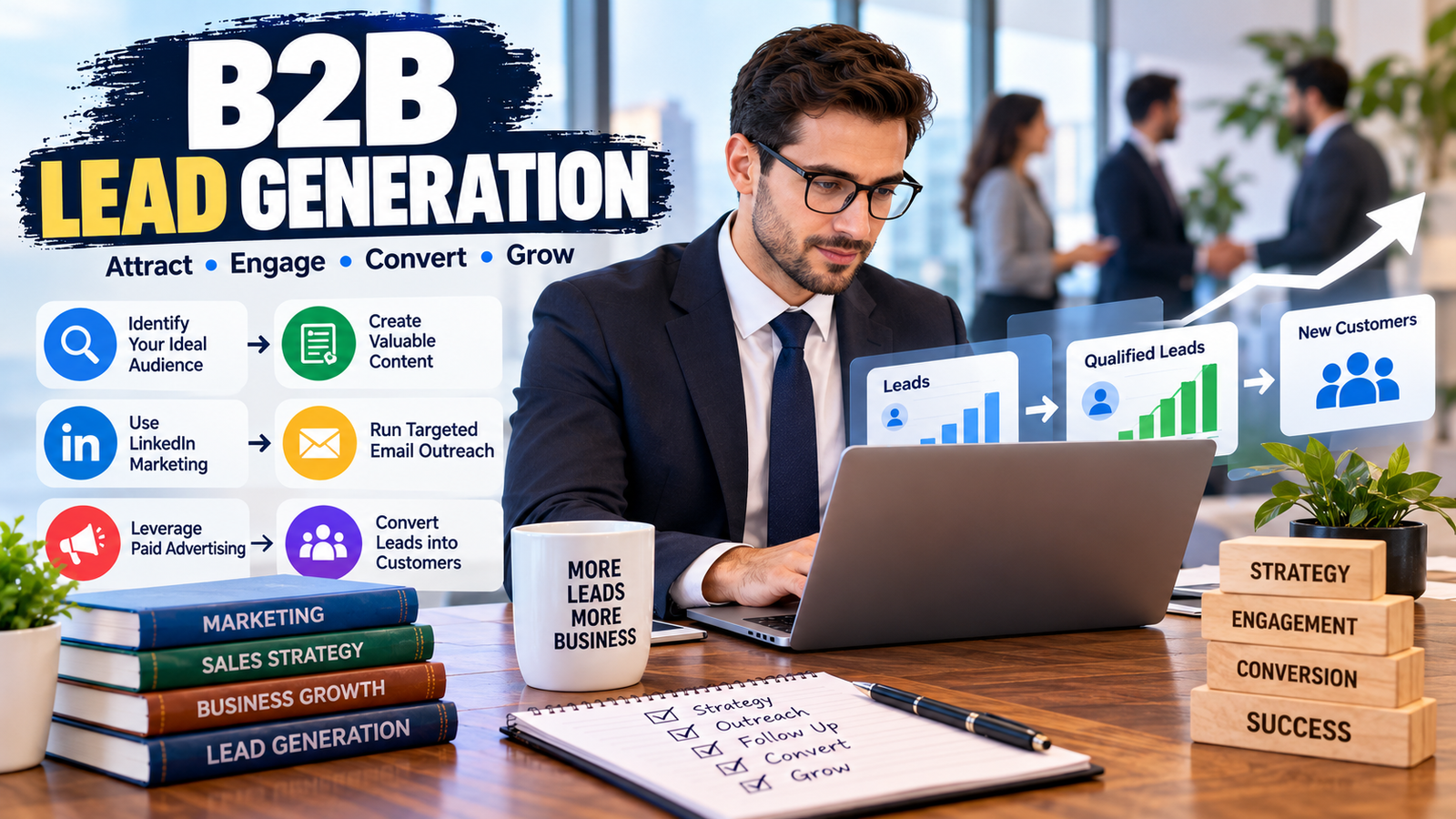
B2B lead generation is the process of identifying and attracting businesses that may need your products or services. For companies that sell to other businesses, generating qualified leads is essential for building relationships, increasing sales opportunities, and achieving sustainable growth.
However, finding potential clients is only the beginning. Businesses must understand their target audience, choose effective marketing channels, communicate their value clearly, and follow up with prospects at the right time.
Whether you run a startup, marketing agency, software company, or consulting business, a structured lead generation strategy can help you connect with decision-makers and turn potential customers into paying clients.
In this guide, you’ll discover nine practical B2B lead generation strategies, learn how to qualify prospects, explore useful tools, and understand how to measure results.
What Is B2B Lead Generation?
B2B lead generation refers to the process of finding businesses that could benefit from your products or services and encouraging them to take the next step, such as requesting a demo, booking a meeting, or asking for a quotation.
B2B stands for business-to-business. Unlike business-to-consumer marketing, which targets individual buyers, B2B marketing focuses on organizations and the people responsible for purchasing decisions.
For example, a software company might generate leads by offering a product demonstration to businesses that need better project management tools. Similarly, a digital marketing agency might attract companies looking for SEO, content marketing, or paid advertising services.
Common B2B lead generation channels include:
-
Search engine optimization (SEO)
-
Content marketing and blogging
-
LinkedIn marketing
-
Email outreach
-
Paid advertising
-
Webinars and industry events
-
Referrals and professional networking
The best approach depends on your target market, budget, sales cycle, and the type of customers you want to reach.
Why Is B2B Lead Generation Important?
A consistent lead generation process helps businesses identify potential customers instead of relying entirely on random inquiries or referrals.
Here are some important benefits.
1. Creates More Sales Opportunities
Lead generation introduces your business to prospects who may be interested in your products or services. A steady flow of relevant prospects gives your sales team more opportunities to start conversations and build relationships.
2. Improves Marketing Efficiency
When you understand your ideal customer, you can focus your marketing budget on the channels and audiences most likely to convert.
This helps reduce wasted effort on prospects who are unlikely to need your offering.
3. Supports Predictable Business Growth
A documented process makes it easier to track how prospects move from initial interest to becoming customers. Over time, this information helps you estimate future sales opportunities and identify gaps in your pipeline.
4. Builds Long-Term Relationships
B2B purchases often involve multiple decision-makers and longer evaluation periods. Helpful content, relevant communication, and consistent follow-ups can build trust before a prospect is ready to buy.
9 Proven B2B Lead Generation Strategies
There is no single channel that works for every business. The strongest approach usually combines targeted outreach with useful content, clear offers, and consistent follow-up.
1. Use SEO and Content Marketing
Search engine optimization can help your business attract prospects who are already looking for solutions to specific problems.
For example, a company selling customer relationship management software could publish articles about managing customer data, choosing CRM software, and improving sales productivity.
To make this approach effective:
-
Research keywords related to your products and services.
-
Create helpful articles that answer real customer questions.
-
Use descriptive headings and relevant internal links.
-
Include clear calls to action on relevant pages.
-
Offer useful resources, such as checklists, templates, or guides.
Content marketing takes time to build momentum, but useful articles can continue attracting potential customers after publication.
Avoid publishing articles simply to target keywords. Focus on answering the reader’s question thoroughly and providing practical information. Google’s guidance emphasizes helpful, reliable, people-first content.
2. Use LinkedIn to Find Decision-Makers
LinkedIn is useful for B2B lead generation because professionals can research companies, identify relevant job roles, and build business relationships.
Start by identifying the people who influence purchasing decisions in your target market. Depending on your offer, these might include founders, marketing managers, sales directors, procurement managers, or department heads.
A practical LinkedIn process includes:
-
Define your ideal customer profile.
-
Search for relevant companies and decision-makers.
-
Review their business needs and professional interests.
-
Connect with a personalized, relevant message.
-
Share useful insights instead of immediately pushing a sale.
-
Follow up professionally when there is a genuine reason to continue the conversation.
For example, if you offer SEO services, focus on businesses that could benefit from stronger organic visibility. Explain how your services relate to their needs rather than sending the same sales pitch to everyone.
LinkedIn also offers advertising and lead-generation tools for businesses that want to reach specific professional audiences.
3. Build a Targeted Email Outreach Campaign
Email outreach allows businesses to introduce their services directly to relevant prospects. It can work particularly well when the target audience and offer are clearly defined.
However, sending thousands of generic emails is rarely a good substitute for understanding your prospects.
Use this approach instead:
-
Build a relevant list of companies that fit your target market.
-
Identify the appropriate business contact.
-
Personalize your message around a relevant problem or opportunity.
-
Explain your value proposition in a few sentences.
-
Include one clear next step.
-
Follow up thoughtfully without sending excessive messages.
Keep outreach relevant and comply with applicable email marketing, privacy, and anti-spam laws. Avoid misleading subject lines and respect opt-out requests.
4. Create Landing Pages That Convert
A landing page gives potential customers a focused place to learn about an offer and take action.
Instead of directing every visitor to your homepage, create dedicated pages for important services, products, or campaigns.
An effective B2B landing page should include:
-
A clear headline explaining the offer.
-
A concise description of the business problem you solve.
-
Specific benefits rather than vague promises.
-
Evidence of credibility, such as genuine case studies or testimonials.
-
A simple contact form or booking option.
-
One prominent call to action.
For example, a software company might create a page offering a free product demonstration. A consulting firm could offer an initial consultation or a downloadable industry report.
Keep forms as short as practical. Asking for too much information may discourage interested visitors from completing them.
5. Offer Valuable Lead Magnets
A lead magnet is a useful resource offered in exchange for contact details or another meaningful action.
It should solve a specific problem for your target audience rather than simply advertise your company.
Examples include:
-
Industry research reports.
-
Business planning templates.
-
SEO audit checklists.
-
Sales scripts and email templates.
-
Cost calculators.
-
Webinars and educational workshops.
Suppose your company provides business consulting services. You could create a downloadable business planning checklist that helps founders identify gaps in their strategy.
The resource attracts people interested in the topic and gives your team a relevant reason to continue the conversation.
Make sure the resource delivers genuine value. If you request an email address, explain how the information will be used and follow applicable privacy requirements.
6. Use Paid Advertising Strategically
Paid advertising can help businesses reach potential customers more quickly than relying exclusively on organic traffic.
Common options include search advertising, LinkedIn advertising, and other professional or industry-specific platforms.
The best channel depends on where your buyers research solutions and how much a qualified customer is worth to your business.
To manage advertising costs effectively:
-
Target specific industries, job roles, or search terms.
-
Match each advertisement to a relevant landing page.
-
Test different headlines and offers.
-
Track qualified leads, not just clicks.
-
Review which campaigns generate sales opportunities.
-
Reduce spending on campaigns that consistently produce poor-quality leads.
Paid advertising should support a defined business objective. Generating a large number of inexpensive leads is not useful if those prospects never become customers.
7. Build Referral and Partnership Programs
Existing customers, professional contacts, and complementary businesses can introduce you to relevant prospects.
Referrals may be especially valuable when buyers need confidence before choosing a service provider.
Start by identifying organizations that serve the same audience without directly competing with your business. For example, a web design agency might partner with a content marketing agency, while an accounting firm might collaborate with a business consultant.
You can develop these relationships by:
-
Providing excellent service to existing customers.
-
Asking satisfied clients for introductions when appropriate.
-
Creating partnerships with complementary businesses.
-
Sharing educational resources with professional networks.
-
Developing a transparent referral process.
Do not assume that every referral will convert. Evaluate the fit of each prospect and treat introductions as the beginning of a relationship rather than a guaranteed sale.
8. Use Webinars and Educational Events
Webinars, workshops, and industry events give businesses an opportunity to demonstrate expertise and connect with people interested in a specific topic.
Choose a subject that addresses a real challenge your audience faces. A cybersecurity company might host a session about reducing security risks, while a marketing agency could teach businesses how to improve lead conversion.
For better results:
-
Select a focused topic.
-
Promote the event to a relevant audience.
-
Provide practical examples and actionable advice.
-
Allow time for questions.
-
Offer a relevant next step after the event.
-
Follow up with attendees according to their interests and consent.
Educational events can also help your sales team understand prospects’ questions, objections, and purchasing priorities.
9. Use CRM Tools and Lead Nurturing
Not every prospect is ready to buy when they first discover your business. Some need more information, internal approval, or time to compare suppliers.
A customer relationship management (CRM) system helps you organize contacts, record interactions, assign follow-up tasks, and track sales opportunities.
A basic lead nurturing process might include:
-
Sending a useful resource after a prospect signs up.
-
Sharing a relevant case study.
-
Answering questions about your service.
-
Scheduling a follow-up when the prospect requests it.
-
Moving qualified opportunities into the sales pipeline.
You can automate routine tasks, but keep communication relevant and monitor the results. Automation should support genuine relationships, not overwhelm prospects with repetitive messages.
How to Identify and Qualify B2B Leads
Generating contacts is only one part of the process. You also need to determine which prospects are most likely to benefit from your offering and become customers.
Define Your Ideal Customer Profile
An ideal customer profile (ICP) describes the type of organization most likely to benefit from your product or service.
Consider these factors:
-
Industry: Which sectors need your solution?
-
Company size: Are you targeting startups, small businesses, or large enterprises?
-
Location: Which countries or regions can you serve?
-
Budget: Can the company afford your offering?
-
Business needs: What problem are you solving?
-
Buying authority: Which people influence or approve the purchase?
A clear ICP helps you focus your time and marketing budget on better-fit prospects.
Understand the Difference Between MQLs and SQLs
A marketing-qualified lead (MQL) has shown interest or meets criteria suggesting they may be worth nurturing. A sales-qualified lead (SQL) has been assessed as a stronger opportunity for direct sales engagement.
The definitions vary by organization, so marketing and sales teams should agree on the criteria before launching a campaign.
For example, someone who downloads a general industry guide may be an MQL. A decision-maker who requests a quotation, has a relevant need, and has the budget to purchase may qualify as an SQL.
Use a Simple Lead Scoring System
Lead scoring assigns points to prospects based on characteristics and actions that indicate potential fit or buying interest.
A basic example might look like this:
| Lead characteristic | Example points |
|---|---|
| Matches target industry | +10 |
| Holds a relevant decision-making role | +10 |
| Visits a service page | +5 |
| Requests a product demonstration | +20 |
| Does not fit the target market | −10 |
These scores are illustrative, not universal benchmarks. Adjust them using actual conversion data and avoid treating a score as a guarantee that someone will buy.
Best B2B Lead Generation Tools
The right tools can reduce manual work, improve follow-up, and help your team understand which channels generate valuable prospects. You do not need every tool at once; start with the functions your business actually needs.
| Tool category | What it helps you do | Examples |
|---|---|---|
| CRM software | Organize contacts and track sales opportunities | HubSpot, Salesforce |
| Professional networking | Find relevant companies and decision-makers | |
| Email marketing | Manage campaigns and nurture subscribers | Mailchimp, HubSpot |
| SEO research | Discover search opportunities and analyze competitors | Ahrefs, Semrush |
| Analytics | Measure website traffic and conversions | Google Analytics |
| Automation | Connect applications and automate routine tasks | Zapier |
Choose tools based on your budget, team size, privacy requirements, and existing workflow. Review pricing and available features before committing to a paid subscription.
For additional ideas, explore these lead generation strategies from LinkedIn.
How to Measure B2B Lead Generation Results
Tracking performance helps you understand whether your campaigns are producing meaningful business opportunities.
Instead of measuring success only by the number of contacts collected, connect your lead generation activity to sales outcomes.
Here are six useful metrics to monitor.
| Metric | What it tells you |
|---|---|
| Number of leads | How many prospects entered your pipeline |
| Qualified leads | How many prospects meet your qualification criteria |
| Conversion rate | The percentage of prospects who complete a desired action |
| Cost per lead | How much you spend to generate each lead |
| Lead-to-customer rate | The percentage of leads that become paying customers |
| Return on investment (ROI) | Whether the campaign generates sufficient financial value relative to its cost |
Example: Calculate Your Cost per Lead
Suppose your business spends $1,000 on a campaign and generates 50 leads.
Your cost per lead is:
If only five of those leads become qualified sales opportunities, your cost per qualified lead is $200.
This example shows why lead quality matters. A campaign with a lower cost per lead may still perform poorly if it attracts people who are unlikely to purchase.
Review performance regularly and use the results to improve targeting, messaging, landing pages, and follow-up.
Common B2B Lead Generation Mistakes to Avoid
Even well-funded campaigns can underperform when the underlying process is weak.
Avoid these common mistakes:
-
Targeting everyone: A broad audience makes it harder to create relevant messaging.
-
Prioritizing quantity over quality: Many unqualified contacts can waste sales time.
-
Sending generic outreach: Messages that ignore the prospect’s needs often fail to build interest.
-
Using weak landing pages: Confusing offers and complicated forms can reduce conversions.
-
Neglecting follow-ups: Interested prospects may lose momentum if communication stops.
-
Ignoring performance data: Without tracking, it is difficult to identify which channels are working.
-
Making unsupported promises: Exaggerated claims can damage credibility and trust.
-
Overusing automation: Repetitive or irrelevant messages can harm relationships and create compliance risks.
A successful approach combines relevant targeting, helpful communication, a clear offer, and consistent measurement.
Frequently Asked Questions
Q1: What is the best B2B lead generation strategy?
Ans: The best strategy depends on your audience and business model. SEO and content marketing can attract prospects searching for solutions, while LinkedIn and targeted email outreach can help you reach specific decision-makers. Testing a combination of channels is often more useful than relying on one method.
Q2: How can small businesses generate B2B leads with a limited budget?
Ans: Start by defining your ideal customer, improving your website, publishing useful content, building professional relationships, and conducting personalized outreach. Track results before investing heavily in advertising or expensive software.
Q3: How long does B2B lead generation take?
Ans: The timeline varies by industry, offer, channel, and buying cycle. Outbound outreach may produce initial conversations relatively quickly, while SEO and content marketing often require more time to build visibility. Neither approach guarantees a specific number of leads or sales.
Q4: What is the difference between B2B and B2C lead generation?
Ans: B2B lead generation targets businesses and the people involved in organizational purchasing decisions. B2C lead generation targets individual consumers. B2B sales often involve multiple stakeholders, larger purchases, and longer evaluation periods.
Q5: Is B2B lead generation the same as sales prospecting?
Ans: They overlap but are not identical. Lead generation attracts or identifies potential customers through marketing and outreach. Sales prospecting is the process of researching and contacting potential buyers to identify sales opportunities.
Q6: How do you generate qualified B2B leads?
Ans: Define your ideal customer profile, target relevant organizations, understand their needs, and use qualification criteria to assess budget, authority, business fit, and buying interest. Review conversion data to refine your process over time.
Conclusion
B2B lead generation helps businesses find potential customers, build relationships, and create a more consistent sales pipeline. The most effective approach starts with a clear understanding of your ideal customer and combines relevant marketing channels with helpful content and personalized communication.
As your business grows, refine your campaigns using real performance data and improve the handoff between marketing and sales. A repeatable, customer-focused process can help your business build stronger relationships and create sustainable growth.
One thought on “B2B Lead Generation: 9 Proven Strategies to Attract More Business Clients”