
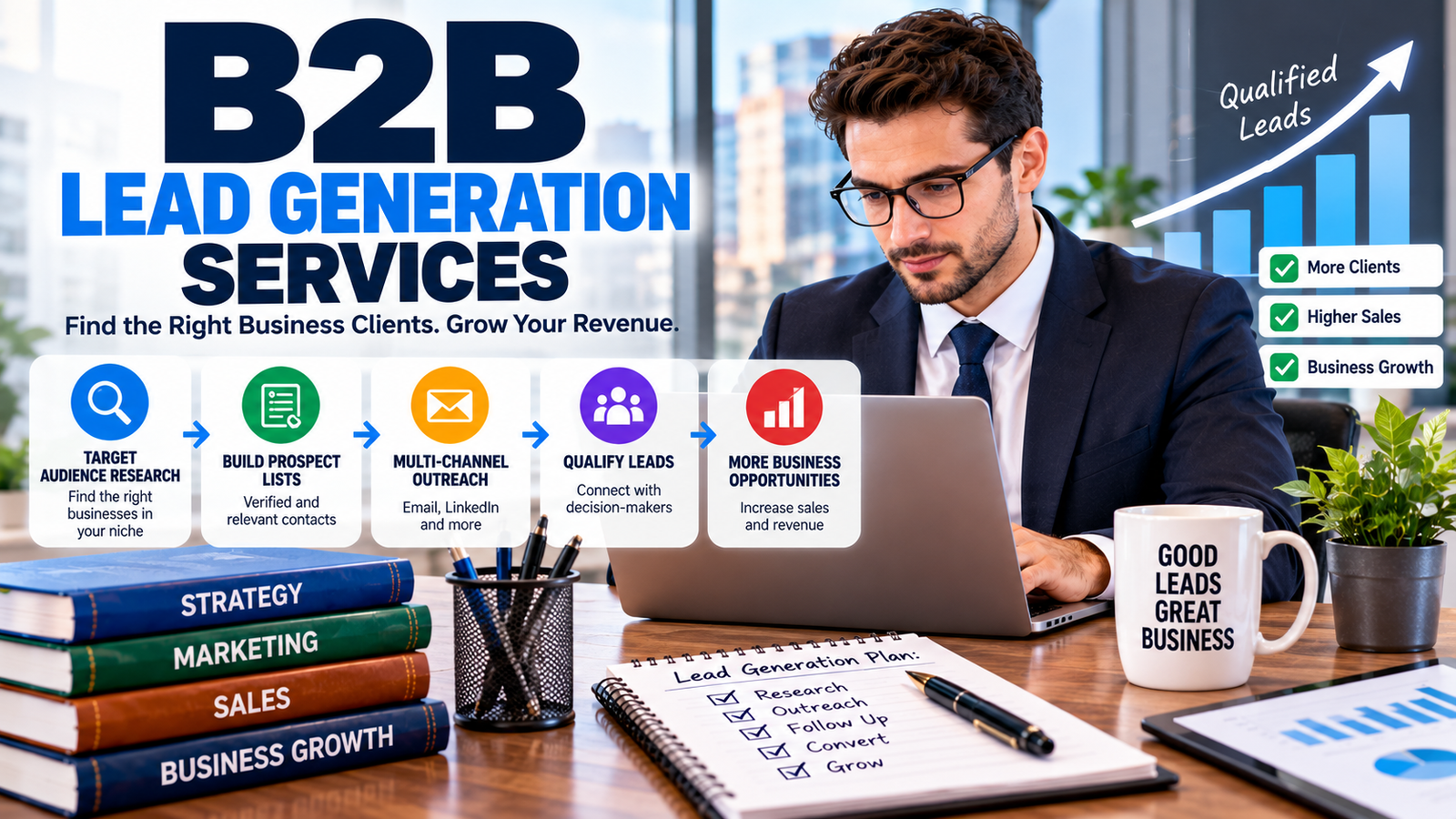
B2B lead generation services help businesses identify potential customers, connect with decision-makers, and create more opportunities to increase sales. Instead of spending hours searching for prospects and managing outreach manually, companies can work with specialists who build targeted lead lists, run campaigns, and help move potential buyers into the sales pipeline.
These services can be particularly valuable for software companies, marketing agencies, consulting firms, manufacturers, and other businesses that sell products or services to organizations.
However, choosing a provider requires more than comparing prices or counting contacts. Businesses need relevant prospects, accurate data, personalized communication, and a clear process for measuring results.
In this guide, you’ll learn what B2B lead generation services include, how they work, which benefits they offer, how much they may cost, and how to choose a provider that fits your business goals.
What Are B2B Lead Generation Services?
B2B lead generation services are professional services that help companies find and attract other businesses that may be interested in their products or services.
A provider may research target companies, identify relevant contacts, collect business information, manage email outreach, generate inbound inquiries, or arrange sales meetings.
For example, a digital marketing agency that wants to work with more small businesses could hire a lead generation provider to identify companies that fit its target market and connect with marketing managers or business owners.
Depending on the provider, services may include:
-
Target audience research and ideal customer profiling.
-
Business and decision-maker contact research.
-
Prospect list building and data verification.
-
Cold email outreach and campaign management.
-
LinkedIn prospecting and professional outreach.
-
Appointment setting and sales development.
-
Inbound lead generation through content and advertising.
-
Lead qualification and CRM management.
-
Campaign reporting and performance analysis.
Not every agency offers all these services. Some focus on delivering contact lists, while others manage complete campaigns and arrange meetings with qualified prospects.
Before choosing a provider, clarify exactly what you will receive and how success will be measured.
How Do B2B Lead Generation Services Work?
A professional lead generation process generally follows several steps. Understanding this process helps you evaluate providers and set realistic expectations.
1. Define Your Ideal Customer
The provider first needs to understand which companies are most likely to purchase your products or services.
This may involve identifying the target industry, company size, geographic location, budget, business challenges, and relevant job titles.
For example, a company selling cybersecurity software may target IT directors and security managers at organizations that match its service capabilities.
Clear targeting helps prevent resources from being wasted on companies that are unlikely to become customers.
2. Research and Build a Prospect List
Once the target audience is established, the provider researches companies and relevant contacts.
Depending on the campaign, the list may include business names, company websites, professional roles, business email addresses, locations, and other relevant details.
The provider should explain how the data is collected, how recently it was verified, and how inaccurate records are handled.
A smaller, well-targeted list may be more useful than thousands of contacts with little connection to your offer.
3. Launch Outreach Campaigns
After preparing the prospect list, the provider may contact potential buyers through email, LinkedIn, phone calls, or other appropriate channels.
Effective outreach focuses on the recipient’s needs instead of relying on generic sales messages.
For example, an agency offering SEO services might explain how it helps businesses improve organic visibility, then invite relevant prospects to discuss their goals.
Campaigns should comply with applicable privacy and marketing laws, respect opt-out requests, and avoid misleading claims.
4. Qualify Interested Prospects
Not every person who responds is ready to buy. Lead qualification helps determine whether a prospect matches your requirements.
Providers may assess factors such as business fit, budget, purchasing authority, business needs, and timing.
Agree on these criteria before a campaign begins so both parties understand what counts as a qualified lead.
5. Track Results and Improve Campaigns
Finally, the provider reports performance and identifies opportunities for improvement.
Useful measures include verified contacts, positive responses, qualified leads, meetings booked, opportunities created, and customers acquired.
The best reporting connects activity to meaningful business outcomes rather than simply reporting the number of emails sent.
9 Benefits of B2B Lead Generation Services
Outsourcing lead generation can help businesses improve their prospecting process, but the results depend on the provider, campaign strategy, target market, and offer.
1. Reach More Relevant Business Prospects
Finding potential customers manually takes time, particularly when your target market includes several industries or geographic regions.
A lead generation provider can help you identify companies that match your ideal customer profile and find the people responsible for purchasing decisions.
This approach is especially useful when your internal team lacks the resources to conduct detailed market research.
Example: A web development agency targeting UK businesses could build a prospect list of companies that need website improvements and identify relevant owners or marketing managers.
2. Save Time for Your Sales Team
Sales representatives often spend significant time researching companies, finding contact details, and organizing prospect information.
Outsourcing some of these tasks allows your sales team to focus more on conversations, proposals, relationship building, and closing opportunities.
However, outsourcing does not eliminate the need for internal sales involvement. Your team still needs to respond to inquiries and manage promising prospects.
3. Improve Lead Quality
A good provider focuses on prospects that match your business requirements rather than delivering the largest possible list.
Lead quality may depend on company size, industry, job role, geographic location, purchasing authority, and the prospect’s current needs.
Before hiring a provider, ask how it defines a qualified lead and what verification process it uses.
4. Expand Into New Markets
Businesses entering a new country or industry may struggle to identify potential buyers and understand local market conditions.
B2B lead generation services can support market research and prospect identification across selected regions.
For instance, a US-based software company expanding into the UK might need a targeted list of British companies, relevant decision-makers, and suitable outreach messaging.
The provider should understand the target market and follow applicable local marketing and privacy requirements.
5. Build a More Consistent Sales Pipeline
A sales pipeline represents potential customers as they progress from initial contact to a sales opportunity and, eventually, a purchase.
Lead generation services can help maintain a regular flow of relevant prospects into this pipeline.
Although no provider can guarantee a fixed number of customers, consistent prospecting and follow-up can make it easier to identify opportunities and plan sales activity.
6. Support Personalized Outreach
Generic sales messages often fail to explain why a particular company should be interested.
A capable provider researches the target audience and helps tailor messages to relevant business challenges.
For example, a marketing agency might approach an online retailer with a message about organic search visibility rather than sending a general advertisement about digital marketing.
Personalization should be genuine, accurate, and relevant—not simply inserting a company name into a template.
7. Scale Prospecting More Efficiently
When a business wants to target additional industries or increase outreach, an established provider may already have the people, processes, and technology required to support that expansion.
You can potentially increase campaign activity without hiring a full internal prospecting team immediately.
Nevertheless, scaling too quickly can reduce targeting quality. Expand campaigns gradually and review results before increasing spending.
8. Access Specialized Tools and Expertise
Lead generation providers may use CRM systems, contact databases, sales engagement platforms, analytics tools, and research processes.
These resources can help identify prospects, organize campaigns, and monitor results.
Before signing a contract, ask which tools the provider uses, whether contact information is verified, who owns the collected data, and whether you can access campaign records.
9. Measure Marketing Performance More Clearly
A structured campaign makes it easier to understand where prospects come from and how they move through the sales process.
For example, you can compare the cost of email outreach with the cost of inbound leads generated through content marketing or paid advertising.
Use this information to identify which channels produce the most valuable opportunities. A campaign that generates fewer leads may still be worthwhile if those leads are better qualified and more likely to become customers.
Types of B2B Lead Generation Services
Different providers specialize in different parts of the sales process. Choosing the right type depends on whether you need contact data, interested prospects, or sales meetings.
| Service type | What it includes | Best suited for |
|---|---|---|
| B2B data and list building | Company research and contact lists | Teams that manage outreach internally |
| Cold email outreach | Targeted email campaigns and follow-ups | Businesses selling to identifiable company buyers |
| LinkedIn prospecting | Professional research and outreach | Companies targeting specific roles or industries |
| Appointment setting | Qualifying prospects and booking meetings | Businesses with an established sales team |
| Inbound lead generation | SEO, content, landing pages, and campaigns | Businesses seeking prospects who discover their services |
| Full-service lead generation | Multiple prospecting and qualification activities | Companies wanting broader campaign support |
Some providers combine several services, while others specialize in a single activity.
If you already have a sales team, a prospect research or appointment-setting service may be sufficient. If your business lacks a clear marketing process, you may need a broader solution.
How Much Do B2B Lead Generation Services Cost?
The cost of B2B lead generation services varies considerably. Pricing depends on the target market, data requirements, campaign complexity, outreach channels, and level of qualification.
Common pricing models include the following.
Monthly Retainer
A provider charges a recurring fee to manage prospecting activities, outreach, reporting, or appointment setting.
This arrangement can work for businesses that need ongoing campaigns and predictable budgeting.
Pay Per Lead
You pay for each lead delivered according to agreed criteria.
Before selecting this model, define what qualifies as a valid lead. For example, specify whether a lead must have verified contact details, fit your target industry, and match an appropriate job role.
Pay Per Appointment
The provider charges for meetings arranged with prospects who meet agreed qualification requirements.
Clarify whether cancelled meetings, no-shows, duplicate contacts, and unqualified appointments count toward the fee.
Project-Based Pricing
You pay a fixed fee for a specific deliverable, such as a verified prospect list or a market research project.
This model may suit companies testing a new market or running a limited campaign.
Performance-Based Pricing
Some providers charge according to agreed outcomes or performance milestones. The contract should clearly define the measurable result, attribution method, and payment terms.
Important: Do not compare providers on price alone. A low-cost list may contain inaccurate or irrelevant contacts, while a more expensive service may include research, verification, outreach, and qualification. Evaluate total cost against actual business value.
How to Choose the Best B2B Lead Generation Services
Selecting a provider is an important decision because lead quality and campaign execution can directly affect your sales team’s time and budget.
Use these factors to compare potential providers.
1. Check Industry Experience
Look for a provider that understands your industry, target buyers, and sales process.
Ask whether it has worked with similar businesses and request relevant case studies. Review the evidence carefully rather than relying only on general claims about experience.
2. Review Data Quality
Ask how the provider sources and verifies contact information.
Important questions include:
-
How recently was the data checked?
-
How are invalid email addresses handled?
-
Can the provider target specific countries and industries?
-
How does it prevent duplicate contacts?
-
Does it follow applicable privacy requirements?
These questions help you understand whether the provider can deliver a list that matches your requirements.
3. Understand the Qualification Process
A provider should explain how it distinguishes a relevant prospect from a qualified sales opportunity.
Agree on the criteria before work begins. Otherwise, you may receive contacts that technically match your industry but have little interest in your offer.
4. Evaluate Communication and Reporting
Choose a provider that offers transparent reporting and communicates regularly.
Depending on the service, reports might include contacts researched, emails delivered, responses received, qualified meetings, and sales opportunities generated.
You should be able to understand what the provider did, what the campaign achieved, and what needs improvement.
5. Compare Pricing and Contract Terms
Review the full cost, minimum commitment, cancellation terms, deliverables, and ownership of campaign data.
Be cautious of providers promising guaranteed sales or unrealistic conversion rates without explaining their assumptions.
Start with a manageable campaign when possible. Evaluate its quality and results before committing to a larger budget.
B2B Lead Generation Services vs. In-House Lead Generation
Businesses can manage prospecting internally or outsource it to an external provider. Both approaches have advantages.
| Factor | Outsourced services | In-house team |
|---|---|---|
| Initial setup | May be faster if the provider has established processes | Requires recruitment, tools, and training |
| Control | Shared with an external provider | Greater direct control |
| Expertise | Depends on the provider’s skills | Develops within your organization |
| Costs | Provider fees and campaign expenses | Salaries, software, training, and management |
| Flexibility | Depends on contract terms | Campaigns can be adjusted internally |
| Best fit | Businesses needing external capacity or expertise | Businesses with ongoing prospecting needs and internal resources |
Neither option is automatically better. Some companies outsource research and list building while keeping sales conversations and relationship management in-house.
This hybrid approach can combine external capacity with internal knowledge of the product and customers.
How to Measure the Success of B2B Lead Generation Services
To evaluate a provider fairly, measure the results that matter to your business rather than focusing only on the number of contacts delivered.
Track these key performance indicators (KPIs):
| KPI | What it measures |
|---|---|
| Lead volume | Number of prospects generated |
| Lead qualification rate | Percentage meeting your qualification criteria |
| Positive response rate | Percentage of contacted prospects responding positively |
| Cost per qualified lead | Total campaign cost divided by qualified leads |
| Meeting conversion rate | Percentage of relevant prospects who book meetings |
| Lead-to-customer rate | Percentage of leads that become paying customers |
| Customer acquisition cost | Total acquisition spending divided by new customers acquired |
For example, suppose a campaign costs $2,000 and produces 40 qualified leads. The cost per qualified lead is $50.
However, that figure alone does not establish success. You must also consider how many leads become customers, the revenue those customers generate, and the ongoing cost of serving them.
Set realistic targets with your provider, review the results regularly, and adjust the campaign based on actual performance.
Common Mistakes to Avoid When Hiring a Lead Generation Agency
Before signing a contract, watch for these common mistakes.
-
Choosing the cheapest provider: Low prices may come with poor targeting or inaccurate data.
-
Buying large, untargeted lists: Contact volume does not guarantee sales opportunities.
-
Ignoring compliance: Outreach methods must follow applicable privacy and anti-spam rules.
-
Failing to define qualified leads: Unclear criteria can create disagreements about deliverables.
-
Expecting immediate sales: B2B buying decisions may involve several stakeholders and lengthy evaluation periods.
-
Ignoring follow-up: Interested prospects can lose momentum if your team does not respond.
-
Not tracking results: Without reporting, it is difficult to know whether the investment is worthwhile.
A reliable provider should be willing to discuss its process, explain its limitations, and agree on measurable expectations.
Frequently Asked Questions
Q1: What do B2B lead generation services include?
Ans: They may include target audience research, prospect list building, contact verification, cold email outreach, LinkedIn prospecting, appointment setting, lead qualification, and campaign reporting. The exact services depend on the provider.
Q2: Are B2B lead generation services worth it?
Ans: They can be worthwhile when they produce relevant prospects at a cost that makes sense for your business. Evaluate lead quality, sales conversion, campaign costs, and customer value before deciding.
Q3: How long does B2B lead generation take?
Ans: The timeline depends on your industry, target market, offer, and sales cycle. Some campaigns may generate initial responses relatively quickly, while building a consistent pipeline can take longer. Results are not guaranteed.
Q4: What is the difference between a B2B lead and a qualified lead?
Ans: A B2B lead is a potential business customer. A qualified lead has been assessed against specific criteria, such as industry fit, business need, purchasing authority, or budget.
Q5: Should I hire a B2B lead generation agency or build an internal team?
Ans: An agency may suit a business that needs specialized expertise or additional capacity without immediately building an internal department. An in-house team may be preferable when you need direct control and have enough ongoing work to support the investment.
Q6: How can I avoid low-quality B2B leads?
Ans: Define your ideal customer profile, agree on qualification criteria, verify contact information, and review the provider’s reporting. Test a smaller campaign before scaling up.
Conclusion
B2B lead generation services can help businesses identify potential customers, reach relevant decision-makers, and create more sales opportunities. From prospect research and email outreach to appointment setting and inbound marketing, the right service depends on your target audience and business objectives.
Before choosing a provider, evaluate its experience, data quality, qualification process, pricing, and reporting. Define what a qualified lead means for your company and measure success through meaningful outcomes rather than contact volume alone.
Start with a clear strategy, test the approach with a manageable campaign, and use performance data to improve your results over time.
One thought on “B2B Lead Generation Services: 9 Ways to Find More Qualified Business Clients”