
The XRP price can change quickly as cryptocurrency markets respond to investor sentiment, trading activity, regulatory developments, and broader economic conditions. Whether you are researching XRP for the first time or already follow the crypto market, understanding these factors can help you make more informed decisions.
XRP is the digital asset associated with the XRP Ledger, a blockchain designed to support fast transactions and other financial applications. However, its technology and potential use cases do not guarantee that its market price will rise.
In this guide, you will learn how to check the XRP price today, understand its historical performance, read a price chart, and evaluate the risks before making an investment decision.
What Is the XRP Price Today?
The XRP price represents the current market value of one XRP token. It is commonly quoted in US dollars as XRP/USD, although exchanges also offer trading pairs against other currencies and stablecoins.
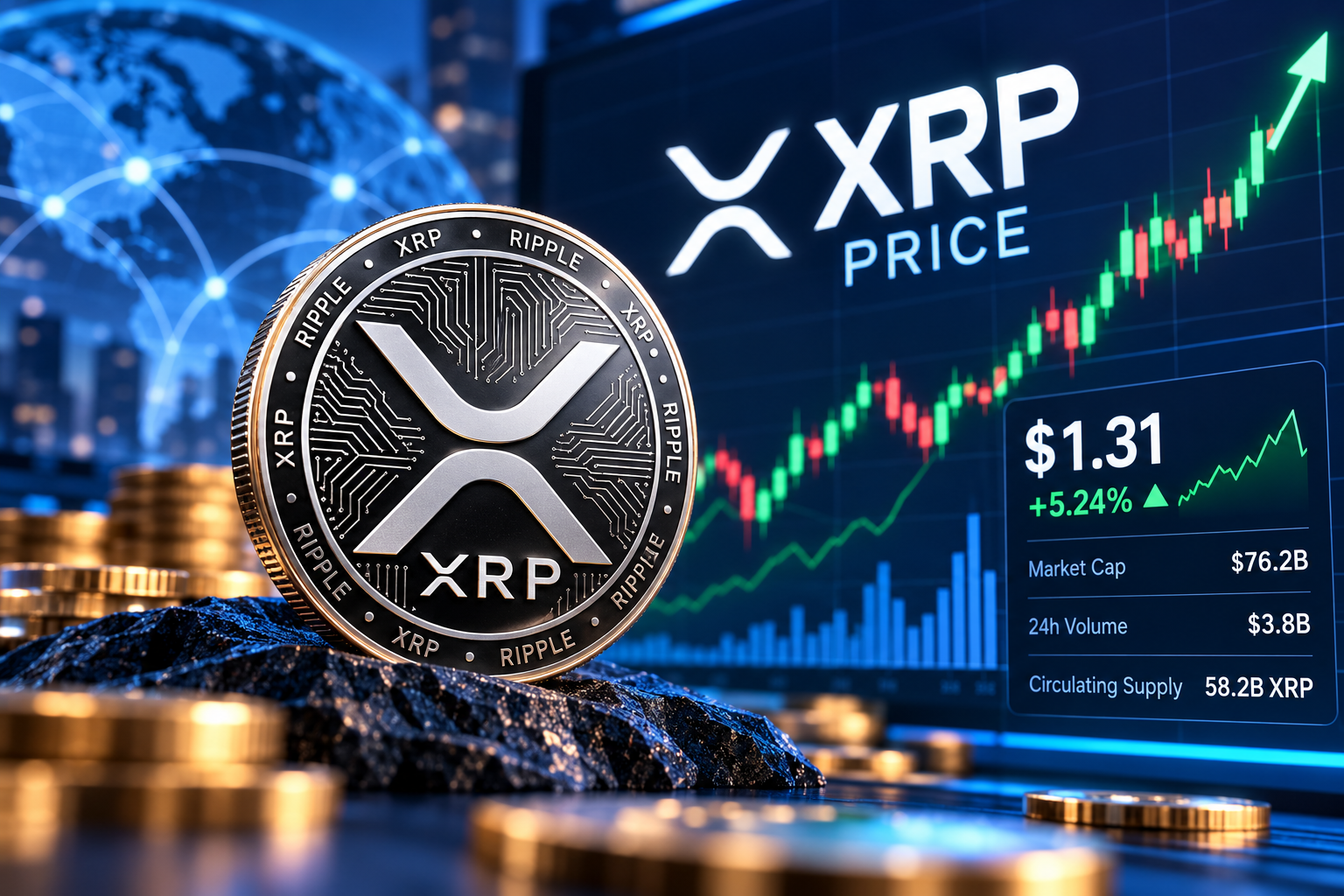
As checked on October 17, 2026, CoinGecko listed XRP at approximately $1.31 per token. The displayed price, daily percentage change, trading volume, and market capitalization can change throughout the day. Different platforms may also show slightly different prices because they aggregate data from different markets.
For the latest figures, check the live XRP price and market data on CoinGecko.
When reviewing the current price, pay attention to these measurements:
- Current price: The latest reported value of one XRP token.
- 24-hour price change: How much the price has increased or decreased over the previous 24 hours.
- Market capitalization: The current price multiplied by the circulating supply.
- Trading volume: The value of XRP traded during a specified period, commonly 24 hours.
- 24-hour range: The highest and lowest prices recorded during that period.
These figures provide more context than the price alone. For example, a price increase accompanied by rising trading volume may indicate stronger market participation. However, volume does not guarantee that an upward trend will continue.
What Is XRP and How Does It Work?
XRP is a digital asset that operates on the XRP Ledger, an open-source blockchain network launched in 2012. The network supports value transfers and additional applications, including tokenization and decentralized financial services.
One of its intended uses is to facilitate payments between parties. XRP can serve as a bridge asset when value needs to move between different currencies. Its design aims to make transactions relatively fast and inexpensive, although actual costs and performance can vary with network conditions and the services used.
It is also important to distinguish XRP from Ripple.
XRP is a digital asset, while Ripple is a company. Ripple develops payment-related products and other financial technology solutions. The XRP Ledger is a network that operates independently of any single company, and XRP is its native digital asset.
This distinction matters because developments involving Ripple may influence market sentiment, but they do not automatically determine the value of XRP.
Investors should also understand that owning XRP is not the same as owning shares in Ripple. XRP holders do not receive company ownership simply by holding the token.
XRP Price History and Major Milestones
XRP has experienced substantial price fluctuations throughout its trading history. Like other cryptocurrencies, it has gone through periods of rapid appreciation, sharp declines, and extended periods of uncertainty.
Historical prices can help investors understand volatility, but they cannot reliably predict future performance.
XRP’s All-Time High
CoinMarketCap’s historical data lists XRP’s all-time high at approximately $3.84 on January 4, 2018. Historical records can differ slightly between data providers because of differences in exchange coverage and price calculations.
An all-time high represents the highest price recorded by a particular data source. It does not mean the asset will eventually return to that level.
Investors should avoid treating a previous peak as a guaranteed future target. Market conditions, circulating supply, investor demand, competition, and regulation may all be different from when the previous high occurred.
Why XRP Has Experienced Large Price Swings
Several developments can contribute to major changes in XRP’s price:
- Cryptocurrency market cycles: Bull markets can attract new buyers, while bear markets may lead to widespread selling.
- Regulatory developments: Legal decisions and policy changes can affect investor confidence and market access.
- Network adoption: Greater use of the XRP Ledger may influence perceptions of the asset’s usefulness.
- Liquidity and trading activity: Large orders and changes in market participation can contribute to sharp movements.
- Macroeconomic conditions: Interest rates, economic uncertainty, and demand for risky assets can influence cryptocurrency prices.
To study past movements, compare XRP’s price across different periods instead of focusing on one dramatic rally or decline. A chart covering several years can provide a broader perspective on its market cycles.
What Factors Affect the XRP Price?
The XRP price is influenced by several interconnected factors. No single indicator can explain every movement, so it helps to evaluate the wider market environment.
1. Supply and Demand
Market prices generally respond to the balance between buyers and sellers. When demand increases faster than available selling supply, the price may rise. Conversely, stronger selling pressure can push it lower.
XRP has a maximum supply of 100 billion tokens, although not all tokens are circulating. Circulating supply, escrow releases, and the movement of tokens between holders can influence how investors assess potential selling pressure.
However, a large token supply does not automatically make an asset inexpensive or expensive. Market capitalization and demand also matter.
2. Overall Cryptocurrency Market Sentiment
XRP rarely trades in complete isolation from the wider crypto market. Bitcoin’s movements, changes in risk appetite, and broad investor sentiment can affect demand for other digital assets.
For example, investors may reduce exposure to several cryptocurrencies during a market downturn, even when individual networks have not experienced negative developments.
For this reason, compare XRP’s performance with Bitcoin and the broader cryptocurrency market before deciding whether a price move is specific to XRP or part of a wider trend.
3. Ripple Developments and XRP Ledger Adoption
Partnership announcements, payment integrations, technical improvements, and new applications may influence perceptions of XRP’s potential usefulness.
Nevertheless, an announcement does not necessarily create immediate demand for the token. The practical importance of a development depends on its scale, implementation, and actual use.
Before reacting to a headline, ask whether it describes a completed development, a proposed partnership, or a future possibility. These are not equivalent.
4. Regulation and Legal Developments
Regulatory clarity can affect how exchanges, financial institutions, and investors approach digital assets. Uncertainty, restrictions, or new compliance requirements may also affect trading activity.
Developments involving Ripple and US regulators have historically attracted significant attention from the cryptocurrency market. However, legal and regulatory situations can change, so investors should verify current information through reliable primary sources rather than relying on old headlines.
5. Institutional Investment and Market Liquidity
Institutional participation may influence trading volume, liquidity, and investor sentiment. Financial products that provide exposure to XRP can also affect how some investors access the asset.
Still, institutional interest is not proof that prices will rise. Funds can experience inflows and outflows, while traders may change positions rapidly as market conditions evolve.
6. Trading Volume and Investor Positioning
Trading volume helps show how much activity is taking place. Rising prices accompanied by stronger volume may suggest broader participation, while a price move on thin volume can be less convincing.
Derivatives markets can add another layer of volatility. Leveraged positions may be liquidated when prices move sharply, potentially accelerating gains or losses.
Volume, open interest, and funding rates can provide useful context, but none should be treated as a standalone signal.
How to Read an XRP Price Chart
An XRP price chart shows how its market value changes over time. Learning to read a chart can help you understand trends and volatility without assuming that technical indicators can predict the future with certainty.
Understand the Time Frame
Start by selecting a time frame that matches your objective.
- Hourly charts: Useful for examining short-term fluctuations.
- Daily charts: Helpful for reviewing recent trends and price levels.
- Weekly charts: Better suited to studying longer-term movements.
- Monthly charts: Useful for placing current prices within broader historical cycles.
A short-term rally may look significant on an hourly chart but relatively minor on a weekly chart. Always consider the larger context.
Learn About Support and Resistance
Support refers to a price area where buying interest has previously helped slow a decline. Resistance refers to an area where selling pressure has previously limited an advance.
These are not fixed barriers. XRP can move below support or above resistance, especially during periods of strong volatility.
Traders often monitor whether a price level holds across several trading sessions and whether volume supports the move.
Understand Moving Averages and RSI
Moving averages smooth price data over a selected period. Traders may use them to assess the direction of a trend or compare short-term momentum with longer-term performance.
The Relative Strength Index, or RSI, measures the speed and magnitude of recent price changes. It is commonly used to assess momentum and identify conditions that traders describe as overbought or oversold.
Neither indicator guarantees a reversal or confirms that a price is cheap or expensive. It is generally more useful to combine chart indicators with market context and risk management than to rely on one signal.
XRP Price Prediction: What Should Investors Consider?
XRP price predictions vary because analysts use different assumptions, time frames, and methods. Some focus on chart patterns, while others emphasize network adoption, market liquidity, regulation, or overall cryptocurrency cycles.
A responsible forecast should explain its assumptions rather than simply publish an attractive price target.
Bullish Scenario
In a bullish scenario, stronger demand, improved market sentiment, wider use of the XRP Ledger, or favorable regulatory developments could support higher prices.
However, these conditions would need to develop in practice. Positive headlines alone may not be enough to sustain an upward trend.
Neutral Scenario
In a neutral scenario, buying and selling pressure may remain relatively balanced. XRP could trade within a broad range as investors wait for clearer signals about adoption, market conditions, or regulation.
Sideways markets can still involve sharp short-term price changes.
Bearish Scenario
In a bearish scenario, weaker cryptocurrency markets, reduced demand, unfavorable regulatory developments, or increased selling pressure could push XRP lower.
A decline can also occur even when a project’s technology continues to develop. Market price and technical progress do not always move together.
Instead of relying on a single forecast, compare several scenarios and consider what evidence would support or weaken each one. Never treat a prediction as a guaranteed outcome.
Is XRP a Good Investment?
Whether XRP is suitable for an investor depends on their financial situation, objectives, risk tolerance, and understanding of cryptocurrency markets. It is not automatically a good investment simply because its price is lower than a previous high.
Potential Advantages
XRP offers exposure to an established digital asset and a network designed to support payments and other blockchain applications. Its liquidity across multiple exchanges can also make it accessible to many cryptocurrency traders.
Investors interested in blockchain-based payment infrastructure may consider learning more about its technology, ecosystem, and adoption.
Important Risks
XRP also carries meaningful risks:
- Price volatility: Its market value can rise or fall sharply.
- Regulatory uncertainty: Rules and interpretations may change across jurisdictions.
- Market risk: Broader cryptocurrency declines can affect XRP.
- Adoption risk: Technical capabilities do not guarantee sustained demand.
- Custody and exchange risk: Poor security practices, exchange failures, and lost private keys can lead to financial losses.
Before investing, review your financial goals and consider whether you could afford a substantial loss. Avoid borrowing money to speculate, and be cautious about online claims promising guaranteed profits.
For general guidance on investment risks and avoiding fraud, review the US Securities and Exchange Commission’s Investor.gov website.
This information is educational and is not personalized financial advice.
How to Track the XRP Price
Monitoring reliable market data can help you understand current conditions and compare prices across platforms.
Here are some useful practices:
- Check a live price tracker. Review XRP’s current price, daily change, and market capitalization.
- Compare trading volume. Check whether a price move is accompanied by a meaningful change in activity.
- Review historical charts. Compare short-term movements with longer-term trends.
- Check exchange prices. Trading pairs, liquidity, spreads, and fees can affect the final price you receive.
- Verify major announcements. Look for original announcements or official documents instead of relying entirely on social media.
- Record your assumptions. If you are researching XRP as an investment, write down your reasons for considering it and the risks that could change your decision.
Remember that a displayed market price is not necessarily the exact price at which you can buy or sell. Transaction fees, spreads, liquidity, and local restrictions may affect the final result.
Frequently Asked Questions About XRP Price
Q1: What Is the Current XRP Price?
Ans: XRP was listed at approximately $1.31 on CoinGecko when checked on October 17, 2026. Its live price changes continuously, so check a current market tracker before trading.
Q2: Why Is the XRP Price Changing?
Ans: The XRP price can change because of supply and demand, cryptocurrency market sentiment, trading volume, regulatory developments, and news about Ripple or the XRP Ledger.
Q3: What Was XRP’s All-Time High?
Ans: CoinMarketCap lists XRP’s all-time high at approximately $3.84 on January 4, 2018. Historical figures may vary slightly between data providers.
Q4: Can XRP Reach a New All-Time High?
Ans: It is possible, but there is no guarantee. Future performance depends on market demand, adoption, regulation, liquidity, and broader cryptocurrency conditions.
Q5: What Factors Affect XRP’s Price?
Ans: Major factors include investor sentiment, trading volume, circulating supply, Bitcoin’s performance, regulatory developments, and adoption of the XRP Ledger.
Q6: Where Can I Check the Live XRP Price?
Ans: You can check the live price, market capitalization, trading volume, and historical chart on CoinGecko. Comparing data across platforms can provide additional context.
Q7: Is XRP a Risky Investment?
Ans: Yes. XRP is a volatile cryptocurrency, and investors can lose some or all of the money they invest. Consider your financial situation and risk tolerance before making a decision.
Q8: Is XRP the Same as Ripple?
Ans: No. XRP is a digital asset, while Ripple is a company that develops financial technology products. The XRP Ledger is the blockchain network on which XRP operates.
Conclusion
The XRP price reflects a combination of market demand, investor sentiment, trading activity, regulatory developments, and expectations about future adoption. Understanding these factors can help you interpret market movements more carefully.
Rather than relying on a single price target or social media prediction, review live data, study historical trends, and consider both bullish and bearish possibilities. Most importantly, remember that cryptocurrency prices are unpredictable and that past performance does not guarantee future returns.
A careful, research-based approach is more useful than assuming XRP must return to a previous high or that any particular forecast will come true.